What Investors Look for in a Pre-Seed Stage Pitch Deck
Investors do not expect a perfect company at the pre-seed stage. They know the product may still be early, revenue may be limited, and the business model may still be developing.
But they do expect a clear problem, a believable market, a strong founding team, early validation, and a deck that explains the opportunity quickly.
A pre-seed pitch deck is not just about looking polished. It must reduce investor confusion. It should make the business easier to understand, easier to evaluate, and easier to discuss after the meeting.
At this stage, your deck does not need to prove everything. It needs to show that the problem is real, the founder understands the customer, the solution has a reason to exist, and the next milestone is worth funding.
What Is a Pre-Seed Pitch Deck?
A pre-seed pitch deck is a short investor presentation used by early-stage founders to explain their startup before the company has fully matured.
It usually covers the problem, solution, market, product vision, team, early validation, business model, roadmap, and funding ask.
A pre seed pitch deck is different from a full business plan. A business plan may go deeper into operations, financial planning, and long-term strategy. A pre-seed investor deck is built for a faster conversation. It helps angel investors, accelerators, and early-stage investors decide whether the idea, team, and market are worth exploring further.
This is why founders should not treat the deck like a long planning document. Lynxify’s Business Plan vs Pitch Deck blog explains this difference clearly: a business plan is built for depth, while a pitch deck is built for fast understanding and investor communication.
What Do Investors Look for in a Pre-Seed Pitch Deck?
Investors look for signs that the startup is early, but not random.
At pre-seed, the company may not have strong revenue or mature traction yet. So investors focus more on the quality of thinking, customer understanding, founder strength, and early proof.
Most investors look for:
a real problem that people or businesses already care about
a clear solution that is easy to understand
a large or growing market with room for growth
strong founder-market fit
early validation, even if it is small
a believable business model
a simple go-to-market plan
clear milestones
logical use of funds
a deck that is easy to understand
Early-stage investor guidance often emphasizes clarity, short decks, strong storytelling, team strength, problem clarity, market logic, and a practical path to first customers.
Pre-seed investors often scan quickly, so the deck must be skimmable and easy to understand. Problem, product, traction, team, and business model are common investor focus areas because they help show whether the startup is early but credible.
The best pre-seed decks do not try to make the company look bigger than it is. They make the opportunity feel focused, believable, and worth a deeper conversation.
What Slides Should a Pre-Seed Pitch Deck Include?
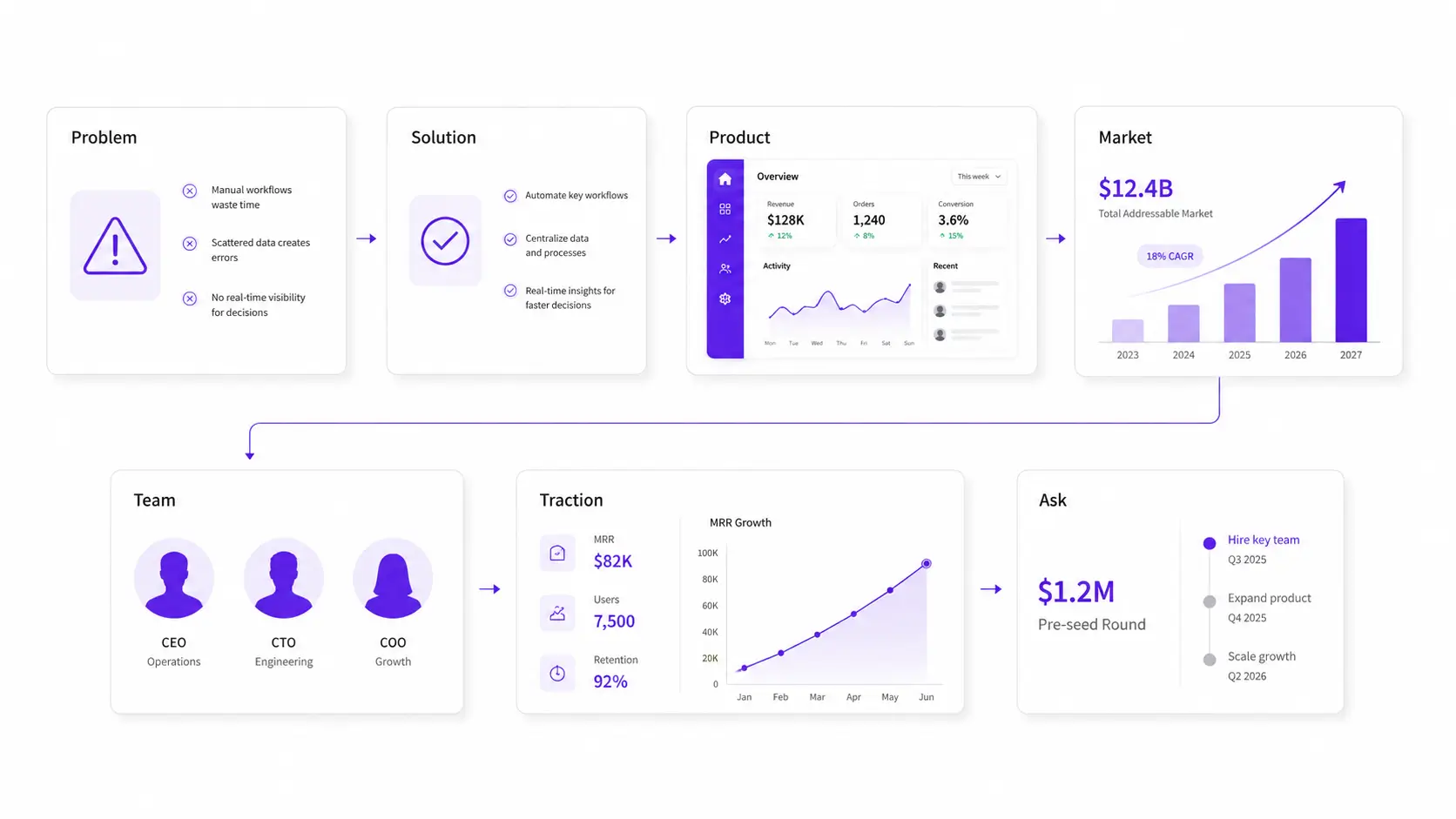
A pre-seed pitch deck should include the slides investors need to understand the problem, solution, market, team, proof, and next milestone.
The exact order can change based on the business, but most early-stage decks follow a structure like this:
Slide | What Investors Look For | Common Mistake |
|---|---|---|
Cover | What the company does and who it serves | A vague tagline that does not explain the business |
Problem | A specific pain that feels real and urgent | Saying the whole industry is broken without proof |
Solution | A simple answer to the problem | Explaining too many features too early |
Product | What exists or what is being built | Showing a product tour without context |
A focused market with growth potential | Using huge TAM numbers with no entry logic | |
Founder-market fit and ability to execute | Listing names without showing relevance | |
Early proof of demand or learning | Showing vanity metrics without meaning | |
How the company may make money | Making revenue logic hard to understand | |
A practical path to first customers | Listing generic channels with no strategy | |
Competition | Market awareness and differentiation | Claiming there are no competitors |
Roadmap and Milestones | What happens after funding | Creating a vague wish list |
Funding Ask and Use of Funds | How much is being raised and why | Asking for money without clear milestones |
This structure helps the deck move like a real investor conversation. It starts with why the company matters, then explains what is being built, what proof exists, and what funding helps unlock next.
Why Pre-Seed Investors Do Not Expect Everything to Be Perfect
Pre-seed investors know they are looking at a business before it is fully proven.
They may not expect strong revenue, a finished product, a large team, or years of customer data. In many cases, the founder may only have a prototype, MVP, waitlist, pilot users, customer interviews, or early revenue signals.
But early does not mean unclear.
Investors still expect the founder to explain:
why the problem matters
who the first customers are
why the current solutions are not good enough
why this is the right time to build
what proof exists so far
what the next funding milestone will unlock
At pre-seed, the deck is often less about certainty and more about risk reduction. Investors want to see that the founder has thought through the obvious risks and has a practical plan to test the next stage.
The Problem Slide: Is This Pain Real Enough?
The problem slide should show a specific pain that is easy to understand and worth solving.
Weak pre-seed decks often start with broad claims like “the industry is broken” or “businesses need better tools.” These statements may sound big, but they do not help investors understand the actual pain.
A stronger problem slide explains:
who has the problem
how often the problem happens
what it costs in time, money, risk, or missed opportunity
why current solutions are frustrating or incomplete
For example, instead of saying:
“Small businesses struggle with marketing.”
A stronger version would be:
“Independent fitness studios spend hours each week creating social content, but most do not have an affordable way to turn class footage into consistent branded posts.”
The second version is more specific. It shows the customer, the pain, and the gap.
At pre-seed, specificity builds trust.
The Solution Slide: Does Your Product Clearly Solve the Problem?
The solution slide should answer four simple questions:
What are you building?
Who is it for?
Why is it better than the current way?
Why does it matter now?
A common mistake is explaining too many features too early. Investors do not need a full product tour on the solution slide. They need the simplest version of the answer.
If the problem is about wasted time, the solution should show how time is saved. If the problem is about missed revenue, the solution should show how revenue opportunities are captured. If the problem is about risk, the solution should show how the risk is reduced.
A good solution slide does not make investors work to understand the idea. It gives them a clean starting point.
The Product Slide: What Are You Actually Building?
The product slide should show what exists or what is being built.
The solution slide explains the idea. The product slide shows the actual thing.
At pre-seed, the product may be an MVP, prototype, wireframe, early demo, clickable flow, product workflow, or first version of the platform. That is fine. Investors do not always expect a finished product, but they do want to see how the idea becomes real.
Useful product slide elements can include:
MVP screenshots
prototype screens
wireframes
product workflow
demo flow
app or dashboard visuals
early product proof
before-and-after process examples
The goal is not to show every feature. The goal is to help investors understand how the product works and how it solves the problem.
The Market Slide: Is the Opportunity Big Enough?
The market slide should prove that the opportunity is worth investor attention.
At pre-seed, investors do not need a perfect market study, but they do need a believable path from a focused customer segment to a larger opportunity.
A weak market slide often shows a huge TAM number with no explanation. A large market number alone does not prove the startup can capture value.
A stronger market slide explains:
the first target market
why that market is reachable
how the market is growing
what niche the startup will enter first
how the company could expand over time
For example, if you are building a SaaS product for healthcare clinics, the first market may not be “global healthcare.” It may be independent clinics in one region, one specialty, or one operational workflow.
Investors want ambition, but they also want logic.
The Why Now Slide: Why Should This Exist Now?
The “why now” slide explains timing.
Investors want to know why this business makes sense now, not five years ago or five years later. A strong why now can make the opportunity feel more urgent and more believable.
Good timing signals may include:
market shifts
technology changes
customer behavior changes
new regulations
cost changes
new distribution channels
a problem becoming more urgent
a category becoming easier to adopt
For example, a product may be more relevant because customers now expect automation, remote workflows, AI support, faster payments, or simpler digital tools.
A strong “why now” section helps explain why the opportunity matters now. It should not be hype. It should explain what changed in the market that makes your startup more likely to work.
The Team Slide: Why Are You the Right Founders?
At pre-seed, the team slide can carry more weight because the company is still early.
Investors are often betting on the founders before the business is fully proven. That means your team slide should not only show names and titles. It should show why this team has the ability to build the company.
Strong founder-market fit can come from:
industry experience
technical ability
sales experience
customer insight
past execution
personal connection to the problem
product-building experience
domain knowledge
If the founder has lived the problem, worked in the industry, built similar products, sold to the target customer, or has rare insight into the market, the deck should make that clear.
The team slide should answer:
Why are these people credible for this opportunity?
The Traction Slide: What Proof Do You Have So Far?
Pre-seed traction does not only mean revenue.
Many early-stage founders avoid traction slides because they think they do not have enough proof. But investors are not always looking for mature revenue at this stage. They are looking for signals that the idea is not just a guess.
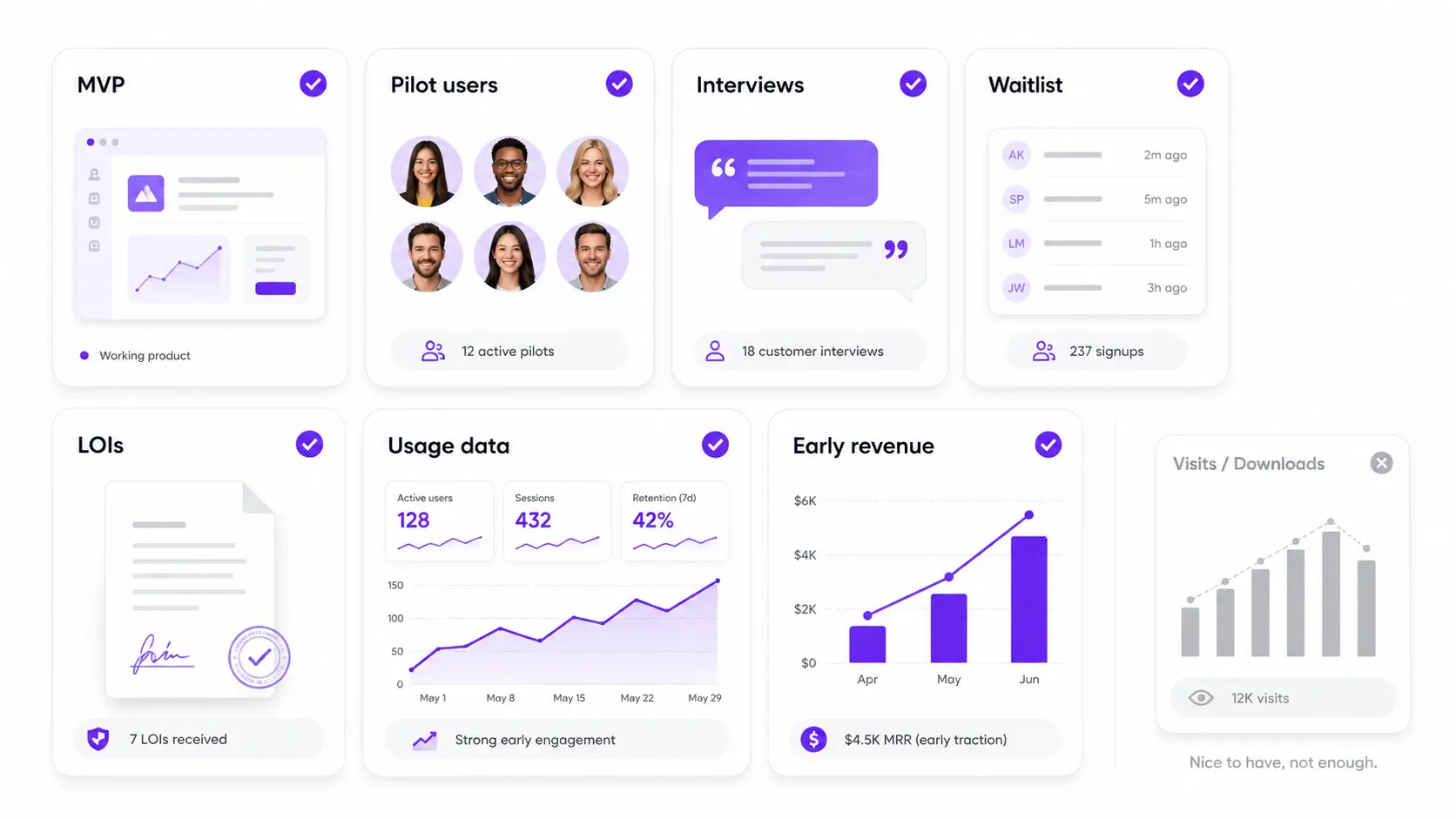
Pre-seed traction can include:
MVP progress
prototype testing
pilot users
early customers
waitlist growth
customer interviews
letters of intent
usage data
partnership interest
advisor support
community growth
revenue signals
The key is to show real signals, not inflated vanity metrics.
For example, “5,000 website visits” may not mean much if no one signed up, joined a waitlist, requested a demo, or gave useful feedback. But “43 customer interviews with clinic owners, 12 pilot requests, and 3 signed letters of intent” tells a stronger story.
At pre-seed, traction should prove learning, demand, or momentum.
The Business Model Slide: How Could This Become a Real Business?
The business model slide should explain how the company may make money.
Investors do not need every pricing detail to be final at pre-seed, but they need to understand the revenue logic. A good business model slide shows how value turns into revenue.
It may explain:
who pays
what they pay for
how pricing may work
whether revenue is recurring or one-time
whether sales are self-serve, founder-led, or enterprise
what makes the model scalable over time
A B2B SaaS deck may explain monthly subscription pricing. A marketplace deck may explain transaction fees. A hardware startup may explain product sales, service revenue, or recurring software revenue.
The details can evolve, but the logic should be visible.
The Go-to-Market Slide: How Will You Reach the First Customers?
The go-to-market slide should show a practical path to early customers.
At pre-seed, investors do not expect a huge growth machine. They want to know how you will get the first real users or customers without guessing.
Common early go-to-market paths include:
founder-led sales
outbound email
partnerships
niche communities
content marketing
product-led growth
accelerator networks
direct outreach to a focused customer segment
pilots with early adopters
A weak go-to-market slide says, “We will use social media, SEO, and paid ads.”
A stronger one says, “We will start with founder-led outreach to 200 independent clinic owners, convert 10 pilot customers, and use results from those pilots to build case studies for the next sales cycle.”
The second version feels grounded. It shows how the first customers may actually be reached.
The Competition Slide: Why Will You Win?
Investors expect competition.
A “no competitors” claim usually makes the deck weaker, not stronger. It can suggest that the market does not exist, the problem is not urgent, or the founder has not researched enough.
Competition can include:
direct competitors
indirect competitors
manual workflows
spreadsheets
agencies
internal tools
legacy software
doing nothing
The goal is not to say everyone else is bad. The goal is to show where your startup has a different angle.
Your advantage may come from:
better timing
deeper customer insight
stronger user experience
niche focus
distribution strategy
product workflow
technology
pricing model
network effects
The competition slide should help investors understand your positioning, not just compare features.
The Roadmap and Milestones Slide: What Happens After Funding?
The roadmap slide should show what funding helps unlock.
Pre-seed investors want to know how the money will reduce risk. That means the deck should connect funding to specific milestones.
Useful milestones may include:
launching the MVP
completing beta testing
hiring a key team member
reaching a user target
converting pilot customers
improving retention
achieving early revenue
building a product feature
entering a new market segment
preparing for the next funding round
A roadmap should not be a long wish list. It should show the next practical steps.
The best milestone slides make investors think:
If this team hits these goals, the company will be in a stronger position.
The Funding Ask and Use of Funds: What Are You Raising and Why?
The funding ask should be specific.
Investors want to know how much you are raising, what the money will be used for, and what milestone it should help you reach. A vague ask makes the round feel less prepared.
Weak ask:
“We are raising money to grow.”
Stronger ask:
“We are raising $750K to complete the MVP, onboard 20 pilot customers, hire one product engineer, and reach the next fundraising milestone within 18 months.”
The exact numbers will depend on the company, but the logic should be clear.
A good use of funds slide usually connects money to:
product development
hiring
customer acquisition
operations
market testing
sales
measurable milestones
At pre-seed, financial projections should stay simple and realistic. Investors usually want to understand runway, cost assumptions, revenue logic, and what the next round of funding should help prove.
Investors do not need every expense line. They need to understand the plan.
What Do the Best Pre-Seed Pitch Decks Usually Have in Common?
The best pre seed pitch decks are usually simple, focused, and easy to follow.
They do not try to make the startup look more mature than it is. They make the opportunity easier to understand.
Strong pre-seed decks often have:
a simple story
a strong problem
a clear product idea
a focused market
a credible team
early proof
clean visual hierarchy
no overloaded slides
a clear next milestone
a funding ask that makes sense
The strongest decks feel honest about what is still early, while showing why the next stage is worth funding.
That balance matters. Too much hype can weaken trust. Too little ambition can make the opportunity feel small.
Pre Seed Pitch Deck Examples: What Founders Should Study
Pre seed pitch deck examples are useful when founders study them for structure, not for copying.
Famous pitch deck examples can help you understand how startups explain their idea in a simple format. But they should not become templates you follow blindly. A SaaS deck, marketplace deck, healthcare deck, fintech deck, and consumer app deck may all need different story structures.
Founders should also study examples by business type.
An AI or SaaS deck often needs to explain the product workflow, technical advantage, use case, and traction signals without making the deck too technical.
A biotech or healthtech deck often needs to translate scientific credibility into market need, validation, regulatory or commercial path, and patient or customer value.
A marketplace deck usually needs to explain supply and demand, liquidity, acquisition strategy, and network effects.
A consumer brand deck should make the brand story, audience, traction, distribution, and margin logic easy to understand.
A creator or media deck often needs to show audience data, engagement, monetization, sponsorship potential, and revenue model.
When studying pre-seed pitch deck examples, look at:
slide order
problem clarity
how much text is used
how traction is shown
how the team is framed
how the ask is explained
how design guides attention
how the deck moves from problem to opportunity
The best way to study examples is to ask why each slide exists.
Does the problem slide create urgency?
Does the product slide make the idea easy to understand?
Does the traction slide prove demand or learning?
Does the team slide explain why the founders are credible?
Does the funding ask connect money to milestones?
Examples should help you understand decisions. They should not replace your own strategy.
Investor-Readiness Details Founders Should Prepare
Not every investor-readiness detail needs a full slide, but founders should be ready to answer deeper questions.
This is not legal advice. The goal is not to turn the deck into a legal document. The goal is to make sure founders are prepared when investors ask basic questions.
Before sending or presenting a pre-seed investor deck, prepare simple answers for:
company setup
cap table
founder roles
vesting basics
IP ownership
fundraising amount
use of funds
basic financial assumptions
next milestone after funding
This does not mean the deck should become legal-heavy or overloaded. It means founders should know the answers if investors ask.
At pre-seed, preparation builds confidence. A clean deck opens the conversation, but strong answers help keep the conversation moving.
Common Pre-Seed Pitch Deck Mistakes
Many pre-seed decks do not fail because the idea is weak. They fail because the deck makes the idea harder to understand.
Common mistakes include:
too much text on each slide
an unclear problem
no customer proof
a generic market slide
weak team explanation
inflated traction
unclear business model
no focused go-to-market plan
no clear funding ask
poor visual hierarchy
slides that look designed but do not explain the business
The last point is important.
A deck can look polished and still fail if the story is hard to follow. Design should not hide weak thinking. It should make strong thinking easier to read.
If you are building your first investor pitch deck, Lynxify’s guide on How to Create a Pitch Deck for Investors can help you understand the core structure before you design the slides.
What Lynxify Has Seen Across Real Investor Decks
Across investor deck work, one pattern appears often: the idea is strong, but the story is scattered.
Lynxify’s investor deck experience includes early-stage and funding-related presentation work across AI and SaaS startups, deep-tech and technical products, biotech and healthtech, consumer brands, real estate and co-living, and creator-led or sponsorship decks. This includes presentation work tied to investor conversations and projects connected to funding outcomes for companies such as DEAN AI, Nesti, Parlay, Mammogen, Satoshi Protocol, and Necto.
The pattern changes by category, but the core challenge is usually the same: the deck needs to make the business easier to understand.
For AI, SaaS, and deep-tech decks, technical complexity often needs to be simplified. Investors should understand the commercial opportunity, use case, customer value, and growth logic, not only the technology.
For biotech, healthtech, and scientific decks, the science needs to be translated into market need, proof, and commercialization logic. A technical breakthrough is important, but investors also need to understand the path from innovation to adoption.
For consumer, marketplace, real estate, and creator-led decks, the deck often needs stronger positioning, market story, traction proof, distribution logic, and use-of-funds clarity.
This is where narrative structure, content refinement, slide architecture, visual hierarchy, and investor storytelling become important. The deck should not make investors decode the business. It should guide them through the opportunity.
How Design Changes the Way Investors Read a Pre-Seed Pitch Deck
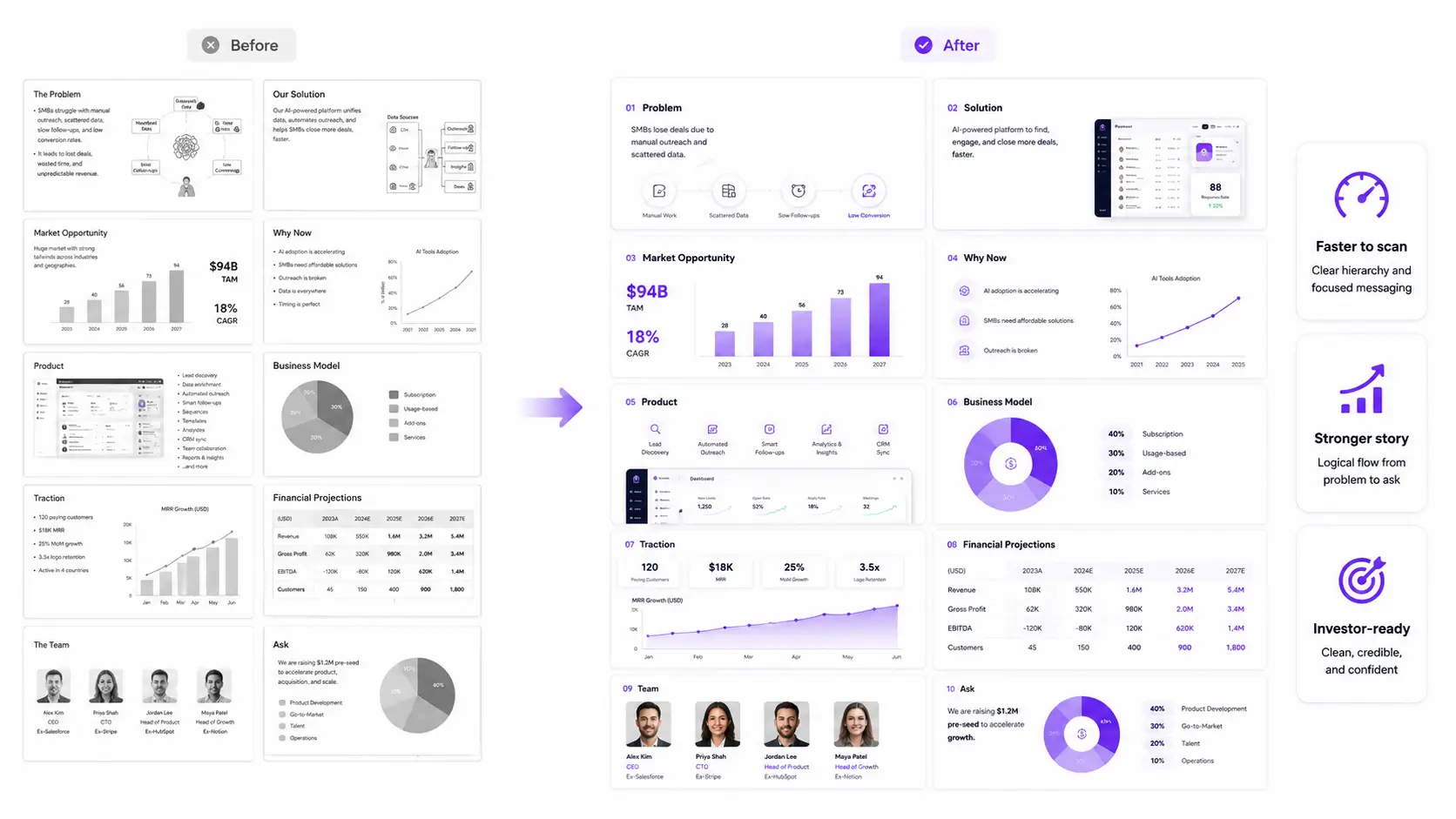
Design is not only decoration. In a pre-seed pitch deck, design affects how quickly investors understand the business.
Good pitch deck design improves:
scan speed
visual hierarchy
message clarity
chart readability
investor focus
story flow
credibility
presentation confidence
At pre-seed, founders often have limited proof. That makes communication even more important. The deck must help investors see what matters without forcing them to dig through crowded slides.
A strong design system can make rough information easier to process. It can turn scattered notes into a cleaner investor story. It can also make the deck easier to present live or send ahead by email.
Lynxify helps founders turn rough pitch content into clearer investor-ready presentation systems through narrative structure, slide architecture, visual hierarchy, and presentation design.
How Lynxify Helps Founders Build Pre-Seed Pitch Decks
Lynxify helps founders build pre-seed pitch decks that are structured, easy to follow, and ready for investor conversations.
With 5,000+ pitch deck and presentation projects delivered worldwide and 7+ years of pitch deck and presentation design experience, Lynxify supports founders who need more than basic slide design.
Lynxify works on:
pre-seed pitch decks
investor pitch decks
startup decks
pitch deck redesigns
SaaS decks
sales decks
business presentations
branded templates
PowerPoint decks
Google Slides decks
editable deck systems
The goal is not to make the deck look expensive. The goal is to make the business easier to understand, evaluate, and present.
Depending on scope, Lynxify can help with:
content refinement
investor storytelling
narrative structure
slide architecture
visual hierarchy
data slides
pitch deck redesign
presentation design
editable PowerPoint delivery
editable Google Slides delivery
For founders comparing scope and budget, Lynxify’s How Much Does a Pitch Deck Design Cost blog explains how pricing can change based on slide count, content readiness, design complexity, writing support, and turnaround.
Lynxify’s Pitch Deck Design Agency service is built for founders who need a deck that does more than sit in a folder. It should help the business story move through investor conversations with less confusion and more confidence.
Final Answer: What Investors Really Look for in a Pre-Seed Pitch Deck
Investors look for clarity, founder strength, market potential, early proof, a believable business model, and a logical next milestone.
A strong pre-seed pitch deck does not need to prove everything. It needs to show that the founder understands the problem, knows the customer, has a focused solution, and can use funding to reach the next meaningful stage.
The best pre-seed decks are simple, honest, and sharp.
They make the opportunity understandable, credible, and worth a deeper conversation.
FAQ
Frequently Asked Questions

What is a pre-seed pitch deck?
A pre-seed pitch deck is a short investor presentation used by early-stage founders to explain the problem, solution, market, product, team, early validation, business model, and funding ask. Its purpose is to help investors understand the opportunity quickly and decide whether it is worth a deeper conversation.
What do investors look for in a pre-seed pitch deck?
Investors look for a real problem, clear solution, founder-market fit, believable market opportunity, early validation, business model logic, and a practical next milestone. They do not expect a perfect company, but they expect focused thinking and a deck that is easy to understand.
How many slides should a pre-seed pitch deck have?
Most pre-seed pitch decks are around 10 to 15 slides. The right length depends on the startup’s complexity and stage, but the deck should be detailed enough to explain the opportunity while remaining easy for investors to scan quickly.
What slides should a pre-seed pitch deck include?
A pre-seed pitch deck usually includes a cover, problem, solution, product, market, team, traction or validation, business model, go-to-market plan, competition, roadmap, milestones, and funding ask. The exact order can change, but the story should remain logical.
Do pre-seed investors expect traction?
Pre-seed investors may not expect major revenue, but they usually expect some validation. This can include customer interviews, MVP testing, pilot users, waitlist growth, letters of intent, early revenue, product usage, or partnership interest. The goal is to show real learning or demand.
Should a pre-seed pitch deck include financial projections?
Should a pre-seed pitch deck include financial projections?
What is the difference between a pre-seed and seed pitch deck?
A pre-seed pitch deck focuses more on the problem, founder-market fit, MVP, early validation, and next milestone. A seed pitch deck usually needs stronger traction, clearer revenue signals, more product progress, and a more developed go-to-market strategy.
What are common pre-seed pitch deck mistakes?
Common mistakes include too much text, an unclear problem, generic market claims, weak customer proof, inflated traction, unclear business model, vague go-to-market plans, and an unclear funding ask. A strong deck should make the business easier to understand, not harder to evaluate.
Featured Blogs

Lynxify’s Evolution: From Pitch Decks to a Multidisciplinary Creative Company

Finance Slide in a Pitch Deck: What Investors Want to See
Go-To-Market Slide in a Pitch Deck: Guide & Examples
Market Size Slide in a Pitch Deck: TAM, SAM & SOM
How Many Slides Should a Pitch Deck Have? 10–15 Slides
Business Model Slide: Show Investors How You Make Money

Product Roadmap Slide in a Pitch Deck: What to Show Investors?
Team Slide in a Pitch Deck: What Investors Want to See

Pre-Seed vs Seed Funding: Amounts, Stage & Key Differences
How Long Should a Pitch Deck Be? Slide Count Guide
What Investors Look for in a Pre-Seed Stage Pitch Deck

10 Common Pitch Deck Mistakes Founders Should Avoid Before Investors See the Deck
How Much Does a Pitch Deck Design Cost?
How to Create a Pitch Deck for Investors
Traction Slide in a Pitch Deck: What Investors Want to See
Business Plan vs Pitch Deck: What Should Founders Use?