
How to Create a Pitch Deck for Investors
Most investor decks do not fail because the idea is bad. They fail because the opportunity is not understood fast enough.
Founders often have the raw material: the product, the market, the numbers, the vision, the team. But once that information becomes a deck, it can easily turn into too much copy, too many slides, unclear positioning, and a story that feels harder to evaluate than the business itself.
That is a problem because investors do not read pitch decks slowly at first. They scan. They look for the shape of the opportunity, the risk, the upside, and whether the founder has thought deeply about the business.
So the goal is not to explain everything.
The goal is to make the company easy to understand, easier to evaluate, and worth discussing further.
This guide explains how to create a pitch deck for investors with the right structure, slide logic, storytelling, and founder-level focus.
What is a pitch deck for investors?
A pitch deck for investors is a short presentation that explains your start-up as an investment opportunity. It shows the problem, solution, market, product, traction, business model, team, and funding ask in a visual, easy-to-scan format.
When people ask what is a pitch deck for investors, the simplest answer is this:
It is not a business plan in slides. It is a focused investment story.
A business plan can go deep into operations, research, financial assumptions, and execution details. A pitch deck does something different. It gives investors enough context to decide whether the opportunity deserves a meeting, follow-up questions, or deeper due diligence.
The best investor decks do not try to say everything. They select the right information and arrange it in the right order.
What do investors actually look for in a pitch deck?
Investors are not only judging the slides. They are judging the thinking behind the slides.
They want to know whether the founder understands the problem, the customer, the market, the risks, and the path to growth. A beautifully designed deck with weak business logic will not fix the story.
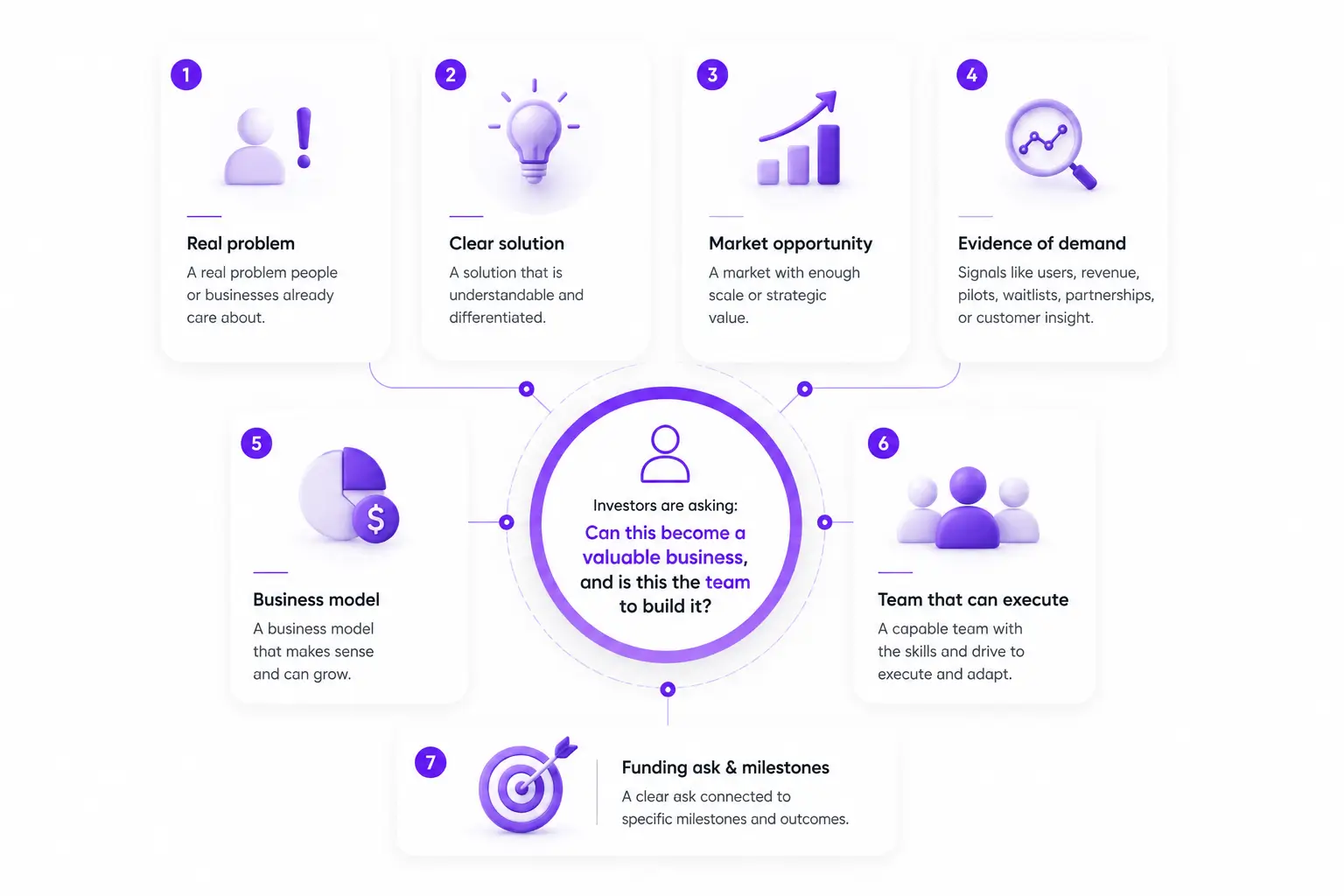
Most investors are looking for a few core signals:
A real problem people or businesses already care about
A clear solution that feels understandable and differentiated
A market worth entering with enough scale or strategic value
Evidence of demand, such as users, revenue, pilots, waitlists, partnerships, or customer insight
A business model that makes sense
A team that can execute
A funding ask connected to clear milestones
This is where many founders lose focus. They explain the product deeply, but they do not frame the investment case well enough.
Investors are not only asking, “Is this product interesting?”
They are asking:
Can this become a valuable business, and is this the team to build it?
Your deck should help them answer that question quickly.
What investor pitch deck structure usually works best?
A practical investor pitch deck structure follows the way investors evaluate opportunities. It moves from problem to solution, then from proof to execution, then from team to funding ask.
Here is a clean investor pitch deck outline most founders can start with:
Slide | Purpose |
Cover | Introduce the company clearly |
Problem | Show the pain point and why it matters |
Solution | Explain your answer to the problem |
Product | Show how the product or service works |
Market | Prove the opportunity is worth pursuing |
Business Model | Explain how the company makes money |
Traction | Show validation, momentum, or early proof |
Go-to-Market | Explain how you will reach customers |
Competition | Show market awareness and differentiation |
Team | Prove why this team can execute |
Financials | Show growth logic and key assumptions |
Funding Ask | Explain the raise, use of funds, and milestones |
The order matters.
Problems should usually come before a product because investors need context before features. Traction should come before future projections because proof makes ambition more believable. The funding ask should come after the investor understands what the business is, why it matters, and what the next stage requires.
A good pitch deck does not feel like random slides. It feels like a guided business conversation.
How do you create a pitch deck for investors without overloading it?
To create a pitch deck for investors, start with the investment story before design. Do not open slides first. Start by deciding what each slide needs to prove. Whether the deck ends up at 10 slides or closer to 15, every slide should earn its place by proving one clear point.
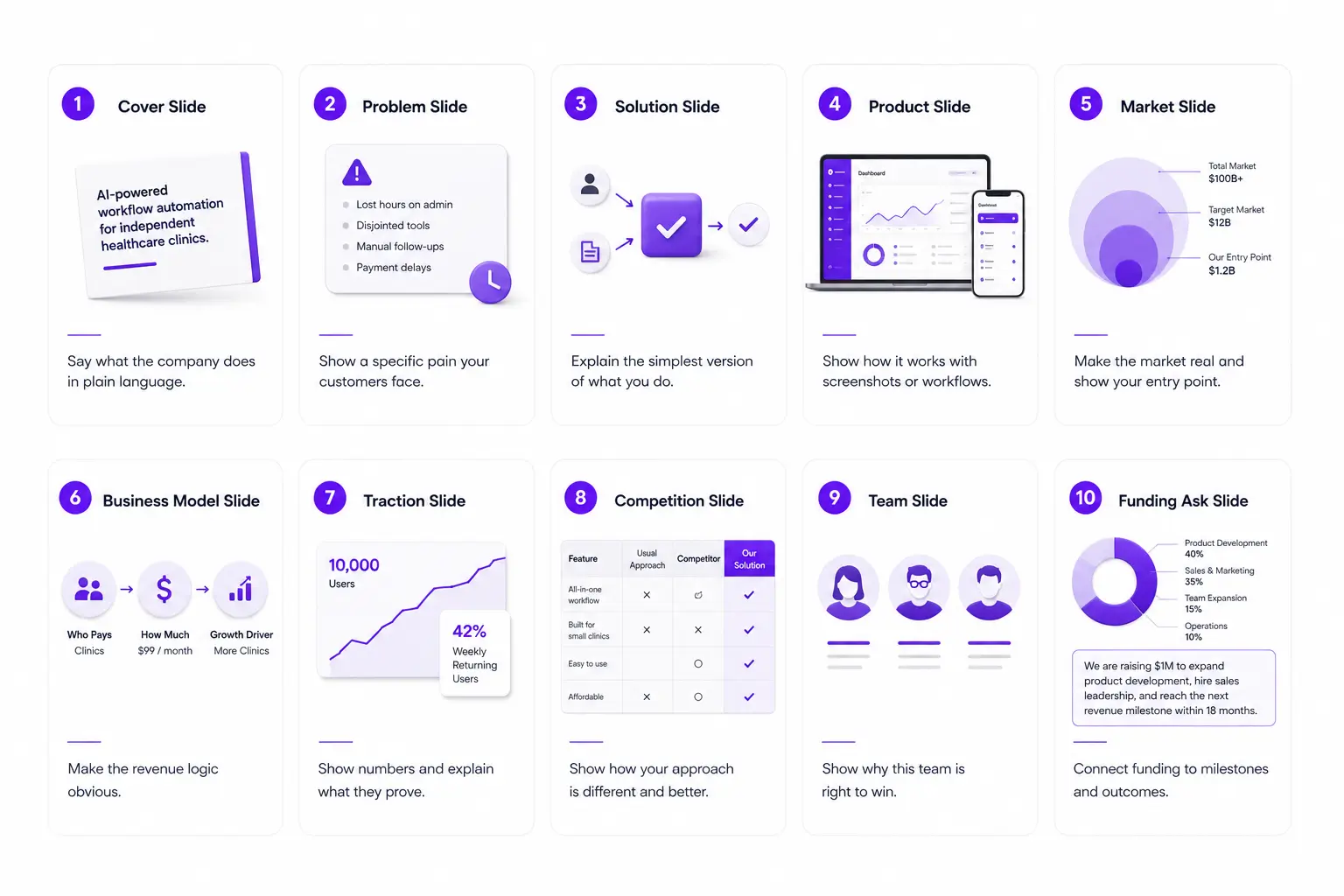
Cover Slide
Say what the company does in plain language. Avoid vague taglines that sound clever but do not explain the business.
Weak:
“Reimagining the future of connected experiences.”
Better:
“AI-powered workflow automation for independent healthcare clinics.”
Investors should understand the category within seconds.
Problem Slide
Show a specific pain, not a dramatic claim that the whole industry is broken.
Weak:
“Healthcare operations are outdated.”
Better:
“Small clinics lose hours each week managing patient intake, follow-ups, and insurance paperwork across disconnected tools.”
Specific problems feel more credible.
Solution Slide
Explain the simplest version of what you do. If the solution needs too much explanation, the positioning probably needs work.
Do not list every feature here. Explain the core idea first.
Product Slide
Show how it works. Use screenshots, workflows, product visuals, or simple diagrams.
This slide should help investors understand the experience, not every technical detail. A product slide overloaded with features often makes the product feel less focused.
Market Slide
Make the market believable.
Founders often use huge market numbers but forget to explain their real entry point. A $100B market means very little if the startup has no defined path into a specific segment.
A stronger market slide shows:
who the first customer is
which segment you are entering
why that segment is reachable
how the opportunity can expand over time
Business Model Slide
Make the revenue logic obvious.
Investors should quickly understand who pays, how much they pay, how often they pay, and what drives growth.
If the business model is complex, simplify it visually.
Traction Slide
Do not just show numbers. Explain what the numbers prove.
Revenue proves something. User growth proves something. Retention proves something. A waitlist, pilot, or partnership can also prove something if framed correctly.
Weak:
“10,000 users.”
Better:
“10,000 users joined organically in 4 months, with 42% returning weekly.”
The second version gives investors a reason to care.
Competition Slide
Do not pretend competitors do not exist.
A market with no competition can signal that the problem is not urgent, the category is unclear, or the founder has not researched deeply enough.
Show how customers solve the problem today, where current options fall short, and why your approach is different.
Team Slide
The team slide should prove founder-market fit, execution ability, or relevant experience.
It is not just a photo grid. It should answer:
Why is this team credible for this specific opportunity?
Funding Ask Slide
Connect funding to milestones.
Weak:
“We are raising $1M.”
Better:
“We are raising $1M to expand product development, hire sales leadership, and reach the next revenue milestone within 18 months.”
A specific ask makes the round feel more intentional.
Is there a difference between an investor deck vs pitch deck?
A pitch deck can be used for different business conversations, including sales, partnerships, accelerators, and internal strategy.
An investor deck is usually a pitch deck created specifically for fundraising. It puts more focus on market opportunity, traction, financial logic, growth potential, team credibility, and the funding ask.
In simple terms:
A pitch deck explains the business. An investor deck frames the business as an investment opportunity.
People often use both terms interchangeably, but the intent matters. If the deck is being sent to investors, it should be built around fundraising logic, not general company storytelling.
Should founders study investor pitch deck examples?
Yes, investor pitch deck examples can be useful, but only when founders study them the right way.
Examples help you understand slide order, narrative flow, market framing, traction presentation, and how successful startups simplified complex ideas. They are helpful for learning structure and logic.
But copying another startup’s deck is usually a mistake. A deck that worked for a consumer app may not work for a B2B SaaS company. A pre-seed deck will not look like a Series A deck. A healthcare startup may need more trust, compliance, and evidence than a social product.
Use examples to study decisions, not to borrow slides.
The better question is not, “Can we copy this format?”
The better question is, “Why did this deck work for that company, at that stage, with that investor audience?”
What mistakes make investor decks hard to read?
Many pitch decks are not weak because they lack information. They are weak because the information is badly ordered, overdesigned, or difficult to scan.
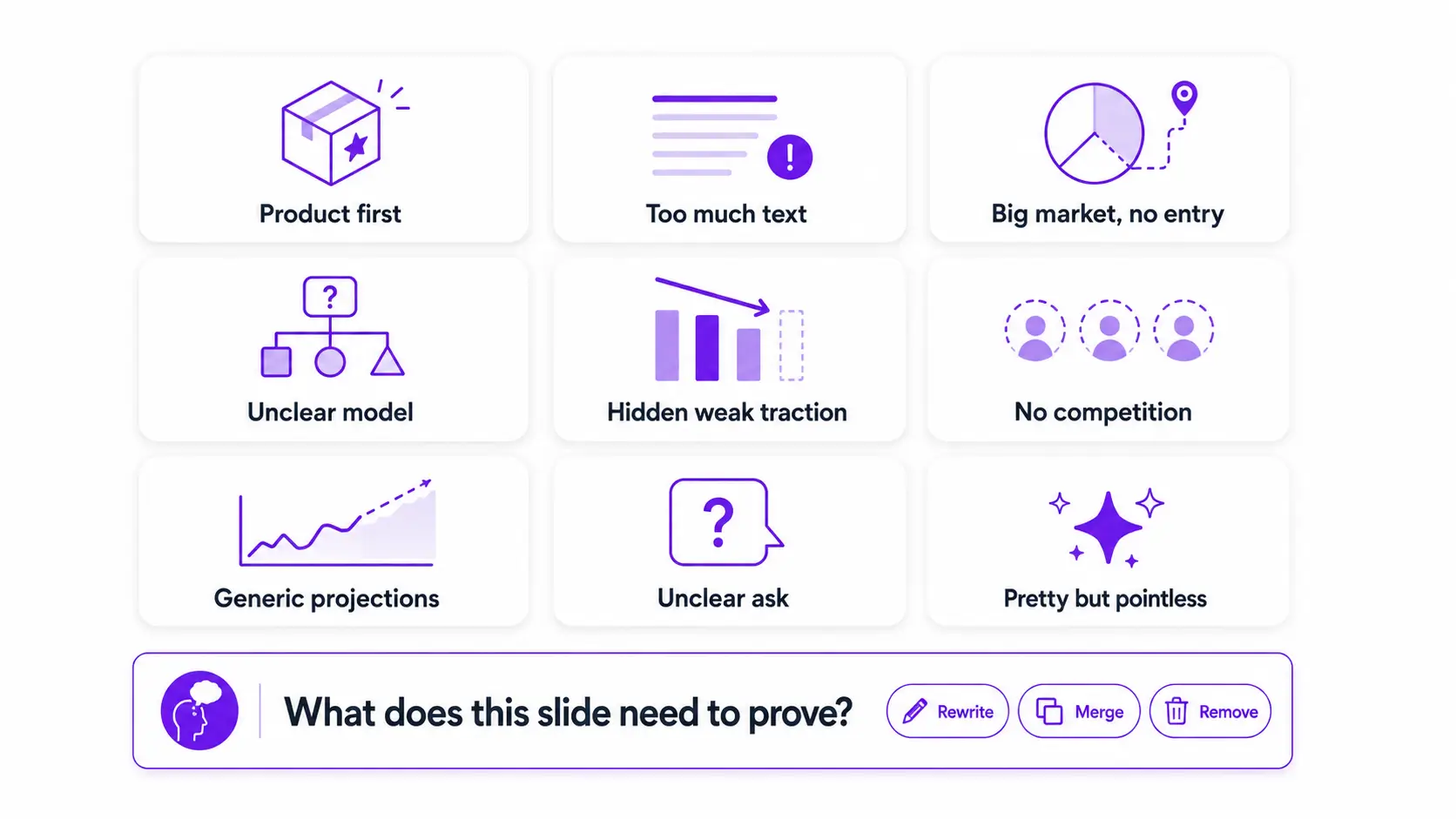
Common mistakes include:
Starting with the product before explaining the problem
Using too much text on every slide
Showing inflated market numbers with no entry strategy
Making the business model hard to understand
Hiding weak traction behind polished design
Ignoring competitors or saying “we have no competition”
Using generic financial projections with no logic
Ending with an unclear funding ask
Creating polished slides that do not make a real point
The last one is especially common.
A slide can look premium and still fail if it does not answer a meaningful investor question. Design should sharpen the story, not decorate confusion.
Before adding anything to the deck, ask:
What does this slide need to prove?
If the answer is unclear, the slide probably needs to be rewritten, merged, or removed.
When should founders hire a professional pitch deck designer?
Founders should hire professional help when the deck needs to support serious fundraising, investor meetings, accelerator applications, or strategic business conversations.
At that stage, the deck is no longer just a presentation. It becomes a decision-making asset.
A professional pitch deck designer does more than make slides look better. The right team helps with narrative structure, slide architecture, visual hierarchy, information flow, and investor readability.
Lynxify helps founders turn raw business information into investor-ready pitch decks through strategic storytelling, slide architecture, visual hierarchy, and presentation design.
For founders preparing for fundraising, Lynxify’s professional pitch deck design support helps shape the business story into a deck investors can understand faster and discuss more seriously.
Lynxify pitch deck work has supported fundraising-related outcomes including Necto raising $8M+, Mammogen raising $2M, Satoshi Protocol raising $2M, Parlay raising $1.7M, and ESPROFILER raising £2.8M.
These outcomes depend on the business, market, traction, team, and investor fit. A clear deck does not raise capital alone, but it helps founders present the opportunity with stronger structure, sharper communication, and more credibility.
What should you check before sending your pitch deck?
Before sending your investor deck, test it like someone seeing the company for the first time.
Ask:
Is the problem understandable within the first few slides?
Can someone understand the product without a live explanation?
Is the market specific and believable?
Does traction prove real momentum?
Is the business model obvious?
Does every slide have one clear job?
Is the competition slide honest and useful?
Are financial projections simple and logical?
Is the funding ask connected to milestones?
Does the deck feel easy to scan?
A good test is simple: send the deck to someone smart who does not know your company. If they cannot explain the business back to you in a few sentences, the deck is not ready.
What is the right way to create a pitch deck for investors?
To create a pitch deck for investors, start with the investment story before design. The best decks are not the longest. They are not the flashiest. They are the most focused.
They help investors understand the problem, believe the opportunity, trust the team, and see what funding will help unlock next. Founders do not need to explain everything in the first deck. They need to create enough confidence for the next conversation.
If your startup is preparing for investor outreach, accelerator applications, or fundraising meetings, Lynxify can help turn your strategy, traction, and vision into a polished investor-ready deck through professional pitch deck design.

Book a call
Need More than One Service?
Combine brand, product, web, presentations, editorial, and video support around one connected project



FAQ
Frequently Asked Questions

How do you prepare an investor pitch deck?
Prepare an investor pitch deck by clarifying the problem, solution, market, traction, business model, team, financials, and funding ask before designing slides. The goal is to build a focused investment story, not just a visual presentation.
What is a pitch deck for investors?
A pitch deck for investors is a short visual presentation that explains a startup as an investment opportunity. It helps investors understand the problem, solution, product, market, traction, business model, team, and funding ask.
What is the best investor pitch deck structure?
The best investor pitch deck structure usually includes cover, problem, solution, product, market, business model, traction, go-to-market, competition, team, financials, and funding ask. The exact order can change, but the story should feel logical.
How long should an investor pitch deck be?
Most investor pitch decks are around 10 to 15 slides. The right length depends on the company stage, industry, and complexity. The deck should be long enough to explain the opportunity, but short enough to scan quickly.
What do investors look for in a pitch deck?
Investors look for a real problem, clear solution, strong market opportunity, evidence of traction, a sensible business model, a credible team, and a funding ask tied to clear milestones.
What is the difference between an investor deck vs pitch deck?
What is the difference between an investor deck vs pitch deck?
Should a pitch deck include financial projections?
Yes, most investor pitch decks should include financial projections or financial highlights. They should be simple, realistic, and connected to the business model, growth assumptions, and funding plan.
Can ChatGPT create a pitch deck?
ChatGPT can help with outlines, slide ideas, and rough messaging. But a serious investor pitch deck still needs human strategy, business judgment, financial clarity, investor storytelling, and professional presentation design.
Featured Blogs

Lynxify’s Evolution: From Pitch Decks to a Multidisciplinary Creative Company

Finance Slide in a Pitch Deck: What Investors Want to See

Go-To-Market Slide in a Pitch Deck: Guide & Examples

Market Size Slide in a Pitch Deck: TAM, SAM & SOM
How Many Slides Should a Pitch Deck Have? 10–15 Slides
Business Model Slide: Show Investors How You Make Money

Product Roadmap Slide in a Pitch Deck: What to Show Investors?

Team Slide in a Pitch Deck: What Investors Want to See

Pre-Seed vs Seed Funding: Amounts, Stage & Key Differences

How Long Should a Pitch Deck Be? Slide Count Guide
What Investors Look for in a Pre-Seed Stage Pitch Deck

10 Common Pitch Deck Mistakes Founders Should Avoid Before Investors See the Deck
How Much Does a Pitch Deck Design Cost?
How to Create a Pitch Deck for Investors

Traction Slide in a Pitch Deck: What Investors Want to See
Business Plan vs Pitch Deck: What Should Founders Use?
Guy Kawasaki Pitch Deck: The 10/20/30 Rule for Startup Decks