


Guy Kawasaki Pitch Deck: The 10/20/30 Rule for Startup Decks
A Guy Kawasaki pitch deck is built around one simple idea: investors need clarity before they need every detail. His 10/20/30 rule, sometimes written as the 10 20 30 rule or 10.20.30, gives founders a practical way to keep a startup presentation focused: 10 slides, 20 minutes, and readable 30-point font.
For startup founders, this rule is useful because it forces discipline. Instead of trying to explain the entire company in one meeting, the deck focuses on the core story: the problem, solution, market, business model, team, and current progress. The rule is not about making every deck look the same. It is about making the pitch easier for investors to understand, remember, and discuss.
What Is the 10/20/30 Rule?
The 10/20/30 rule means a pitch presentation should have 10 slides, be delivered in 20 minutes, and use 30-point font or larger. Guy Kawasaki created this PowerPoint rule to help founders avoid long, crowded, hard-to-follow presentations. The idea is simple: if the pitch needs too many slides, too much time, or very small text, the story probably needs more focus. So, you need to know the ideal pitch deck slide count for the best pitch deck.
Part of the Rule | What It Means | Why It Matters |
10 slides | Limit the pitch to 10 core slides | Forces the founder to focus on what matters most |
20 minutes | Present in 20 minutes or less | Leaves room for investor questions and discussion |
30-point font | Use large, readable text | Prevents clutter and makes slides easier to scan |
Some founders search for this as the 10 20 30 rule, the 10-20-30 rule, or simply 10.20.30 — the meaning is the same across every version. The rule works because it protects the pitch from becoming a long business document. A strong pitch deck should start the investor conversation, not answer every possible question in the first meeting.
Why Does Guy Kawasaki’s Pitch Deck Rule Matter for Founders?
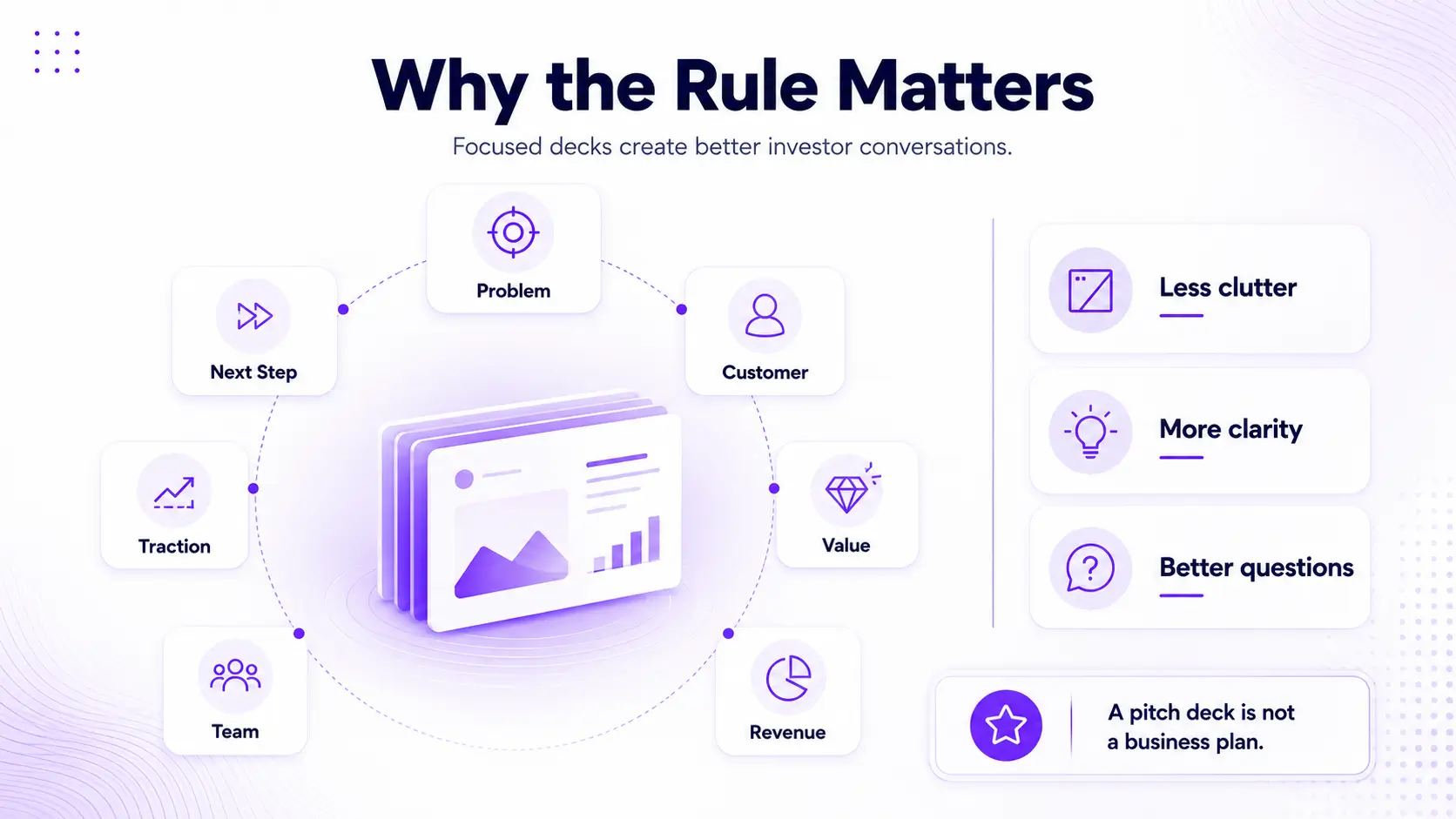
Guy Kawasaki’s pitch deck rule matters because founders often explain too much too early.
A pitch deck is not a full business plan. It does not need to include every feature, every future idea, every financial detail, or every internal assumption. Its job is to help investors understand the business quickly enough to ask better questions.
A focused deck helps investors understand:
what problem the startup solves
who the target customer is
why the solution matters
how the business may make money
who is building it
what progress has been made
what should happen next
Shorter decks often create better investor conversations because they leave space for questions. A founder who can explain the company simply usually feels more prepared, more thoughtful, and easier to follow.
If you are building a full investor structure, Lynxify’s blog on How to Create a Pitch Deck for Investors can help you understand how slide flow should support the pitch before design begins.
What Are the Guy Kawasaki 10 Slides?
The Guy Kawasaki 10 slides are the core slides he recommends for a startup pitch. They cover the main areas investors usually need to understand first.
Slide | Purpose |
Title | Introduce the company, category, and contact details |
Problem or Opportunity | Explain the pain, gap, or market opportunity |
Value Proposition | Show the value your solution creates |
Underlying Magic | Explain the product, technology, or unique insight |
Show how the company makes money | |
Explain how you will reach customers | |
Competitive Landscape | Show alternatives and differentiation |
Management Team | Prove why this team can execute |
Financial Projections | Show growth logic and key assumptions |
Current Status and Timeline | Explain progress, milestones, and what happens next |
This structure is simple, but it covers the main investor questions. Many founders look for a Guy Kawasaki pitch deck template, but it works better as a structure to adapt than a fixed template to copy, founders can adjust the slides based on stage, industry, and audience while keeping the core logic intact.
How Do the 10 Slides Work in a Startup Pitch Deck?
These Kawasaki slides work because they follow the natural path of investor questions. A good startup pitch deck should answer:
What is this company?
What problem does it solve?
Why does the solution matter?
How does the business make money?
Who is building it?
What progress has been made?
What happens next?
This flow helps the deck feel organized instead of random. Each slide has a job, and each slide moves the investor closer to understanding the opportunity.
Modern fundraising decks may also include a clear funding ask or use of funds if the deck is being used for investor outreach. That does not weaken the Guy Kawasaki framework. It simply adapts the structure to what investors need in a specific fundraising conversation.
Why Should a Startup Pitch Be 20 Minutes?
A startup pitch should be 20 minutes because the meeting should not be used only for presenting. Investor meetings are conversations. The founder needs time for questions, objections, feedback, and deeper discussion. If the whole meeting is spent going through slides, the investor may not get enough space to explore the parts of the business that matter most.
A shorter pitch shows respect for the investor’s time. It also shows that the founder can communicate clearly. A 20-minute pitch helps protect space for:
product questions
market questions
investor concerns
traction review
funding and milestone discussion
The goal is not to rush. The goal is to explain the business well enough to create a better conversation afterward.
Why Does the 30-Point Font Rule Matter?
The 30-point font rule matters because small text usually means the slide has too much content.
If you need to shrink the font to fit everything, the slide probably needs to be simplified. Investors should be able to read your slides easily in a meeting room, on a laptop, or during a video call.
Large text forces better decisions. It pushes founders to use fewer words, stronger slide titles, and cleaner layouts.
A good pitch slide usually has:
one main idea
a clear headline
short supporting copy
readable visuals
simple chart design
strong visual hierarchy
Extra detail can go into speaker notes, appendix slides, follow-up materials, or a business plan. The slide should support the pitch. It should not compete with the founder speaking.
How to Use the 10/20/30 Rule in a Modern Pitch Deck
The 10/20/30 rule is still useful, but founders should adapt it based on the context. A live pitch deck can be shorter because the founder is there to explain the details. A send-ahead deck may need slightly more context because investors may read it without a live presentation.
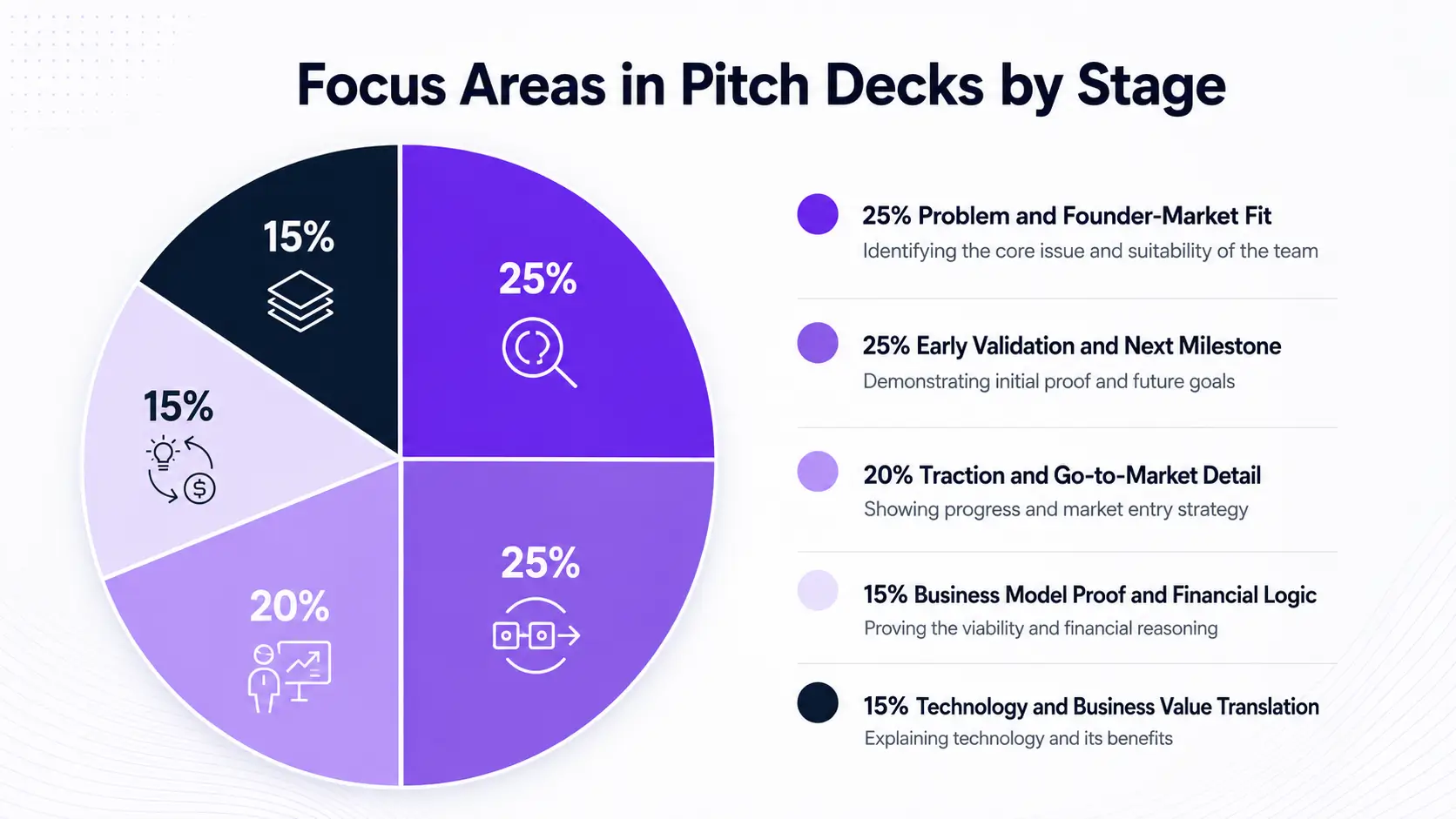
A pre-seed pitch deck may focus more on the problem, founder-market fit, early validation, and the next milestone. A seed-stage pitch deck may need stronger traction, go-to-market detail, business model proof, and financial logic. A SaaS deck may need to show product workflow and revenue model. An AI or technical deck may need to explain the technology, but it should still translate technical features into business value.
The main deck should stay focused. Extra proof can go into appendix slides.
Guy Kawasaki Pitch Deck vs a Full Investor Deck
A Guy Kawasaki pitch deck is the core presentation. A full investor deck or fundraising package may include more supporting material.
The core pitch deck is built for fast understanding. It introduces the business, explains the opportunity, and creates the first investor conversation.
A wider fundraising package may include:
business plan
financial model
data room
product demo
customer proof
appendix slides
technical documents
legal or company information
This is where founders often confuse a pitch deck with a business plan. A pitch deck should be concise and easy to discuss. A business plan can go deeper into operations, financial planning, and long-term strategy.
Lynxify’s Business Plan vs Pitch Deck blog explains this difference in more detail and helps founders decide what belongs in the pitch and what belongs outside it.
Common Mistakes Founders Make With the 10/20/30 Rule
These Guy Kawasaki pitch deck rules are simple, but founders can still apply them the wrong way.
Treating 10 Slides as a Fixed Law
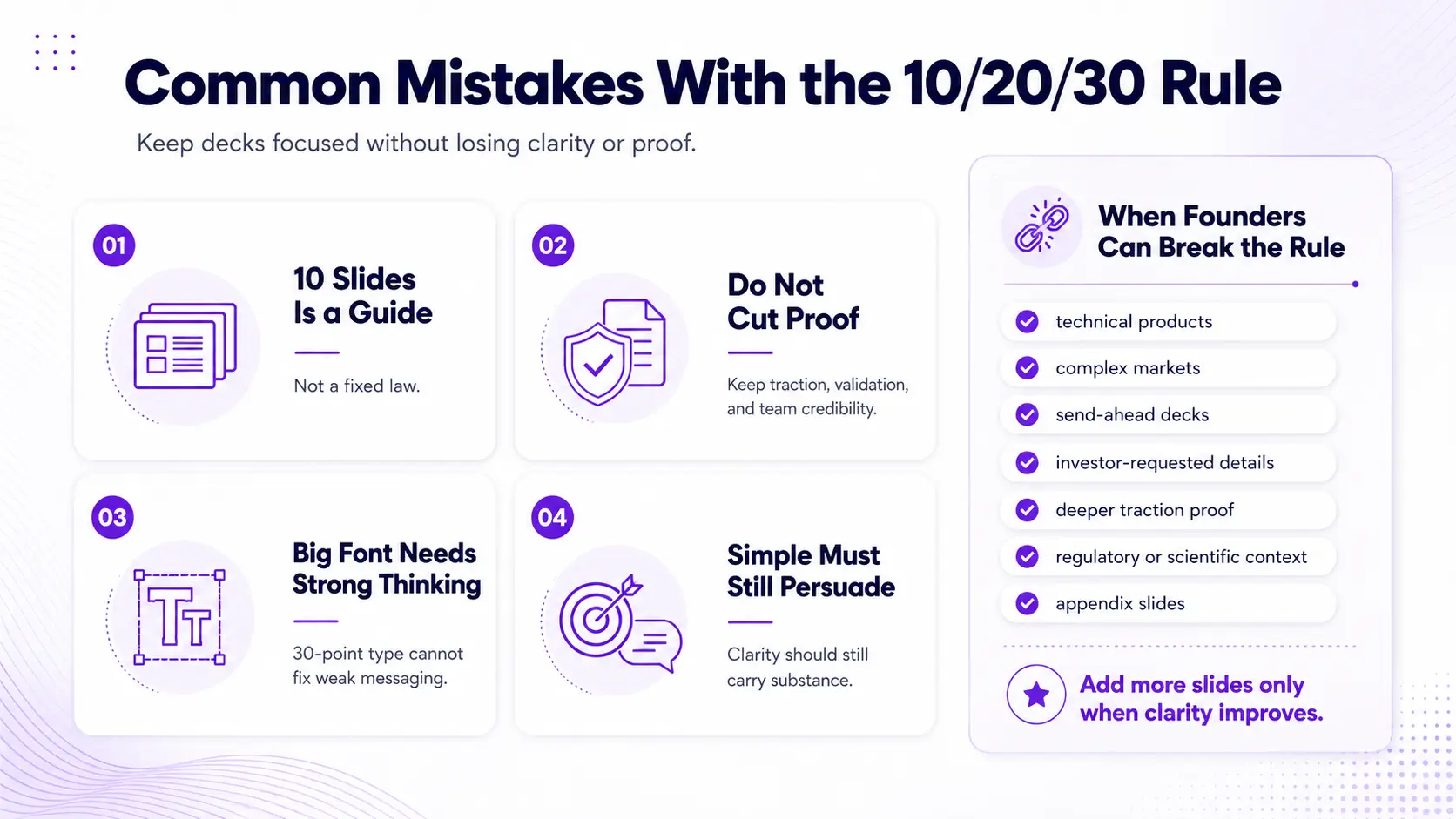
The 10-slide rule is a guideline, not a strict law. Some decks may need 11 or 12 slides. Some may need appendix slides. The real goal is focus, not forcing every company into the exact same shape.
Cutting Important Proof Just to Stay Short
A short deck can still be weak if it removes the proof investors need. Do not cut traction, customer validation, product evidence, or team credibility just to stay under 10 slides. If a slide helps investors understand the business, it may deserve a place.
Using Large Font but Weak Messaging
Large font does not fix vague thinking. A slide can use 30-point font and still fail if the headline is weak, the point is unclear, or the story does not move forward.
Making the Deck Simple but Not Persuasive
Simple does not mean empty. A good pitch deck is easy to follow, but it still needs substance. It should explain the customer pain, market opportunity, product value, business model, team, and next milestone clearly enough for investors to take the conversation seriously.
When Should Founders Break the 10/20/30 Rule?
Founders can break the 10/20/30 rule when more context improves clarity.
The rule should guide the pitch, not limit useful information. Some businesses need more explanation because the product, market, or investor audience is more complex.
More slides may be useful for:
technical products
complex markets
send-ahead decks
investor-requested details
deeper traction proof
regulatory or scientific context
appendix slides
The key is restraint. Add more slides only when they help investors understand the opportunity better.
For PowerPoint decks, the 10/20/30 structure behind the Kawasaki pitch deck is a strong starting point, but the final deck should match the purpose of the meeting.
How Lynxify Thinks About the Guy Kawasaki Pitch Deck Rule
Across pitch deck and presentation work, including decks built around the Guy Kawasaki 10 20 30 rule, Lynxify often sees founders with strong ideas but unclear decks.
Guy Kawasaki’s pitch deck framework is useful because it pushes clarity, structure, and restraint. It reminds founders that investors do not need every detail in the first conversation. They need a focused story that is easy to follow.
Lynxify helps founders improve narrative structure, slide architecture, visual hierarchy, content refinement, and editable presentation systems across investor decks, startup decks, pre-seed decks, SaaS decks, PowerPoint decks, and Google Slides decks.
For founders who already have a deck but feel the story, structure, or slide flow is not clear enough, Lynxify’s Pitch Deck service is a natural place to explore how a stronger investor presentation can be structured, refined, and designed.
Final Answer: What Is the 10/20/30 Rule?
The 10/20/30 rule means a startup presentation should have 10 slides, last 20 minutes, and use 30-point font or larger.
The rule helps founders keep startup presentations focused, readable, and easier to discuss. It reduces clutter, protects investor attention, and forces the deck to focus on what matters most.
It does not mean every pitch deck must follow the exact number forever. It means every slide should earn its place.
Sum Up



FAQ
Frequently Asked Questions

What is Guy Kawasaki’s 10/20/30 rule?
Guy Kawasaki’s 10/20/30 rule says a startup pitch presentation should use 10 slides, last 20 minutes, and use 30-point font or larger. The rule helps founders keep presentations short, readable, and focused on the investor questions that matter most.
What is the Guy Kawasaki pitch deck?
The Guy Kawasaki pitch deck is a 10-slide startup presentation framework based on his 10/20/30 Rule of PowerPoint. It helps founders explain the problem, value proposition, product, business model, go-to-market plan, competition, team, financial projections, and current status in a simple structure.
What are the Guy Kawasaki 10 slides?
The Guy Kawasaki 10 slides are title, problem or opportunity, value proposition, underlying magic, business model, go-to-market plan, competitive landscape, management team, financial projections, and current status and timeline. These slides cover the main areas investors usually need to understand first.
Is the 10/20/30 rule still relevant?
Yes, the 10/20/30 rule is still relevant because founders still need to explain complex businesses quickly. The rule helps keep startup pitch decks focused, readable, and easier for investors to discuss, especially when the founder has limited time in a pitch meeting.
Can a pitch deck have more than 10 slides?
Yes, a pitch deck can have more than 10 slides if more context improves understanding. Technical products, send-ahead decks, complex markets, and investor-requested details may need extra slides. The main deck should still stay focused, while deeper detail can go into an appendix.
Why does Guy Kawasaki recommend a 30-point font?
Why does Guy Kawasaki recommend a 30-point font?
How long should a startup pitch presentation be?
A startup pitch presentation should usually be short enough to leave time for questions. Guy Kawasaki recommends 20 minutes, even if the meeting is longer. This gives investors time to ask about the market, product, business model, risks, traction, and next steps.
Can Lynxify help improve a pitch deck using the 10/20/30 rule?
Yes. Lynxify can help founders use the 10/20/30 rule as a practical starting point, then refine the deck through narrative structure, slide architecture, visual hierarchy, content refinement, and editable presentation design. The goal is a clearer, more focused deck for investor conversations.
