Pre-Seed vs Seed Funding: Amounts, Stage & Key Differences
Pre-seed vs seed funding is not only a difference in investment amount. The real difference is startup stage, proof, traction, investor expectations, and what the pitch deck needs to prove.
The simplest pre-seed vs seed funding difference is this: pre-seed funding usually supports early validation, while seed funding usually supports growth after the startup has stronger evidence that the product, market, and business model can work.
For founders, this matters because a pre-seed pitch deck and a seed pitch deck should not tell the same story. A pre-seed deck needs to make the opportunity believable. A seed deck needs to make the business more provable.
Quick Answer: Pre-Seed vs Seed Funding
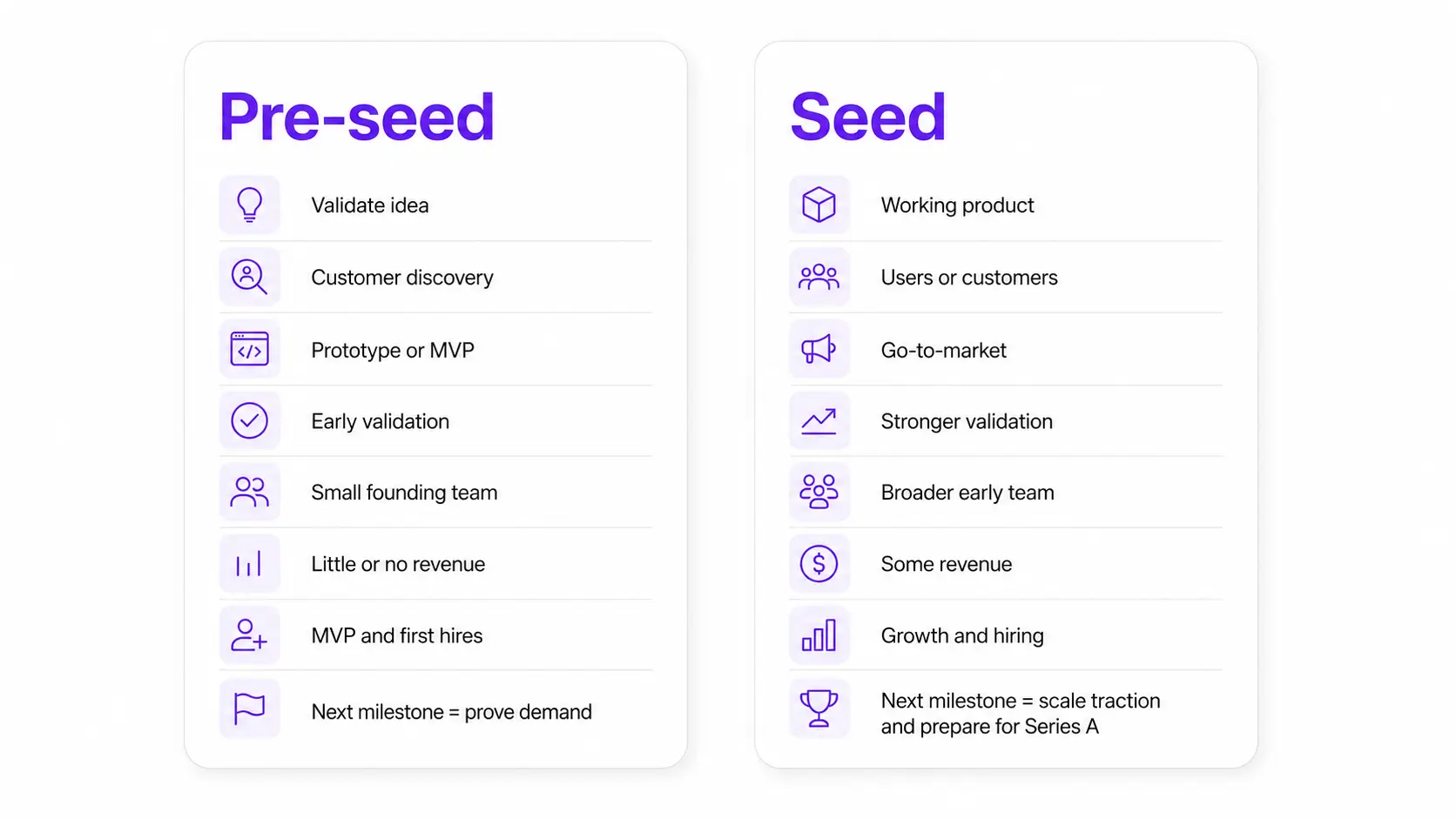
Pre-seed funding is usually the earliest startup funding stage. It helps founders validate an idea, build an MVP, test demand, and reach the first meaningful milestone.
Seed funding usually comes after the startup has stronger proof, such as a working product, early users, customer feedback, traction, or revenue signals. Pre-seed is about proving the opportunity is worth building. Seed is about proving the business can grow.
Funding amounts vary by market, industry, traction, and investor appetite, but pre-seed rounds are usually smaller than seed rounds because the startup has less proof and more uncertainty.
What Is Pre-Seed Funding?
Pre-seed funding is usually the earliest external funding stage for a startup.
It often happens when the founder has a clear problem, early customer insight, a rough product direction, or an MVP plan, but not yet strong revenue or mature traction.
The goal of pre-seed funding is early validation. Founders may use the money to test customer demand, build a prototype, create an MVP, run customer discovery, hire first team members, or reach the next milestone.
Pre-seed funding may come from founders, friends and family, angel investors, accelerators, early-stage funds, or operators who believe in the founder and the market. Some startups also bootstrap before raising a pre-seed round.
At this stage, investors usually understand that the company is still early. They are not expecting everything to be proven. But they do expect the founder to show why the problem matters, why the market is worth studying, and why this team has a strong reason to build the solution.
A strong pre-seed story usually includes:
A Clear Problem
Founder-market Fit
Early Customer Discovery
Problem Validation
Market Validation
Prototype Or Mvp Direction
Early User Or Customer Feedback
A Clear Use Of Funds
A Believable Next Milestone
Pre-seed funding is not just money for an idea. It is usually money to test whether the idea deserves to become a company.
What Is Seed Funding?
Seed funding usually comes after pre-seed or after the startup has made meaningful early progress.
At the seed funding stage, investors usually expect more evidence than they would at pre-seed. The company may have a working product, beta users, pilot customers, early revenue, strong usage, customer feedback, design partners, waitlist demand, or a clearer go-to-market plan.
The purpose of seed funding is to grow a working product, acquire customers, strengthen the team, improve the go-to-market motion, and prove that the business can scale toward the next funding milestone.
Seed funding for startups may be used for:
Product Development
Hiring
Customer Acquisition
Sales And Marketing
Go-to-market Testing
Retention Improvement
Early Revenue Growth
Operational Systems
Preparing For Series A
Seed investors usually want stronger proof around customer demand, business model clarity, retention, user growth, revenue potential, and team readiness.
A seed-stage startup does not always need perfect product-market fit. But it should usually show stronger signs that the market is responding and that the business has a path toward repeatable growth.
Pre-Seed vs Seed Funding Difference
The main pre-seed vs seed funding difference is that pre-seed usually funds early validation, while seed funding usually supports growth after the startup has stronger proof.
Pre-seed asks: Is this worth building?
Seed asks: Can this become a real business?
That difference changes how founders should think about the round, the investor conversation, and the pitch deck.
At pre-seed, the founder is often proving the problem, the insight, the market opportunity, and the early direction. At seed, the founder is usually proving that the product works, customers care, and the business can grow.
The difference also affects:
Product Maturity
Traction Level
Investor Expectations
Funding Use
Team Readiness
Financial Assumptions
Pitch Deck Focus
Next Milestone
In simple terms, pre-seed is about early validation. Seed is about stronger evidence.
Pre-Seed vs Seed Funding Comparison Table
Category | Pre-Seed Funding | Seed Funding |
Main purpose | Validate the idea and build early proof | Grow a working product and prove stronger business potential |
Startup stage | Very early stage, often before strong traction | Early stage, usually after meaningful progress |
Product stage | Prototype, MVP plan, early MVP, or beta direction | Working product, MVP, beta, or early commercial product |
Traction level | Early validation, customer discovery, waitlist, pilots, feedback | Users, customers, usage growth, revenue, retention, or stronger validation |
Investor expectation | Founder insight, problem clarity, market potential, early proof | Product usage, traction, go-to-market clarity, business model logic |
Typical use of funds | MVP, validation, first hires, customer discovery, runway | Growth, hiring, sales, marketing, product improvement, operations |
Team | Founder or small founding team | Broader early team or clear hiring plan |
Revenue expectation | Often no strong revenue yet | Revenue is helpful, but expectations vary by category |
Pitch deck focus | Why this problem matters and why this team can validate it | Why the product is working and how the business can grow |
Risk level | Higher uncertainty around product, market, and business model | Lower than pre-seed, but still early-stage risk |
Next milestone | Build MVP, prove demand, secure early users or customers | Grow traction, improve retention, prepare for Series A |
Idea Stage vs Pre-Seed vs Seed Funding
Idea stage, pre-seed, and seed are different startup funding stages because each one has a different level of proof.
At the idea stage, the founder may only have a concept, early research, or personal insight. At pre-seed, the founder is testing the idea and building early evidence. At seed, the startup usually has a working product or stronger validation and is ready to grow.
Stage | What Exists | Main Goal | What Investors Look For |
Idea stage | Concept, research, early problem insight | Understand whether the idea is worth testing | Founder insight, market understanding, and early customer discovery |
Pre-seed | Prototype, MVP plan, early validation, customer feedback | Build proof and reach the next milestone | Problem clarity, founder-market fit, market potential, and early validation |
Seed | Working product, users, pilots, revenue signals, traction | Grow the product and prove repeatability | Product usage, traction, retention, go-to-market logic, and business model clarity |
The idea stage is usually too early for many institutional investors unless the founder has unusual credibility, a strong track record, deep market insight, or early support from angels or accelerators.
Pre-seed is where the founder begins turning insight into evidence. Seed is where the evidence should become stronger and more business-focused.
When Should You Raise Pre-Seed Funding?
You should raise pre-seed funding when you have more than a raw idea, but not yet enough proof for a seed round.
A founder may be ready for pre-seed when they have a clear problem, strong customer insight, early customer discovery, a believable market, and a plan for testing the product or building the MVP.
Pre-seed may make sense when funding can help you reach a specific milestone, such as:
Building A Prototype
Launching An MVP
Testing Demand
Hiring A First Technical Or Product Role
Running Pilots
Validating Pricing
Gathering Early Customer Feedback
Creating Enough Proof For A Seed Round
Founders should be careful not to raise too early. If the deck only says “we have an idea” but does not explain the problem, customer pain, market need, or next milestone, investors may not have enough reason to engage.
A stronger pre-seed story shows why the founder understands the problem better than most people and what the money will help prove next.
When Should You Raise Seed Funding?
You should raise seed funding when the startup has more proof than an idea and is ready to grow a working product.
Seed-stage founders usually need stronger evidence than pre-seed founders. That evidence may include an MVP, beta users, pilot customers, early revenue, user growth, retention signals, customer feedback, design partners, letters of intent, or go-to-market learning.
A startup may be ready for seed funding when it can show:
A Working Product Or MVP
Early Customer Demand
Clear Traction Or Validation
Go-to-market Learning
A Believable Business Model
Early Revenue Or Strong Usage Signals
Team Readiness
A Specific Growth Milestone
Seed investors usually expect the founder to understand the customer, product, market, and growth path more clearly than at pre-seed. The seed round should not only fund exploration. It should fund a stronger push toward repeatable growth, business model clarity, and the next major milestone, often preparation for Series A.
Pre-Seed Investors vs Seed Investors
Pre-seed investors and seed investors may both invest early, but they often look for different levels of proof. Pre-seed investors may include angel investors, accelerators, operators, friends and family, early-stage funds, and founder-friendly investors who are comfortable with more uncertainty. They may focus heavily on the founder, the problem, the market insight, and the first signs of validation.
Seed investors may include larger seed funds, micro VCs, sector-focused funds, institutional investors, and angels who want stronger evidence before joining the round. They usually expect more product progress, customer demand, traction, business model clarity, or go-to-market learning. This matters because the pitch deck should match the investor audience. A pre-seed deck can lean more on insight and validation. A seed deck usually needs stronger proof that the startup is becoming a real business.
What Investors Expect at Pre-Seed vs Seed
At pre-seed, investors often focus on founder quality, problem insight, market potential, early validation, and why now. At seed, investors usually want stronger proof. They look for product usage, customer demand, traction, revenue signals, retention, go-to-market clarity, and business model logic.
Investor Question | Pre-Seed Focus | Seed Focus |
Is the problem real? | Customer discovery, founder insight, problem validation | Customer proof, usage, revenue, or stronger market demand |
Is the founder credible? | Founder-market fit, experience, insight, commitment | Team quality, execution ability, hiring plan |
Does the product work? | Prototype, MVP plan, early testing | Working product, user behavior, customer feedback |
Is there market demand? | Early signals, waitlist, interviews, pilots | Traction, retention, growth, revenue, pipeline |
Can this grow? | Market potential and early go-to-market thinking | Repeatable channels, growth logic, sales motion |
Can the business model work? | Early revenue logic and pricing assumptions | Revenue model, margins, unit economics, business model clarity |
What will the funding unlock? | MVP, validation, first hires, customer testing | Growth, team expansion, customer acquisition, Series A readiness |
The investor standard changes because the startup is expected to mature between rounds. Pre-seed investors may accept more uncertainty. Seed investors usually expect more proof that the uncertainty is reducing.
Pre-Seed Pitch Deck vs Seed Pitch Deck
A pre-seed pitch deck and a seed pitch deck should not tell the story the same way.
The pre-seed deck should focus on making the opportunity believable. It should show problem clarity, founder insight, market opportunity, early validation, MVP plan, why now, team credibility, use of funds, and the next milestone.
The seed pitch deck should focus on making the business more provable. It should show traction, working product, customer proof, retention, business model clarity, go-to-market learning, growth channels, financial logic, team expansion, and scalable execution.
This is where many founders make mistakes. They either use a seed-style deck too early and overstate proof, or they use a pre-seed-style deck at seed and fail to show enough traction.
Slide Area | Pre-Seed Deck Should Prove | Seed Deck Should Prove |
Problem | The problem is real and worth solving | The problem is real and customers are already responding |
Solution | The solution direction is clear and credible | The solution works for early users or customers |
Product | There is a prototype, MVP plan, or early product direction | There is a working product with usage or customer proof |
Market | The opportunity is meaningful and well-defined | The market is reachable through a clear entry point |
Traction | There is early validation, feedback, pilots, or demand signals | There is measurable traction, usage, revenue, retention, or growth |
Business model | There is a believable way to make money | The revenue model is clearer and more testable |
Go-to-market | The founder has a logical starting strategy | The startup has early channel learning or repeatable motion |
Team | The founding team has insight, commitment, and credibility | The team can execute and expand toward the next stage |
Financials | Assumptions are disciplined and tied to milestones | Projections connect to traction, growth, runway, and use of funds |
Ask | Funding will unlock validation and MVP milestones | Funding will unlock growth, hiring, and stronger market proof |
Lynxify’s guide on What Investors Look for in a Pre-Seed Pitch Deck explains the pre-seed side in more detail. For founders building the full investor story, Lynxify’s guide on how to create a pitch deck for investors can help connect slide flow to investor expectations.
Founders can also study public pitch deck examples to understand how stage, proof, and investor context shape the way a startup tells its story.

SAFE vs Equity Round for Pre-Seed Funding
Many pre-seed rounds use SAFEs or convertible notes because valuation can be difficult to set when the startup is still very early. A SAFE or convertible note is often used to delay formal valuation until a later priced round, although the exact terms can vary. An equity round usually sets a valuation and sells shares directly to investors.
There is no single structure that is always better. The right choice depends on the startup, investor expectations, jurisdiction, negotiation terms, valuation, dilution, cap table impact, and legal documents. Founders should speak with qualified legal and financial advisors before choosing a SAFE, convertible note, equity round, or any other funding instrument. This article is educational and should not be treated as legal, tax, financial, or investment advice.
Can You Skip Pre-Seed and Go Straight to Seed Funding?
Yes, some startups can skip pre-seed and raise seed funding directly if they already have strong proof.
This can happen when founders bootstrap early progress, have strong founder credibility, build a working product before raising, secure customers, generate early revenue, join a strong accelerator, or show meaningful traction without outside funding.
Investors care about fundraising readiness, not just the name of the round. A startup calling the round “seed” still needs to show the kind of proof seed investors expect. If the company only has an idea and limited validation, the investor may view it as pre-seed regardless of the label.
Common Mistakes Founders Make When Comparing Pre-Seed and Seed
Founders often compare pre-seed and seed funding only by investment amount. That is too narrow.
The bigger difference is what the startup must prove.
Common mistakes include:
Thinking Seed Is Only A Larger Pre-seed Round
Raising Before There Is Enough Proof
Using A Seed-style Deck At Pre-seed
Using A Pre-seed-style Deck At Seed
Overstating Traction
Claiming Product-market Fit Too Early
Showing Vague Market Size
Not Explaining Use Of Funds
Using Funding Labels Instead Of Milestones
Ignoring Investor Expectations
Making Financials Look Too Certain Too Early
Hiding Weak Proof Behind Design
Lynxify’s Common Pitch Deck Mistakes guide covers many of the deck issues that weaken investor confidence, especially when founders do not match the story to the stage. A pre-seed deck should not pretend the startup is already mature. A seed deck should not feel like the company is still only exploring the idea.
How Lynxify Thinks About Funding Stage and Pitch Deck Clarity
Lynxify sees that founders often confuse funding stages with slide count or design style. The real difference is not whether the deck has 10 slides, 12 slides, or 15 slides. The real difference is what the deck must prove.
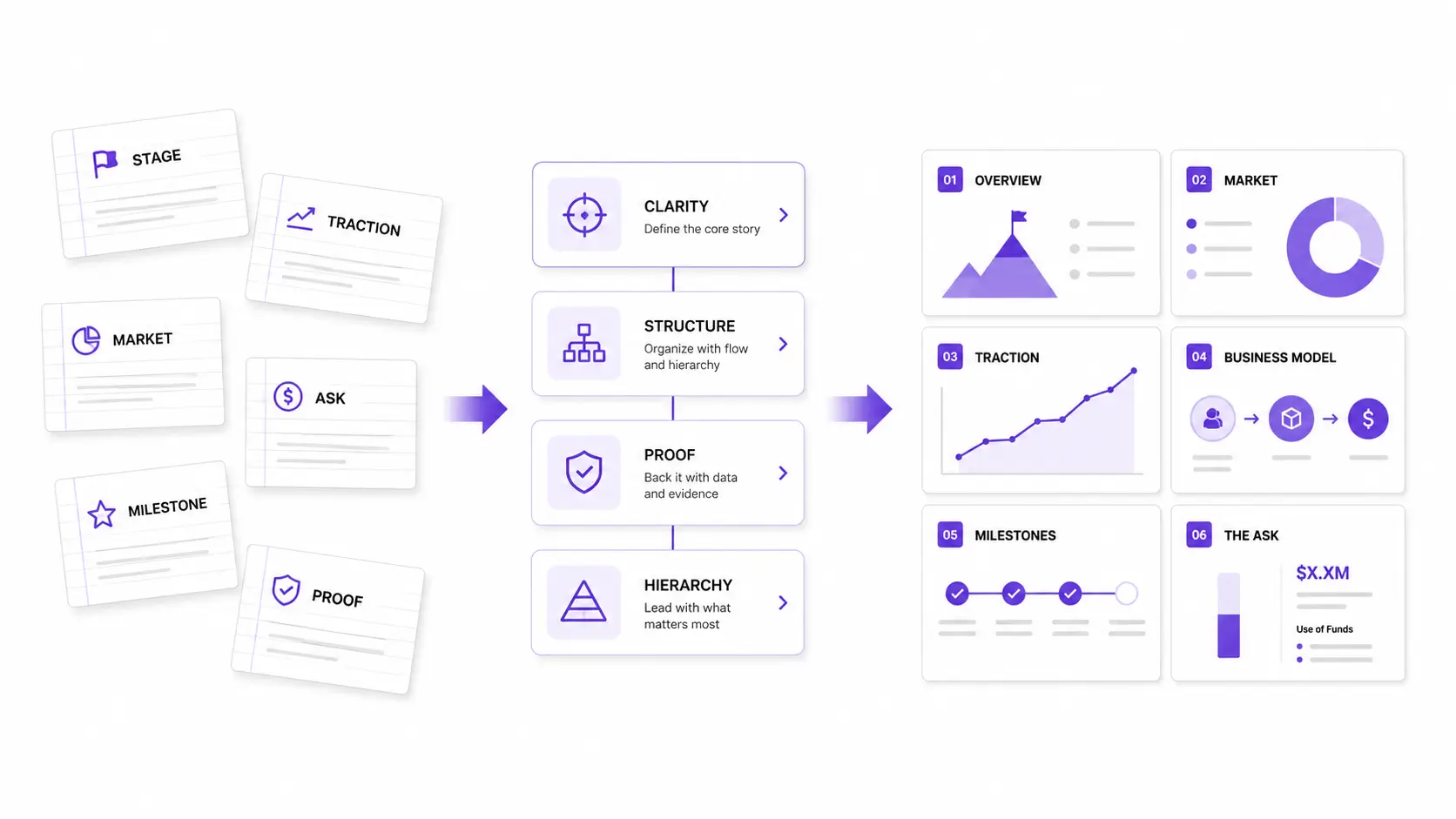
A pre-seed deck must make the opportunity believable. A seed deck must make the business more provable. Design helps, but only when the story, proof, and slide hierarchy are clear. A polished deck with weak logic still leaves investors confused. A strong investor deck should make the stage, traction, market, business model, funding ask, and next milestone easy to understand.
Lynxify helps founders turn scattered business information into investor-ready pitch decks that feel structured, focused, and easier for investors to follow.
Final Answer: What Is the Difference Between Pre-Seed and Seed Funding?
The pre-seed vs seed funding difference is about startup stage, proof, investor expectations, product maturity, and what the pitch deck needs to prove. Pre-seed funding helps founders validate the idea, build early proof, test customer demand, and reach the next milestone.
Seed funding helps founders grow a working product with stronger traction, clearer customer proof, better go-to-market learning, and stronger business model logic. Pre-seed asks whether the opportunity is believable. Seed asks whether the business is becoming provable.
FAQ
Frequently Asked Questions

What is the main difference between pre-seed and seed funding?
The main difference is stage and proof. Pre-seed funding usually supports early validation, customer discovery, MVP development, and first milestones. Seed funding usually supports growth after the startup has stronger proof, such as a working product, traction, revenue signals, customer demand, or clearer go-to-market learning.
Is pre-seed before seed funding?
Yes, pre-seed usually comes before seed funding. It is often the earliest external funding round, although some startups bootstrap and skip it. Pre-seed helps founders validate the idea and build early evidence before raising a larger seed round.
What is pre-seed funding used for?
Pre-seed funding is usually used to validate the problem, build a prototype or MVP, run customer discovery, test demand, hire early team members, and reach the next milestone. The main goal is learning, validation, and early product progress.
What is seed funding used for?
Seed funding is usually used to grow a working product, acquire customers, improve go-to-market, hire key team members, strengthen product development, and prove stronger business potential.
Can a startup skip pre-seed and go straight to seed funding?
Yes, a startup can skip pre-seed and raise seed directly if it already has strong proof. This may happen when founders bootstrap progress, build a working product, secure customers, show revenue, gain traction, or have strong founder credibility.
Do you need revenue to raise pre-seed funding?
Do you need revenue to raise pre-seed funding?
Do you need traction to raise seed funding?
Seed investors usually expect some form of traction, but traction can look different by startup type. It may include revenue, users, retention, pilots, letters of intent, design partners, usage growth, waitlist demand, or customer feedback.
What should be different in a pre-seed vs seed pitch deck?
A pre-seed pitch deck should focus on problem clarity, founder insight, market opportunity, early validation, MVP plan, and next milestone. A seed pitch deck should show stronger traction, working product, customer proof, business model clarity, go-to-market learning, financial logic, and a clearer growth plan.
Featured Blogs
Types of Video Editing: Styles, Cuts, Effects, and Services Explained

Lynxify’s Evolution: From Pitch Decks to a Multidisciplinary Creative Company

Finance Slide in a Pitch Deck: What Investors Want to See
Go-To-Market Slide in a Pitch Deck: Guide & Examples
Market Size Slide in a Pitch Deck: TAM, SAM & SOM
How Many Slides Should a Pitch Deck Have? 10–15 Slides
Business Model Slide: Show Investors How You Make Money

Product Roadmap Slide in a Pitch Deck: What to Show Investors?
Team Slide in a Pitch Deck: What Investors Want to See
Pre-Seed vs Seed Funding: Amounts, Stage & Key Differences
How Long Should a Pitch Deck Be? Slide Count Guide
What Investors Look for in a Pre-Seed Stage Pitch Deck

10 Common Pitch Deck Mistakes Founders Should Avoid Before Investors See the Deck
How Much Does a Pitch Deck Design Cost?
How to Create a Pitch Deck for Investors
Traction Slide in a Pitch Deck: What Investors Want to See
Business Plan vs Pitch Deck: What Should Founders Use?