How Long Should a Pitch Deck Be? Slide Count Guide
Most investor pitch decks should be around 10 to 15 slides, but the right length depends on the deck’s purpose, company stage, audience, and whether it is presented live or sent ahead. A live pitch deck may be shorter, while a send-ahead deck may need more context because the founder is not there to explain every slide.
So, how long should a pitch deck be? Long enough to explain the business clearly, but short enough to keep investors focused. A pitch deck should not tell the entire history of the company. It should create clarity, spark interest, and help move the conversation to the next step.
We have also answer for how many slides a pitch deck should have, so check that one out as well.
Quick Answer: How Long Should a Pitch Deck Be?
A pitch deck should usually be 10 to 15 slides for investor meetings. A live pitch deck may be closer to 10 to 12 slides, while a send-ahead or email pitch deck can be 15 to 20 slides if the extra detail helps the investor understand the business without a presenter.
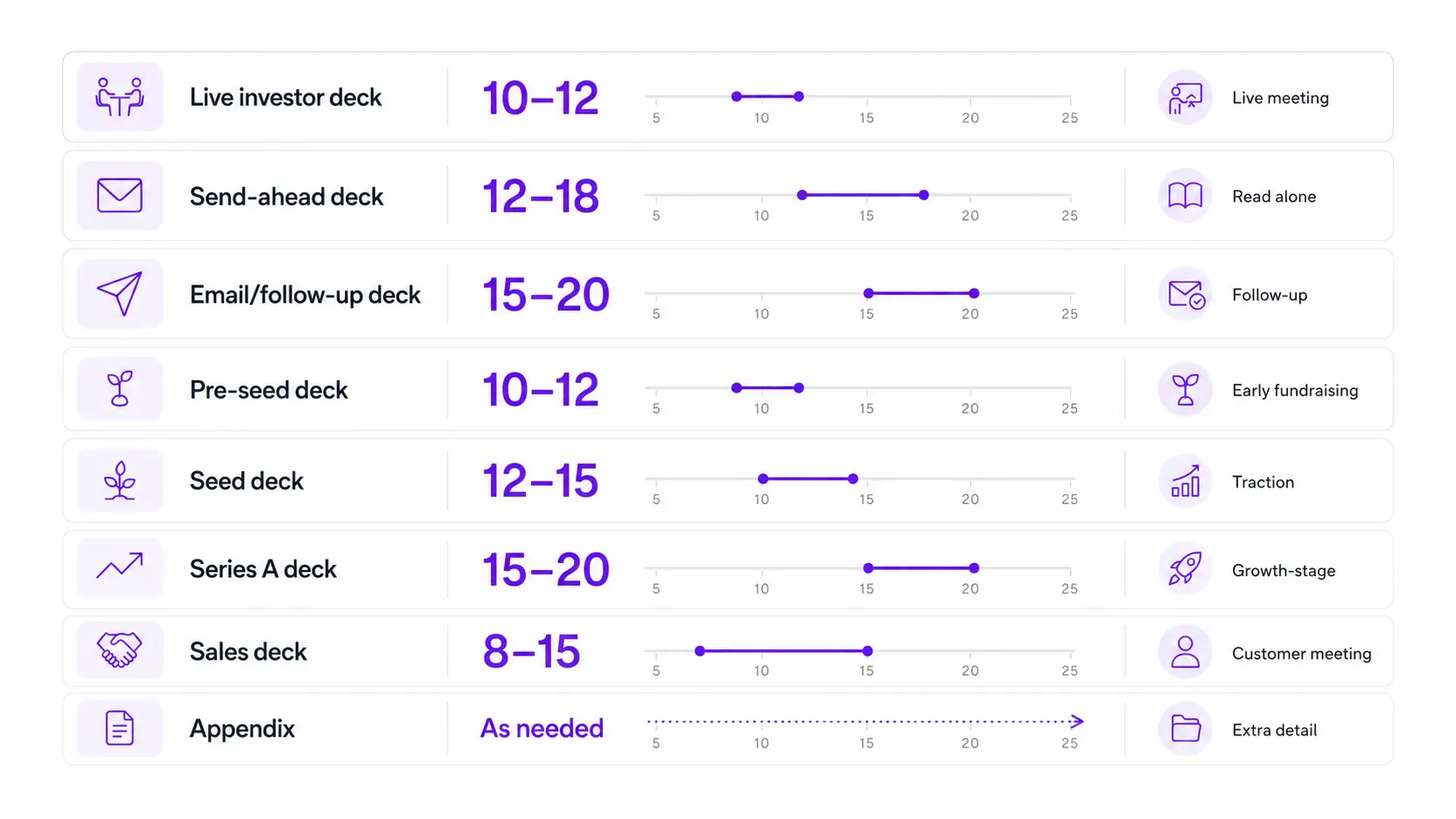
Deck Type | Recommended Length | Best Use |
Live investor pitch deck | 10 to 12 slides | Founder-led investor meetings |
Send-ahead investor deck | 12 to 18 slides | Investors reading without a live explanation |
Email or follow-up deck | 15 to 20 slides | Follow-up after intros, meetings, or investor interest |
Pre-seed pitch deck | 10 to 12 slides | Early fundraising, angel investors, accelerators |
Seed pitch deck | 12 to 15 slides | Fundraising with early traction or validation |
Series A pitch deck | 15 to 20 slides | Growth-stage fundraising with stronger proof |
Sales pitch deck | 8 to 15 slides | Customer meetings, demos, partnerships |
Appendix | As needed | Extra detail outside the core story |
Appendix slides can be longer, but they should not be counted as the core pitch deck. The main deck should stay focused on the story investors need first.
Why Pitch Deck Length Matters More Than Founders Think
Pitch deck length matters because it affects attention, clarity, and investor confidence.
Investors often scan decks quickly. If the deck is too long, the main story can get buried. If it is too short, it may skip important proof, such as traction, business model, market logic, or the funding ask.
The purpose of a pitch deck is not to close the entire fundraising round in one file. Its job is to create enough interest and confidence for the next conversation.
A strong deck should help investors understand:
what problem you solve
who needs the solution
why the market matters
how the business makes money
what proof exists so far
why your team can execute
what funding will help unlock next
The best length is not the longest or shortest version. It is the clearest version.
How Long Should an Investor Pitch Deck Be?
An investor pitch deck should usually be 10 to 15 core slides. The exact number depends on the company stage, traction, market complexity, and whether the deck is being presented live or sent ahead.
Most investor pitch deck slides include:
Title
Problem
Solution
Market
Product
Business Model
Go-To-Market
Competition
Traction
Team
Financials
Ask or Use of Funds
Some decks may also need a “Why Now” slide, roadmap slide, or product demo slide. But the core investor story should stay tight.
A deck can include appendix slides, but those should be used for deeper follow-up. The main investor pitch deck should be easy to scan and easy to present.
If the slide flow still feels unclear, a stronger pitch deck structure can help the main story feel easier to follow.
How Long Is a Pitch Deck for a Live Presentation?
A live pitch deck should usually be 10 to 12 slides because the founder is there to explain the business.
A live deck should support the spoken pitch, not replace it. It should not be packed with paragraphs, tiny charts, or every detail the founder knows. The slides should guide the conversation and help investors follow the story.
Guy Kawasaki’s 10/20/30 rule is useful here because it encourages founders to keep the deck short, readable, and discussion-friendly: 10 slides, 20 minutes, and 30-point font.
Lynxify’s Guy Kawasaki Pitch Deck Guide explains this rule in more detail, but the main idea is simple:
If the founder is speaking live, the deck should stay focused.
How Long Is a Send-Ahead or Email Pitch Deck?
A send-ahead or email pitch deck can be slightly longer because the investor may read it without the founder presenting.
In this format, the deck may need more context, clearer slide titles, short explanations, and simple notes around traction, market size, or financial assumptions. A send-ahead deck is often around 12 to 18 slides, while a follow-up deck may reach 15 to 20 slides if the extra detail is useful.
A strong email pitch deck should include:
clear slide titles
short explanations
contextual captions
simple traction notes
easy-to-read financial or market slides
appendix slides for deeper detail
The goal is still not to explain everything. The goal is to make the business understandable without a live voiceover.
How Long Should a Pre-Seed Pitch Deck Be?
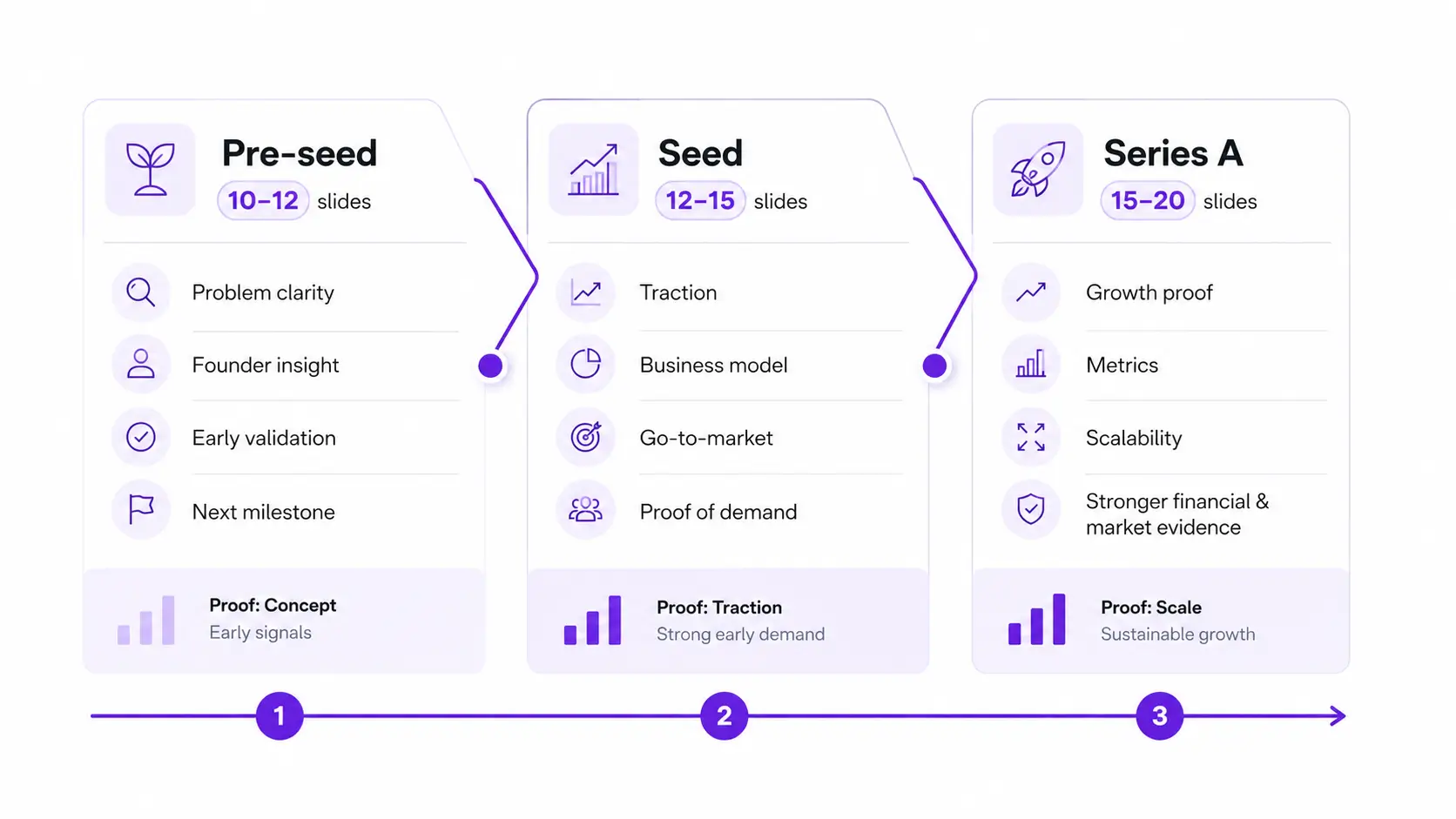
A pre-seed pitch deck should usually be around 10 to 12 slides.
At pre-seed, investors do not expect a fully mature company. They may not expect strong revenue, a large team, or years of traction. But they do expect the deck to explain the problem, founder insight, early validation, and next milestone clearly.
A pre-seed pitch deck should focus on:
problem clarity
founder-market fit
early validation
product direction
market opportunity
next milestone
funding ask
Pre-seed founders do not need to pretend they have mature traction. The deck should show learning, insight, customer understanding, and the next risk that funding will help reduce.
At this stage, pre-seed investors usually care more about founder insight, customer understanding, early validation, and the next milestone than polished growth numbers.
How Long Should a Seed or Series A Pitch Deck Be?
A seed pitch deck is usually around 12 to 15 slides, while a Series A pitch deck may be closer to 15 to 20 slides.
Seed-stage decks often need more proof than pre-seed decks. Investors may expect stronger traction, clearer customer validation, a sharper business model, and a practical go-to-market plan.
Series A decks may need more detail because the company is usually further along. A Series A pitch deck may include more proof around:
revenue growth
customer acquisition
retention
go-to-market channels
team growth
financial logic
unit economics
market expansion
Even when the deck is longer, the core story should still be focused. More slides should mean better understanding, not more clutter.
How Long Is a Sales Pitch Deck?
A sales pitch deck is usually 8 to 15 slides, depending on the buyer, product complexity, and sales process.
A sales deck is different from an investor pitch deck. Investors care about the business opportunity, market, team, traction, and funding logic. Buyers care about their own problem, business outcomes, proof, pricing, and next steps.
A sales pitch deck often focuses on:
customer pain
business outcomes
use cases
proof or case examples
process
implementation
pricing or next step
If the buyer already understands the problem, the deck can be shorter. If the product is complex or the buying team is large, the deck may need more context.
How Long Should Your Synopsis Be for a Pitch Deck?
A pitch deck synopsis should usually be short: one paragraph, 3 to 5 sentences, or about 100 to 150 words.
The synopsis is not the deck. It is a short written summary that introduces the opportunity before someone opens the presentation or after they have reviewed it.
A good pitch deck synopsis should explain:
what the company does
who it helps
what problem it solves
why now
what proof exists
what the founder wants next
Keep it simple. The synopsis should make someone want to read the deck, not replace the deck.
How Long Does It Take to Make a Pitch Deck?
A simple pitch deck can take a few days if the story, content, brand assets, and data are already prepared. A more strategic investor deck may take 1 to 3 weeks depending on research, narrative clarity, slide count, design complexity, financials, revisions, and how much content needs to be shaped.
The timeline depends on the starting point.
A deck is faster to make when:
the slide outline is ready
the founder knows the audience
traction data is organized
financial assumptions are clear
brand assets are available
the story already makes sense
It takes longer when the business story needs content refinement, narrative structure, slide architecture, or data visualization.
What Makes a Pitch Deck Feel Too Long?
A pitch deck feels too long when it repeats ideas, buries the point, or includes information that does not help the next conversation.
The problem is not always slide count. A 12-slide deck can feel long if every slide is crowded. A 20-slide deck can feel clear if every slide has a purpose.
Common reasons decks feel too long include:
repeated points
too much founder background
too many product screenshots
unnecessary market education
overloaded financials
weak slide titles
no clear flow
slides that do not answer investor questions
too much text on every slide
details that belong in the appendix
If a slide does not answer a real investor question, it may not belong in the main deck. Many pitch deck mistakes come from adding more slides instead of making the core story clearer.
What Should Go Into the Appendix?
Appendix slides are useful for details that may be needed later but should not slow down the main story.
The appendix can include:
detailed financial projections
technical architecture
market research
customer case studies
regulatory details
product screenshots
team bios
full competition analysis
extra traction data
product demo notes
deeper unit economics
The appendix can be longer than the main deck because it is not meant to be presented slide by slide. It is there for follow-up questions and deeper investor review.
The main pitch deck should stay focused. The appendix should hold the supporting detail.
A Better Way to Decide Pitch Deck Length
Founders should not only ask, “How many slides should a pitch deck be?” A better question is, “What does this deck need to do?”
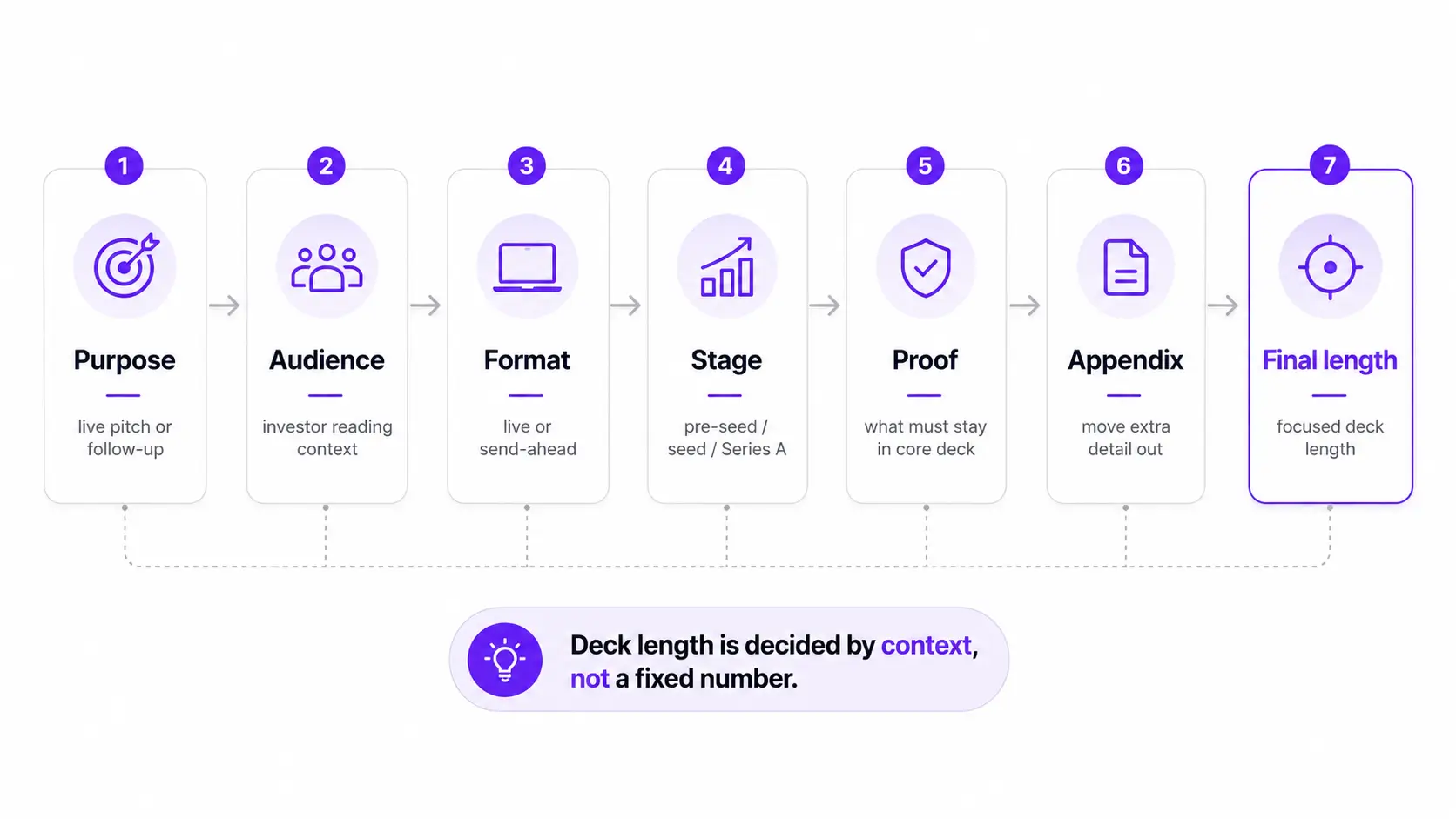
The right pitch deck length depends on purpose, stage, audience, format, and proof.
Question | What It Helps Decide |
What is the purpose of this deck? | Whether it should be short for a live pitch or longer for send-ahead review |
Who will read it? | How much context and explanation the deck needs |
Will I present it live or send it ahead? | Whether the slides should support speech or stand alone |
What stage is the company? | Whether the deck should focus on early validation, traction, or growth proof |
What proof does the investor need? | Which slides must stay in the core deck |
What can move to the appendix? | How to keep the main deck focused |
What does the next meeting need to happen? | What information must be clear enough to create follow-up interest |
This decision framework is more useful than a fixed slide number.
A strong deck is not judged by slide count alone. It is judged by how quickly it explains the business and helps the next conversation happen.
Final Answer: The Right Pitch Deck Length
Most investor pitch decks should be 10 to 15 slides.
Live decks should usually be closer to 10 to 12 slides. Send-ahead or email decks can be 15 to 20 slides if the extra context helps the investor understand the business. Sales decks are often 8 to 15 slides. Appendix slides can be added separately and should not count as the core pitch deck.
The right deck length is not the longest or shortest version. It is the clearest version.
A pitch deck should be long enough to answer the investor’s real questions, but short enough to keep the story focused.
FAQ
Frequently Asked Questions

How many slides should a pitch deck be?
A pitch deck should usually be 10 to 15 slides. Pre-seed decks may be closer to 10 to 12 slides, seed decks are often 12 to 15 slides, and Series A decks may reach 15 to 20 slides. Extra details should usually go into appendix slides.
How long should an investor pitch deck be?
An investor pitch deck should usually be 10 to 15 core slides. It should cover the problem, solution, market, product, traction, team, business model, competition, financials, and funding ask. Appendix slides can be added for deeper detail, but the main investor story should stay focused.
How long should a pitch deck presentation be?
A pitch deck presentation should usually take 10 to 15 minutes, even if the meeting is longer. This gives the founder enough time to explain the business while leaving room for investor questions, objections, and discussion. The slides should support the pitch, not fill the entire meeting.
What is the 10 20 30 rule for pitch decks?
The 10 20 30 rule says a pitch presentation should have 10 slides, last 20 minutes, and use 30-point font or larger. Popularized by Guy Kawasaki, the rule helps founders keep startup presentations short, readable, and easier for investors to discuss.
How long does it take to make a pitch deck?
A simple pitch deck can take a few days if the story, data, brand assets, and slide outline are ready. A more strategic investor deck may take 1 to 3 weeks depending on content clarity, slide count, design complexity, financials, revisions, and how much narrative work is needed.
How long should your synopsis be for a pitch deck?
How long should your synopsis be for a pitch deck?
How long is a sales pitch deck?
A sales pitch deck is usually 8 to 15 slides. The right length depends on the buyer, product complexity, and sales process. Sales decks usually focus on customer pain, outcomes, use cases, proof, process, pricing, implementation, and the next step.
Should appendix slides count in pitch deck length?
Appendix slides should not count as the core pitch deck length. The main deck should usually stay around 10 to 15 slides, while appendix slides can hold detailed financials, technical notes, market research, product screenshots, customer proof, or extra competition analysis for follow-up questions.
Featured Blogs
Types of Video Editing: Styles, Cuts, Effects, and Services Explained

Lynxify’s Evolution: From Pitch Decks to a Multidisciplinary Creative Company

Finance Slide in a Pitch Deck: What Investors Want to See

Go-To-Market Slide in a Pitch Deck: Guide & Examples

Market Size Slide in a Pitch Deck: TAM, SAM & SOM

How Many Slides Should a Pitch Deck Have? 10–15 Slides

Business Model Slide: Show Investors How You Make Money

Product Roadmap Slide in a Pitch Deck: What to Show Investors?

Team Slide in a Pitch Deck: What Investors Want to See

Pre-Seed vs Seed Funding: Amounts, Stage & Key Differences
How Long Should a Pitch Deck Be? Slide Count Guide

What Investors Look for in a Pre-Seed Stage Pitch Deck

10 Common Pitch Deck Mistakes Founders Should Avoid Before Investors See the Deck

How Much Does a Pitch Deck Design Cost?

How to Create a Pitch Deck for Investors

Traction Slide in a Pitch Deck: What Investors Want to See

Business Plan vs Pitch Deck: What Should Founders Use?