


Business Plan vs Pitch Deck: What Should Founders Use?
Founders often hear two pieces of advice early in their startup journey: “write a business plan” and “create a pitch deck.”
Both sound important. Both explain the business. Both can help with strategy, funding, and decision-making. But they are not the same document, and using the wrong one in the wrong situation can slow down conversations with investors, partners, and internal teams.
The real difference in business plan vs pitch deck is simple:
A business plan explains the company in depth.
A pitch deck presents the business clearly, visually, and quickly for decision-making.
One is built for planning. The other is built for persuasion.
For founders, startups, and product teams, knowing when to use each can make your communication sharper, your fundraising process smoother, and your business story easier to understand.
What is a business plan?
A business plan is a detailed written document that explains how a company works, where it is going, and how it plans to grow.
It usually covers the company’s mission, market research, business model, product or service, operations, marketing strategy, financial projections, team structure, and long-term goals.
A business plan is useful when you need depth. It helps founders think through the mechanics of the business, not just the pitch.
A strong business plan usually includes:
Executive summary
Company overview
Market analysis
Target audience
Competitive research
Product or service details
Revenue model
Go-to-market strategy
Operations plan
Team structure
Financial projections
Risks and growth assumptions
The purpose of a business plan is to create a serious internal and external reference document. It is often used for banks, grants, partnerships, internal planning, strategic decisions, and detailed funding conversations.
In simple terms, a business plan answers:
“How will this business operate, grow, and become financially sustainable?”
What is a pitch deck?
A pitch deck is a short visual presentation that explains the business opportunity quickly and clearly.
It is usually used in fundraising, investor meetings, accelerator applications, partnership discussions, and startup competitions. Unlike a business plan, a pitch deck is not designed to explain everything. It is designed to make the right people understand the opportunity fast.
A typical startup pitch deck includes:
Problem
Solution
Market opportunity
Product or service
Business model
Traction
Go-to-market strategy
Competition
Team
Financial highlights
Fundraising ask
Vision
The purpose of a pitch deck in fundraising is to help investors understand the story, opportunity, and potential of the business in a short amount of time.
Investors do not read pitch decks like reports. They scan them. They look for clarity, logic, market size, traction, team strength, and whether the business feels investable.
That is why pitch deck design matters. A strong deck is not just “good-looking slides.” It is a structured business story with clear messaging, strong slide hierarchy, and visual flow.
For founders preparing for investor conversations, working with a professional pitch deck design team can help turn scattered business information into a clear, investor-ready narrative.
What is the main difference between a business plan and a pitch deck?
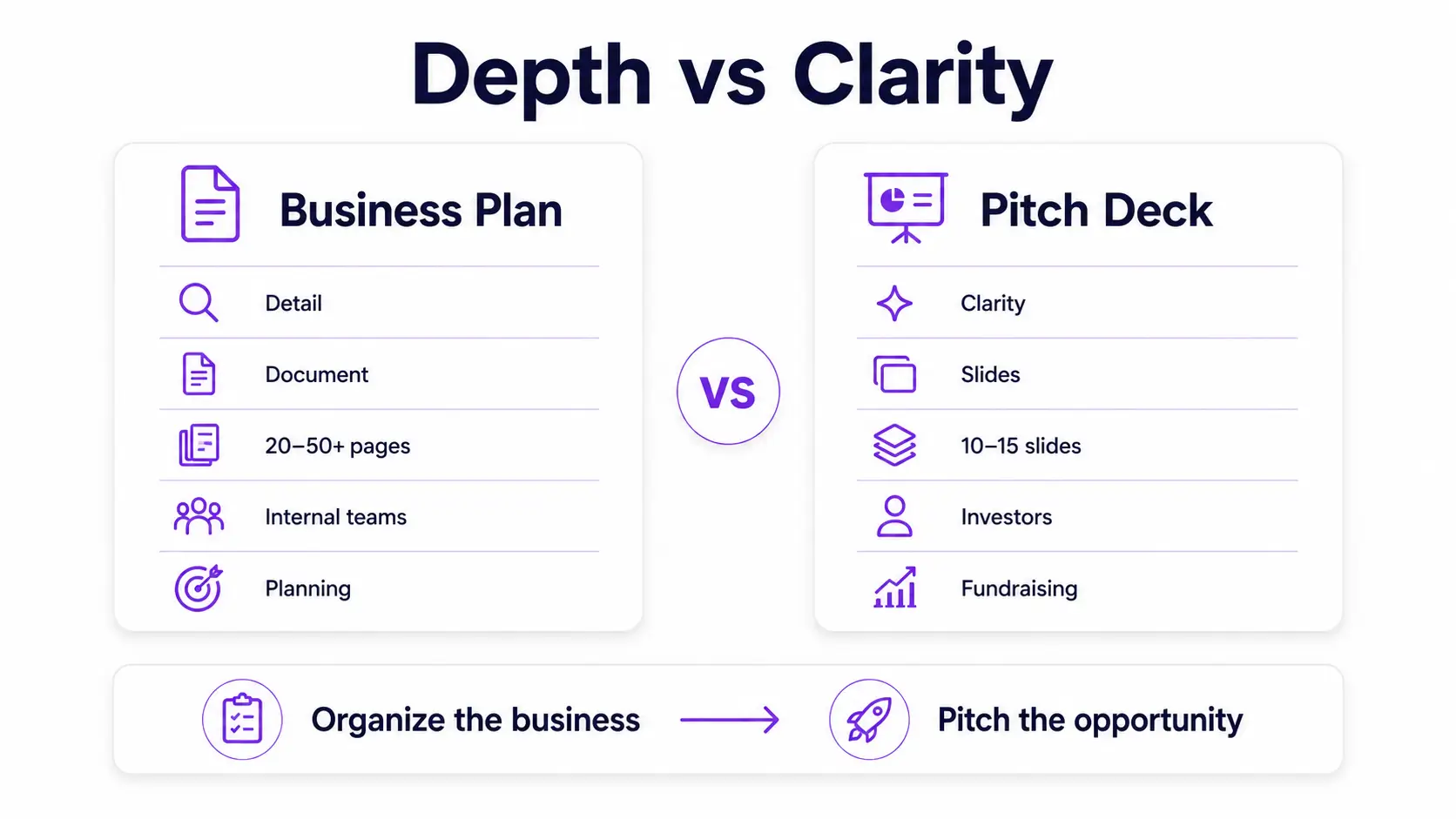
The main difference between a business plan and a pitch deck is depth versus clarity.
A business plan gives detailed information about how the business works. A pitch deck turns the business into a concise story for investors, partners, or decision-makers.
Here is the simplest comparison:
Area | Business Plan | Pitch Deck |
Main purpose | Planning and detailed explanation | Fundraising and quick communication |
Format | Written document | Visual presentation |
Length | Often 20–50+ pages | Usually 10–15 slides |
Audience | Founders, banks, partners, internal teams | Investors, accelerators, advisors, partners |
Style | Detailed and analytical | Clear, visual, persuasive |
Use case | Strategy, operations, funding support | Investor meetings, startup pitches, fundraising |
Focus | Full business logic | Business opportunity and growth story |
Reading behavior | Read in detail | Scanned quickly |
A business plan helps you organize the business.
A pitch deck helps others believe in the opportunity.
Both can support each other, but they should not be written the same way.
When should founders use a business plan?
Founders should use a business plan when they need detailed strategy, operational clarity, or a formal written document.
A business plan is useful before or alongside fundraising because it forces the founder to think through important questions:
Who exactly is the customer?
How will the company make money?
What market problem is being solved?
What are the costs and risks?
What does the growth plan look like?
What assumptions support the financial model?
A business plan is especially useful when:
Applying for a bank loan
Applying for government grants
Building an internal strategy document
Planning operations and hiring
Aligning co-founders
Explaining the business to partners
Preparing long-term financial projections
For early-stage startups, a business plan does not need to be overly long. If the next step is fundraising, a pre-seed pitch deck should turn that early thinking into a clear investor story.
The goal is not to create a document full of corporate language. The goal is to make the business easier to understand and execute.
When should founders use a pitch deck?
Founders should use a pitch deck when they need to explain the business quickly, especially in fundraising or high-stakes business conversations.
A pitch deck is useful when the reader does not have time to study a long document, which is why most investor decks work better at around 10 to 15 slides instead of trying to explain everything at once. So, the deck length is matter very much.
Use a pitch deck when:
Contacting investors
Joining accelerator programs
Presenting to venture capital firms
Pitching angel investors
Explaining the startup to strategic partners
Presenting at demo days
Preparing for fundraising meetings
Sharing a quick business overview
A pitch deck works best when it simplifies complexity. It should not include every detail from the business plan. Instead, it should show the most important points clearly enough that the investor wants a second conversation.
A strong deck helps answer:
“Why this problem, why this solution, why this market, why this team, and why now?”
That is the core of a startup pitch.
What do investors prefer: a pitch deck or a business plan?
Most investors prefer a pitch deck at the first stage because it is faster to review. Investors see many opportunities. They usually do not start by reading a long business plan. They want a clear snapshot of the business, the market, the traction, the team, and the investment opportunity.
A pitch deck gives them that snapshot. However, this does not mean the business plan is useless. If an investor becomes interested, they may ask for deeper information, financial models, customer research, technical details, or strategic plans. So the better question is not:
“Do investors prefer a pitch deck or a business plan?”
The better question is:
“What does the investor need at this stage of the conversation?”
At the first stage, they usually need a pitch deck. During deeper due diligence, they may need business plan details.
Is a business plan enough for fundraising?
A business plan alone is usually not enough for fundraising. It may contain the right information, but it is often too detailed for the first investor conversation. Investors need a quick, clear, and compelling view of the opportunity before they decide whether to spend more time.
A business plan can support fundraising, but it rarely replaces a pitch deck. For fundraising, founders usually need:
A clear investor pitch deck
A strong verbal pitch
Financial assumptions
Market evidence
Traction data
A clear funding ask
Supporting documents for due diligence
The pitch deck opens the door. The business plan supports the deeper conversation.
What are common business plan vs startup deck examples?
Here is a simple example.
A founder building a health-tech startup may use a business plan to explain regulations, operating costs, partnerships, revenue assumptions, patient segments, and long-term expansion.
But in a pitch deck, that same founder would focus on:
The healthcare problem
The market gap
The product solution
Early traction
Why the model can scale
Why the team is credible
How much funding is needed
What the funding will help achieve
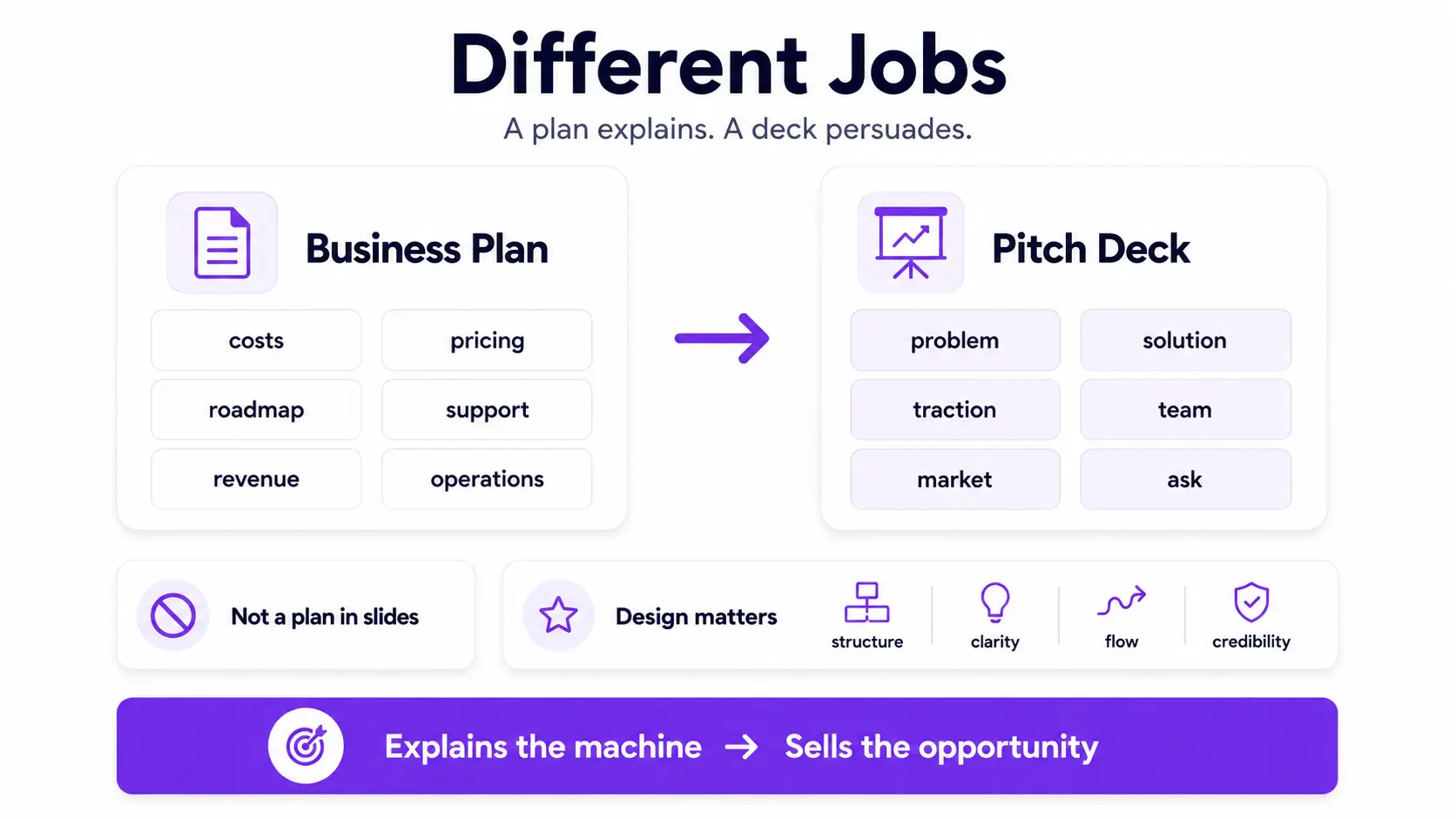
The business plan explains the machine.
The pitch deck sells the opportunity.
Another example:
A SaaS founder may use a business plan to map pricing, sales channels, support costs, churn assumptions, hiring plans, and product roadmap.
The pitch deck would simplify that into the problem, product, market size, traction, business model, growth plan, and funding ask. This is why startup planning docs, pitch deck vs plan discussions matter. Each document has a different job.
What are the biggest misconceptions about pitch decks?
Many founders think a pitch deck is just a shorter business plan. That is one of the biggest mistakes.
A pitch deck is not a compressed report. It is a structured story.
Is a pitch deck just a business plan in slides?
No. A pitch deck should not copy and paste business plan content into slides.
A business plan explains.
A pitch deck selects, simplifies, and persuades.Every slide should have a clear job. If a slide does not help the investor understand the opportunity, it probably does not belong in the deck.
Does a pitch deck need heavy design?
A pitch deck needs clear design, not decoration.
Good pitch deck design improves readability, flow, hierarchy, and confidence. It helps investors understand the business faster. Poor design can make even a strong business feel unclear, early, or unprepared.
What is a business deck?
A business deck is a visual presentation used to explain a company, idea, strategy, product, or investment opportunity.
A pitch deck is one type of business deck, focused specifically on pitching a startup, raising funding, or presenting a business opportunity to investors and decision-makers.
Why does professional pitch deck design improve fundraising communication?
Professional pitch deck design improves fundraising communication because it turns business information into a clear investor story.
Most founders have the information. The harder part is deciding what to show, what to remove, what to simplify, and how to make the story easy to follow.
A professional pitch deck design team helps with:
Slide structure
Investor narrative
Visual hierarchy
Message clarity
Data presentation
Story flow
Brand consistency
Readability
Fundraising positioning
This matters because investors often make early judgments quickly. If the deck feels confusing, overloaded, or visually weak, the business may not get the attention it deserves.
Lynxify has supported pitch deck and investor communication projects across startups, product teams, and growing businesses, with fundraising-related work connected to outcomes such as Necto raising $8M+, Mammogen raising $2M, Satoshi Protocol raising $2M, Parlay raising $1.7M, and ESPROFILER raising £2.8M.
These outcomes do not mean design alone raises capital. Fundraising depends on the business, market, team, traction, and investor fit. But a clear pitch deck can help founders present the opportunity with more confidence, structure, and credibility.
What pitch deck tips should founders follow?
Founders should treat the pitch deck as a decision-making tool, not a design file. The goal is to help investors understand the business quickly and want the next conversation.
Here are practical pitch deck tips for founders:
Start with the problem clearly
Do not make investors guess what problem you solve. Explain the pain, who has it, and why it matters now.
Keep one main idea per slide
A crowded slide weakens the message. Each slide should communicate one clear point. If a slide needs too much explanation, simplify it.
Show traction with context
Traction is stronger when it is easy to understand. Instead of only showing numbers, explain what the numbers prove. Revenue, users, partnerships, waitlists, pilots, retention, and growth signals should connect to investor confidence.
Make the market opportunity believable
Large market numbers alone are not enough. Show the specific segment you are entering, why it is reachable, and how your company can capture value.
Explain the business model simply
Investors should quickly understand how the company makes money. Avoid complicated pricing logic unless it is essential.
Make the funding ask specific
Do not just say you are raising money. Explain how much you are raising, what it will be used for, and what milestone it helps the company reach.
Design for fast reading
Investors scan decks quickly, which is why simple frameworks like the Guy Kawasaki pitch deck rule still help founders keep slides focused, readable, and easy to present.
Is ChatGPT reliable for business pitch decks?
ChatGPT can help with early pitch deck thinking, outlines, rough messaging, and idea organization. But it is not fully reliable for a final investor-ready pitch deck without expert review.
AI tools can generate generic slides quickly, but they may miss investor logic, business nuance, competitive positioning, financial clarity, and visual storytelling.
ChatGPT can help you:
Brainstorm slide structure
Simplify rough content
Draft problem and solution statements
Create early pitch angles
Organize business ideas
But founders should be careful with:
Generic investor language
Unsupported claims
Weak differentiation
Overconfident market statements
Unclear financial logic
Slides that sound polished but say very little
For serious fundraising, AI can support the process, but human strategy, business judgment, and professional deck design still matter.
What is the best way to use both documents together?
The best approach is to use the business plan as the foundation and the pitch deck as the communication tool.
Start with the business plan to clarify the details. Then use the pitch deck to present the most important points in a clear, visual, and persuasive way.
A simple workflow looks like this:
Build the business plan to clarify the model.
Extract the strongest investor-relevant points.
Turn those points into a pitch deck narrative.
Design the slides for fast understanding.
Prepare supporting documents for due diligence.
This gives founders both depth and clarity.
The business plan keeps the team grounded.
The pitch deck helps the market understand the opportunity.
What should founders remember about business plan vs pitch deck?
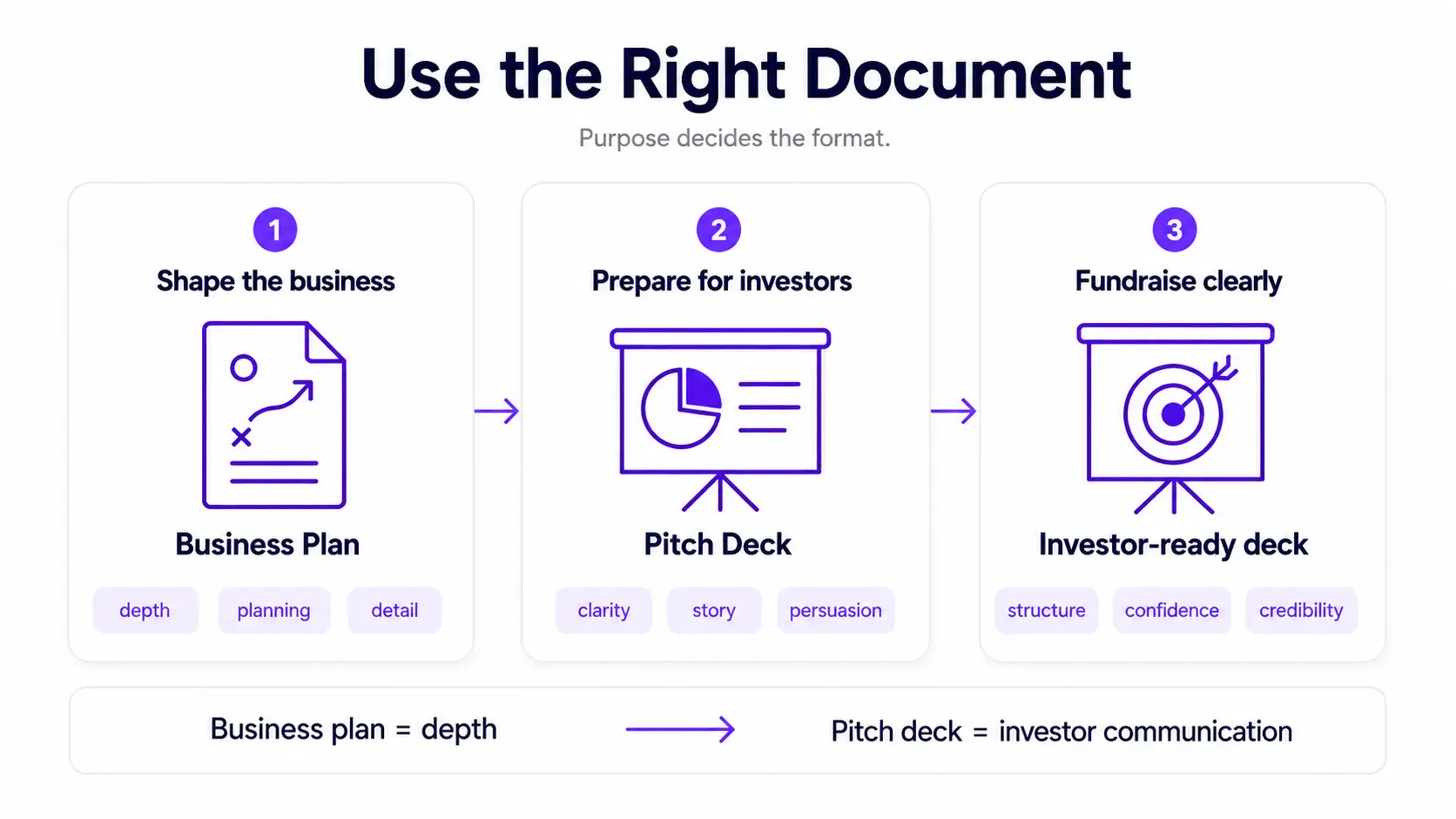
The key difference between a business plan and a pitch deck is purpose. A business plan is for depth, planning, and detail. A pitch deck is for clarity, persuasion, and investor communication. Founders do not need to choose one forever. They need to use the right document at the right stage.
If you are still shaping the business, start with the business plan.
If you are preparing for investors, build the pitch deck.
If you are fundraising seriously, make sure your pitch deck is clear, structured, and professionally designed.
For startups, founders, and product teams preparing for investor conversations, Lynxify helps turn business ideas, traction, and strategy into investor-ready presentations through professional presentation services.
Sum Up



FAQ
Frequently Asked Questions

What is the difference between a pitch deck business plan and a normal business plan?
A pitch deck business plan usually refers to the relationship between both documents. The business plan explains the company in detail, while the pitch deck turns the most important parts into a short visual presentation for investors or stakeholders.
When should you use a pitch deck vs business plan?
Use a business plan when you need detailed strategy, operations, financial planning, or formal documentation. Use a pitch deck when you need to present the business quickly to investors, accelerators, partners, or decision-makers.
What is the purpose of a pitch deck in fundraising?
The purpose of a pitch deck in fundraising is to help investors quickly understand the problem, solution, market opportunity, traction, team, business model, and funding ask. It is designed to create interest and move the conversation forward.
Is a business plan enough for fundraising?
Usually, no. A business plan can support fundraising, but most investors expect a pitch deck first. The pitch deck gives them a quick overview, while the business plan can provide deeper detail later.
What do investors prefer: pitch deck or business plan?
Most investors prefer a pitch deck at the first stage because it is faster to review. If they are interested, they may later ask for business plan details, financial models, or additional documents.
What is a business deck?
What is a business deck?
Is ChatGPT reliable for business pitch decks?
ChatGPT can help with outlines and early messaging, but it should not replace strategic pitch deck writing, investor logic, financial clarity, or professional design. It is useful as a starting point, not as the final fundraising deck.
What should be included in a startup pitch deck?
A startup pitch deck usually includes the problem, solution, market opportunity, product, business model, traction, go-to-market strategy, competition, team, financial highlights, and funding ask.
