Business Model Slide: Show Investors How You Make Money
A business model slide is not just a revenue slide. It is the slide that explains how your startup creates value, captures value, earns revenue, and can grow into a real business.
Investors use the business model slide to understand what you sell, who pays, how pricing works, and whether the model can become repeatable. A strong business model slide in a pitch deck makes the money-making logic simple enough to understand quickly.
The goal is not to show every financial detail. The goal is to help investors believe that customer demand can turn into revenue, margin, and future growth.
Quick Answer: What Is a Business Model Slide in a Pitch Deck?
A business model slide is the pitch deck slide that explains how the startup makes money. It shows what the company sells, who pays, how pricing works, and which revenue streams matter. A strong business model slide connects revenue logic to customer value, market demand, scalability, and future growth. The best version makes the money-making logic easy to understand quickly.
What Is a Business Model Slide?
A business model slide explains the commercial logic behind the startup.
It helps investors understand how customer value turns into revenue. This is important because a startup can have a strong product, a real problem, and a large market, but still feel incomplete if the path to revenue is unclear.
For a startup business model slide, the goal is not to show a full financial model. The goal is to explain the main money-making structure in a simple way.
A business model slide usually answers:
What the Company Sells
Who Pays for It
How Customers Are Charged
How Often Customers Pay
Which Revenue Streams Matter Most
What Pricing Logic Supports the Model
How Revenue Can Grow Over Time
The slide may also include key cost or margin insight if it helps investors understand the model better. But it should not become a spreadsheet, pricing document, or business model canvas. The best business model slide makes one thing clear: how the company turns demand into repeatable revenue.
Why the Business Model Slide Matters to Investors
The business model slide matters because investors want to know whether the startup can become a real business, not only a useful product.
A product may solve a real problem, but investors still need to understand how the company captures value from that solution. If customers love the product but there is no clear way to earn revenue, the business story feels incomplete.
Investors use this slide to understand:
How the Company Makes Money
Who Pays
Why Customers Will Pay
Whether Pricing Makes Sense
Whether the Model Can Scale
Whether Margins Can Improve
Whether Revenue Can Become Repeatable
Whether the Business Model Fits the Market
A strong business model slide helps reduce investor doubt about commercial viability. It shows that the founder has thought beyond the product and understands how the company can grow.
A weak business model slide can create concern even if the product and market look strong. Investors may ask whether the startup understands the buyer, pricing, cost structure, sales motion, and path to revenue.
What Do Investors Look for on a Business Model Slide?
Investors look for simple revenue logic that matches the customer, market, and business model.
They do not need every financial detail on this slide. They need to understand how the company earns money and why that model can work.
Investors often look for:
Clear Revenue Streams
Simple Pricing Logic
Customer Segment Clarity
Who Pays Versus Who Uses
Revenue Quality
Repeatability
Scalability
Gross Margin or Cost Awareness if Relevant
Sales Motion
Market Fit
Future Expansion Potential
Pricing Confidence
Connection to Traction or Customer Demand
The business model should feel believable for the category. A SaaS startup may need to show subscription logic. A marketplace may need to show take rate or transaction revenue. A fintech startup may need to explain transaction fees, subscription, interchange, lending spread, or another financial mechanism.
The slide should answer one question clearly: why can this company make money in this market?
What Should You Include on a Business Model Slide?
A business model slide should include the most important information investors need to understand how revenue works.
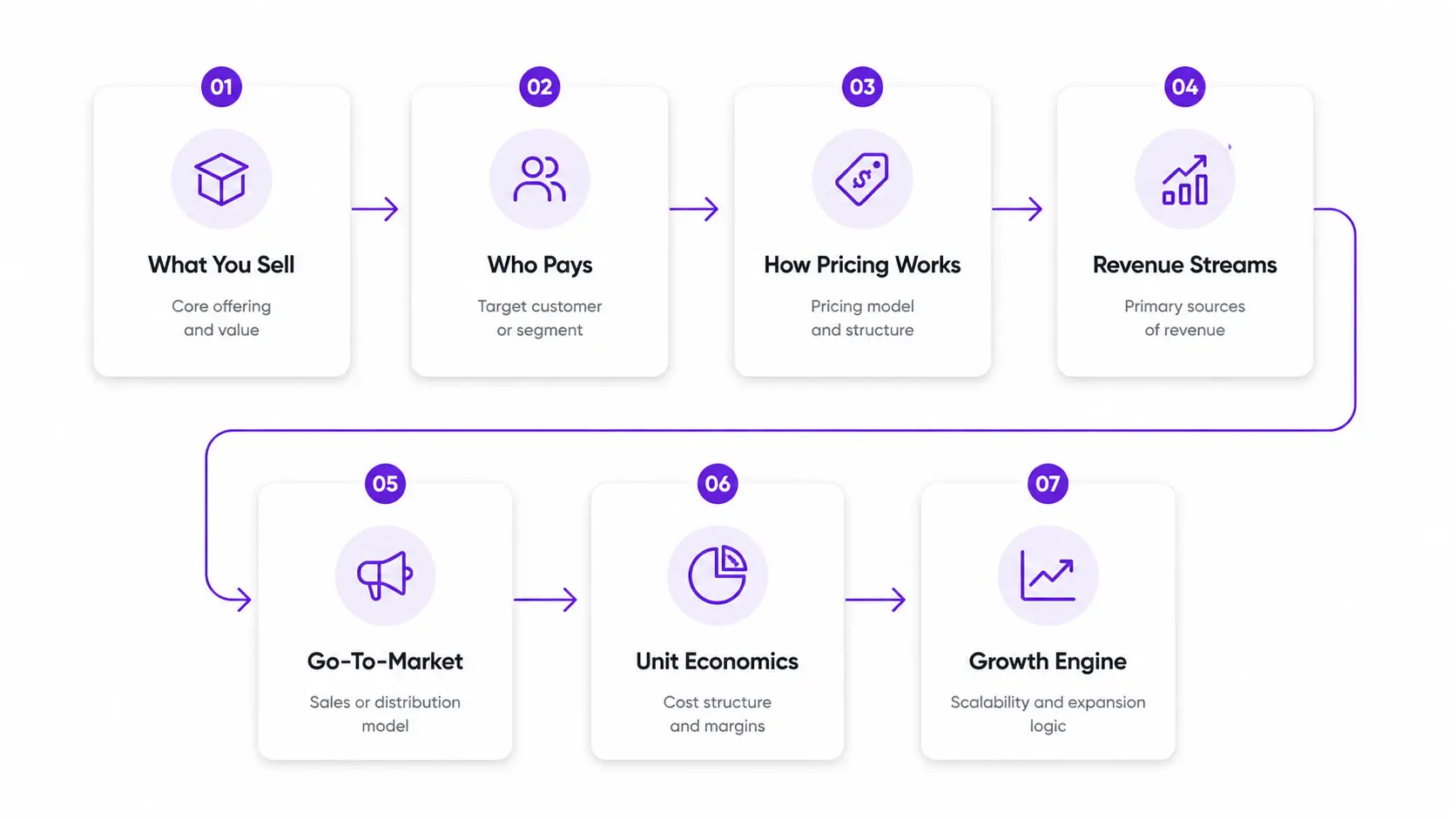
A clear structure usually includes:
What you sell
Who pays
How pricing works
Main revenue streams
Sales or distribution model
Key cost or margin insight if relevant
Growth or expansion logic
The slide should show the business model clearly, not overload investors with financial projections.
A simple structure can work well:
Element | What to Show |
Customer | Who buys or pays |
Offer | What the company sells |
Pricing | How customers are charged |
Revenue stream | Where revenue comes from |
Growth lever | How revenue can increase over time |
For example, a B2B SaaS startup may show customer segment, subscription tiers, annual contracts, expansion revenue, and enterprise sales motion.
A marketplace may show buyer and seller sides, transaction flow, take rate, and repeat usage.
A consumer app may show freemium, subscription, in-app purchase, advertising, or creator monetization.
The key is focus. Show the main model first. Secondary revenue streams can be mentioned only if they are realistic and relevant.
Business Model Slide vs Revenue Slide
A business model slide and a revenue slide are not the same.
A business model slide explains how revenue is created. A revenue slide shows revenue numbers, performance, projections, or growth. A financials slide usually goes deeper into costs, forecasts, runway, margins, and assumptions.
Slide Type | Main Purpose | Best Use |
Business model slide | Explain how the company makes money | Showing the core revenue logic |
Revenue slide | Show revenue performance or revenue growth | Showing historical or current revenue progress |
Financials slide | Show projections, costs, runway, margins, and assumptions | Explaining financial planning and future expectations |
A business model slide explains the logic. A financial slide explains the numbers. A traction slide may show proof that the model is starting to work.
For example, a traction slide may show growing paid customers, while the business model slide explains how those customers generate sustainable revenue. Together, they show both market validation and commercial viability.
Common Revenue Models to Show on a Business Model Slide
Founders should show the revenue model that actually fits the business. Do not include every possible revenue model just to make the company look bigger.
Revenue Model | How It Works | Best For |
Subscription | Customers pay monthly or annually | SaaS, media, memberships, software tools |
Usage-based | Customers pay based on usage, volume, seats, or activity | AI tools, infrastructure, fintech, APIs |
Transaction fee | Company earns a fee per transaction | Fintech, payments, booking platforms |
Commission | Company earns a percentage from sales or deals | Marketplaces, agencies, platforms |
Licensing | Customers pay to use technology, content, or IP | Software, healthcare, enterprise tools |
Freemium | Free product leads to paid upgrades | SaaS, consumer apps, productivity tools |
Marketplace take rate | Platform takes a percentage of GMV | Two-sided marketplaces |
Advertising | Revenue comes from advertisers or sponsors | Media, consumer apps, creator platforms |
Hardware plus software | Hardware sale plus recurring software or service | IoT, healthtech, devices, enterprise hardware |
Services plus recurring revenue | Service delivery plus monthly or retained revenue | B2B services, agencies, productized services |
Enterprise contract | Customers pay through large contracts | B2B SaaS, enterprise software, infrastructure |
One-time purchase | Customers pay once for a product or service | Consumer products, tools, digital products |
The model should match customer behavior. If customers need ongoing value, subscription may make sense. If value depends on volume, usage-based pricing may fit better. If the company connects buyers and sellers, a take rate or commission may be more logical.
SaaS Business Model Slide: What to Show
A SaaS business model slide should usually show how the company earns recurring revenue.
SaaS investors often want to understand pricing, customer segment, retention logic, sales motion, and how the model can expand over time.
A SaaS business model slide may include:
Monthly or Annual Subscription
Pricing Tiers
Paid Users or Customers
ARPA or ARPU if Relevant
Retention
Churn Awareness
Expansion Revenue
Customer Acquisition Motion
Gross Margin Awareness
Enterprise Versus Self-Serve Motion
Do not turn the SaaS business model slide into a full financial model. The goal is to make the pricing and revenue logic clear.
A hypothetical SaaS pricing structure might show:
Plan | Customer Type | Pricing Logic |
Small Team | Small teams getting started | Lower monthly subscription |
Growth Plan | Growing teams with more usage | Higher plan with more seats or features |
Enterprise Plan | Larger organizations | Custom pricing, support, controls, or integrations |
This type of structure helps investors understand how revenue can grow from smaller customers to larger accounts.
The slide should also make the value clear. Customers do not pay for “features.” They pay because the product solves a workflow problem, saves time, improves revenue, reduces risk, or creates a better business outcome.
Business Model Slide Examples by Startup Type
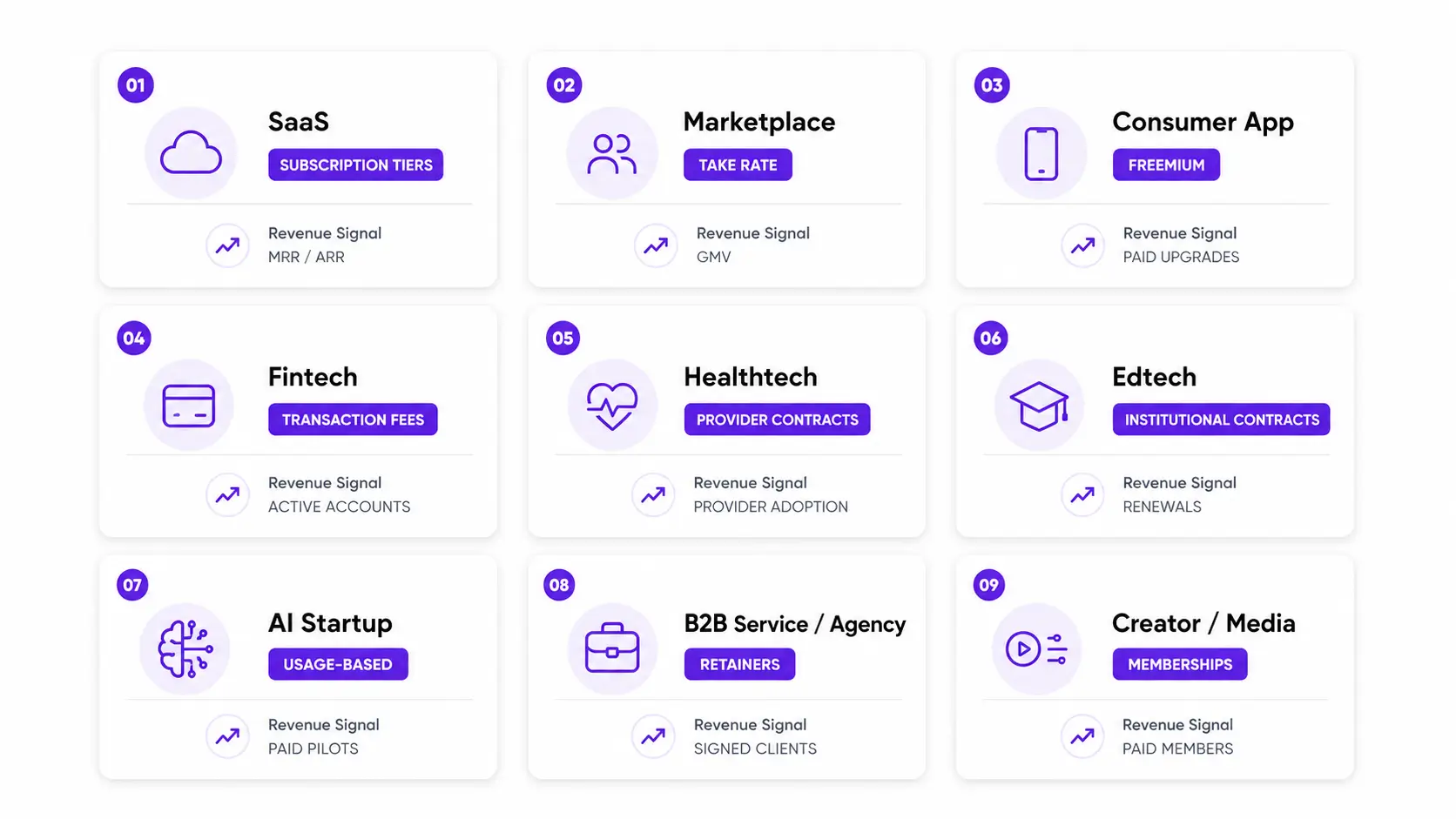
Different startups need different business model slides. A SaaS model, marketplace model, fintech model, and AI model should not all be explained the same way.
Startup Type | What the Business Model Slide Should Emphasize | Useful Revenue Signals |
SaaS | Subscription tiers, retention, expansion revenue, customer size | Paid customers, MRR, ARR, churn, expansion revenue |
Marketplace | Take rate, GMV, transaction volume, supply and demand balance | GMV, repeat transactions, active buyers, active sellers |
Consumer app | Freemium, subscription, in-app purchase, advertising, retention | Active users, paid upgrades, engagement, retention |
Fintech | Transaction fees, interchange, subscription, lending spread, compliance cost awareness | Active accounts, transaction volume, retained users |
Healthtech | Subscription, licensing, provider contracts, reimbursement or enterprise sales | Pilot customers, signed interest, provider adoption |
Edtech | Subscription, institutional contracts, course fees, certification, community revenue | Active learners, completion, renewals, school or company contracts |
AI startup | Usage-based pricing, subscription, enterprise contracts, workflow value | Paid pilots, usage depth, enterprise interest |
B2B service or agency-style startup | Project fees, retainers, recurring services, productized delivery | Signed clients, repeat customers, pipeline, margins |
Creator or media startup | Sponsorship, subscription, advertising, memberships, product sales | Audience engagement, paid members, sponsor interest |
The best business model slide explains the model in the language of the business. Do not force a SaaS-style model onto a marketplace. Do not make a fintech model sound like a consumer app. The commercial logic should feel natural for the market.
Business Model Slide Examples by Startup Stage
A business model slide should change as the startup matures.
At pre-seed, the model may still include assumptions. At seed, investors usually expect more proof. At Series A, the business model should show stronger repeatability, revenue quality, and scalability.
Startup Stage | What the Slide Should Emphasize | How to Present It |
Pre-seed | Planned pricing, customer segment, early assumptions, business logic | Show how the company expects to make money and what will be tested |
Seed | Pricing tests, paid pilots, early customers, revenue signals, customer demand | Show early proof that customers may pay and the model can work |
Series A | Repeatability, revenue quality, margins, expansion, scalable sales motion | Show how the model supports growth and future scale |
A pre-seed business model slide may show planned pricing and early assumptions. That is acceptable if the founder is honest about what has been tested and what has not. A seed business model slide should usually show early proof, such as paid pilots, customer demand, pricing tests, retained users, or revenue signals.
A Series A business model slide should show repeatability, margins, expansion, and a clearer path to scale. The amount of evidence investors expect also changes as startups move from pre-seed to seed funding, making the business model progressively more important as validation increases.
How Much Detail Should a Business Model Slide Show?
A pitch deck business model slide should be clear but not overloaded.
It should show enough detail to explain how the company makes money, but not so much that the slide becomes a financial model.
A good business model slide should:
Show the Main Revenue Logic
Explain Who Pays
Explain What They Pay For
Show Pricing Simply
Separate Primary and Secondary Revenue Streams
Avoid Every Pricing Edge Case
Avoid Full Spreadsheets
Avoid Too Many Revenue Streams
Avoid Projections That Belong on the Financials Slide
Use Simple Visuals
Show the Main Logic First
If investors need a long explanation to understand how the company makes money, the slide needs simplifying.
The founder should be able to explain the business model in one clear sentence before going into details.
For example:
“We sell annual subscriptions to mid-market finance teams, with expansion revenue from additional seats and advanced reporting modules.”
That is clearer than listing every future pricing idea on one slide.
Where Should the Business Model Slide Go in a Pitch Deck?
The business model slide usually works best after the product, traction, or market section.
If the model is simple, it may come after the solution or product slide. This helps investors understand how the product turns into revenue early in the deck.
If the model needs proof, it may work better after the traction slide. This lets investors see customer demand before they evaluate pricing or revenue logic.
If pricing is central to the opportunity, the business model slide may appear before financials so the numbers have context.
A simple placement guide:
Situation | Best Placement |
Business model is simple | After solution or product |
Pricing needs proof | After traction |
Revenue logic depends on market size | After market |
Model supports financial projections | Before financials |
Business has multiple revenue streams | After product and before financials |
Place the business model slide where it helps investors understand how the startup turns customer demand into revenue, not where a template says it belongs.
A strong business model slide works best when it fits naturally into the overall pitch deck structure, rather than being treated as a standalone revenue slide.
How to Design a Business Model Slide
A business model slide should make the revenue logic easy to understand in seconds.
From Lynxify’s perspective, the design should clarify the value exchange between customer and company. It should not feel like a dense spreadsheet or a complicated pricing document.
Good business model slide design usually follows these principles:
Use a Simple Revenue Flow
Show Customer to Company Value Exchange
Use Clear Pricing Blocks
Avoid Too Much Text
Avoid Too Many Arrows
Show the Main Revenue Stream First
Separate Primary and Secondary Revenue Streams
Use Icons Carefully
Avoid Tiny Financial Tables
Make the Investor Takeaway Clear in the Headline
Whether the business model slide is designed in PowerPoint, Google Slides, or another presentation tool, the goal is the same: make the revenue logic easy to understand.
A hypothetical headline could be:
“Subscription revenue with expansion from team plans to enterprise accounts”
That headline explains the model before the investor studies the visual.
Avoid a slide title like “Business Model” with five boxes, seven arrows, and no clear takeaway. The headline should help investors understand the logic immediately.
Business Model Slide Best Practices
A strong business model slide should make investors think, “This company understands how value becomes revenue.”
Best practices include:
Lead With How the Company Makes Money
Show Who Pays
Connect Pricing to Customer Value
Keep Revenue Streams Focused
Show Scalability Without Hype
Separate Current Model From Future Model
Avoid Unsupported Revenue Claims
Show Cost Awareness if Relevant
Connect the Model to Traction When Possible
Make the Model Easy to Explain in One Sentence
The slide should be specific, not vague.
“Subscription revenue from businesses” is a start, but it may not be enough. “Annual subscription sold to HR teams, priced by employee count” is clearer because it explains who pays and how pricing works.
If there are future revenue streams, separate them from the current model. Investors need to know what is working now, what is being tested, and what is only a future possibility.
Common Business Model Slide Mistakes to Avoid
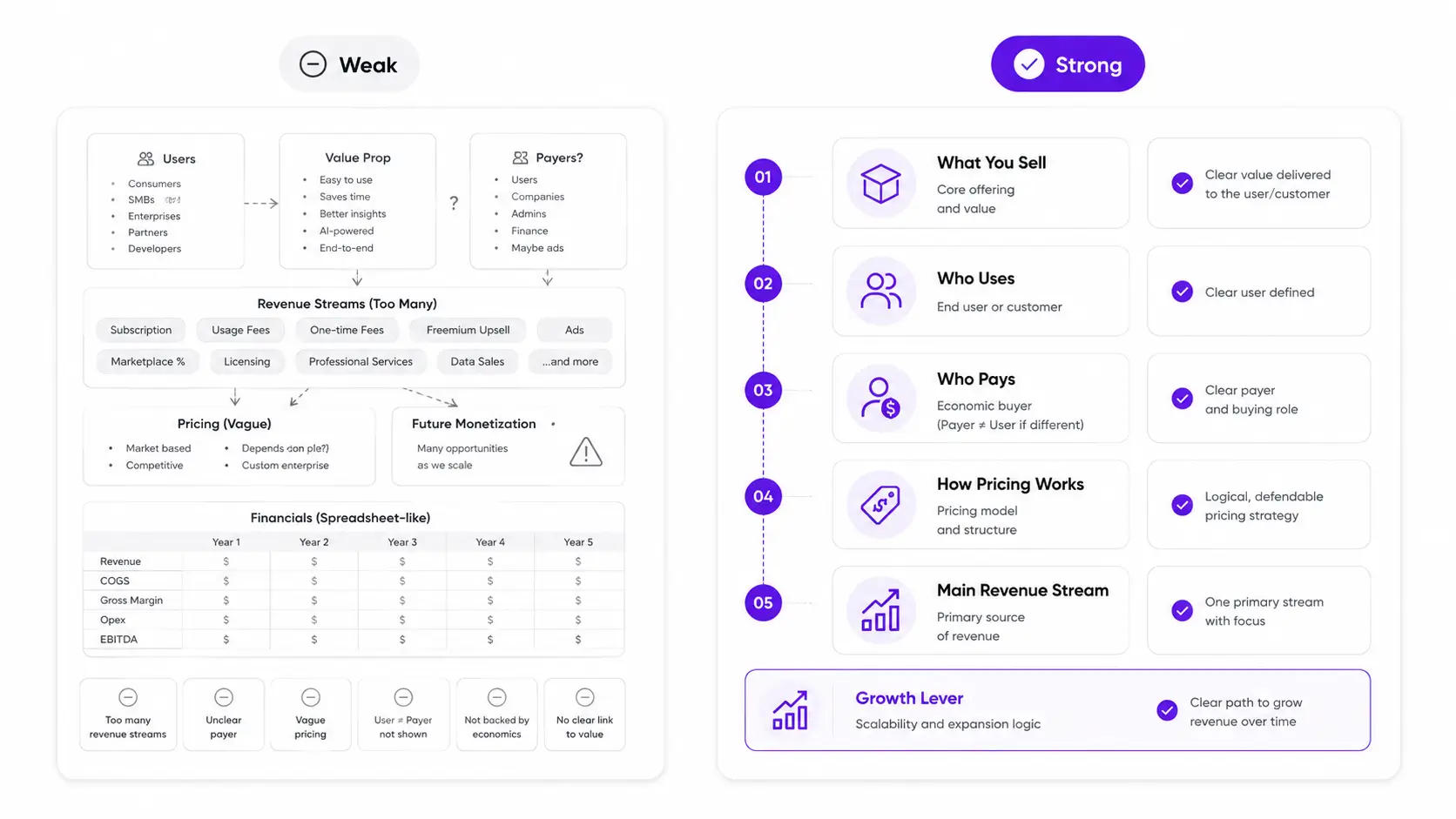
The most common business model slide mistake is showing too many revenue streams before the core model is clear.
A business model slide should simplify the commercial logic. It should not make the business feel unfocused.
Common mistakes include:
Showing Too Many Revenue Streams
Making the Model Too Complex
Using Vague Pricing
Not Explaining Who Pays
Confusing User With Customer
Ignoring Cost Drivers
Showing Projections Instead of Model Logic
Making Unsupported Margin Claims
Using a Business Model Canvas as the Slide
Copying Famous Startup Models Without Adapting Them
Including Future Revenue Streams That Are Not Validated
Hiding Monetization Because It Is Early
Making the Slide Look Like a Spreadsheet
Not Connecting Pricing to Customer Value
Confusing users with customers is especially common. In some businesses, the user and the payer are the same. In others, they are different.
For example, a student may use an edtech product, but the school, parent, or employer may pay. A consumer may use a free app, but advertisers or sponsors may be the customer.
The slide should make that difference clear.
Unclear pricing or confusing revenue logic is one of the most common pitch deck mistakes because it leaves investors questioning how the business will actually grow.
How to Talk About the Business Model Slide During a Pitch
Do not read every pricing detail during the pitch.
Lead with how the company makes money. Explain who pays, why they pay, how often they pay, and why the model can grow.
Then connect the model to customer value, traction, pricing tests, or sales learning.
Instead of saying:
“We charge customers monthly.”
Say something more useful:
“Customers pay a monthly subscription because the product solves an ongoing workflow problem, and our next step is testing expansion pricing for larger teams.”
The second version explains why the model fits the customer behavior.
When presenting the business model slide, be ready to answer:
Who Pays
What They Pay For
How Pricing Was Chosen
Whether Customers Have Tested the Price
What Costs Matter
How Margins May Improve
How Revenue Can Become Repeatable
What Assumptions Still Need Validation
The business model slide should make investors confident in the commercial logic, not overwhelmed by pricing details.
What Slides Should Be in a Pitch Deck?
A standard pitch deck often includes cover, problem, solution, market, product, traction, business model, go-to-market, competition, team, financials, roadmap, and ask.
The exact order depends on the startup stage, business model, investor audience, and strength of proof. Some decks may introduce the business model early if revenue logic is central to the story. Others may wait until after traction if customer proof makes the model easier to believe.
For a full slide-by-slide structure, Lynxify’s guide on How to Create a Pitch Deck for Investors explains how the full deck should flow.
Final Answer: What Makes a Strong Business Model Slide?
A strong business model slide shows how the startup makes money and why that model can work. It should not show every financial detail. It should explain what the company sells, who pays, how pricing works, which revenue streams matter, and how the model can scale.
The slide should make the startup’s commercial logic easy to trust. Investors should understand how customer value becomes revenue, why the pricing fits the market, and how the model can grow over time.
Even a strong revenue model can lose its impact if investors struggle to understand it. Clear structure, visual hierarchy, and concise storytelling make the commercial logic much easier to evaluate. And this much quality and understanding of the business is only done by an experienced pitch deck company not Ai. So, make sure to give proper thought to hire someone.
FAQ
Frequently Asked Questions

What is a business model slide in a pitch deck?
A business model slide explains how a startup makes money. It shows what the company sells, who pays, how pricing works, and why the revenue model can grow over time.
What should a business model slide include?
A strong business model slide typically includes the target customer, product or service, pricing model, primary revenue streams, sales approach, and the main growth driver. The goal is to make the revenue logic easy for investors to understand.
Why is the business model slide important to investors?
Investors use the business model slide to evaluate whether the company has a realistic path to generating repeatable revenue. It helps them understand if the pricing, customers, and revenue model fit the market opportunity.
Is a business model slide different from a financials slide?
Yes. A business model slide explains how the company earns revenue, while a financial slide presents forecasts, costs, margins, runway, and other financial projections.
Where should the business model slide appear in a pitch deck?
Most startups place the business model slide after the product or traction section and before financials. The exact position depends on when the revenue model becomes easiest for investors to understand.
What are the most common business model slide mistakes?
What are the most common business model slide mistakes?
Should early-stage startups include a business model slide?
Yes. Even pre-seed startups should explain how they expect to generate revenue. Investors understand that assumptions may evolve, but they still want to see a credible commercial strategy.
How detailed should a business model slide be?
Keep it simple. Focus on the primary revenue model, pricing approach, customer, and growth logic. Detailed forecasts and financial assumptions belong on the financials slide, not the business model slide.
Featured Blogs
Types of Video Editing: Styles, Cuts, Effects, and Services Explained

Lynxify’s Evolution: From Pitch Decks to a Multidisciplinary Creative Company

Finance Slide in a Pitch Deck: What Investors Want to See

Go-To-Market Slide in a Pitch Deck: Guide & Examples

Market Size Slide in a Pitch Deck: TAM, SAM & SOM

How Many Slides Should a Pitch Deck Have? 10–15 Slides
Business Model Slide: Show Investors How You Make Money

Product Roadmap Slide in a Pitch Deck: What to Show Investors?

Team Slide in a Pitch Deck: What Investors Want to See

Pre-Seed vs Seed Funding: Amounts, Stage & Key Differences

How Long Should a Pitch Deck Be? Slide Count Guide

What Investors Look for in a Pre-Seed Stage Pitch Deck

10 Common Pitch Deck Mistakes Founders Should Avoid Before Investors See the Deck

How Much Does a Pitch Deck Design Cost?

How to Create a Pitch Deck for Investors

Traction Slide in a Pitch Deck: What Investors Want to See

Business Plan vs Pitch Deck: What Should Founders Use?