Traction Slide in a Pitch Deck: What Investors Want to See
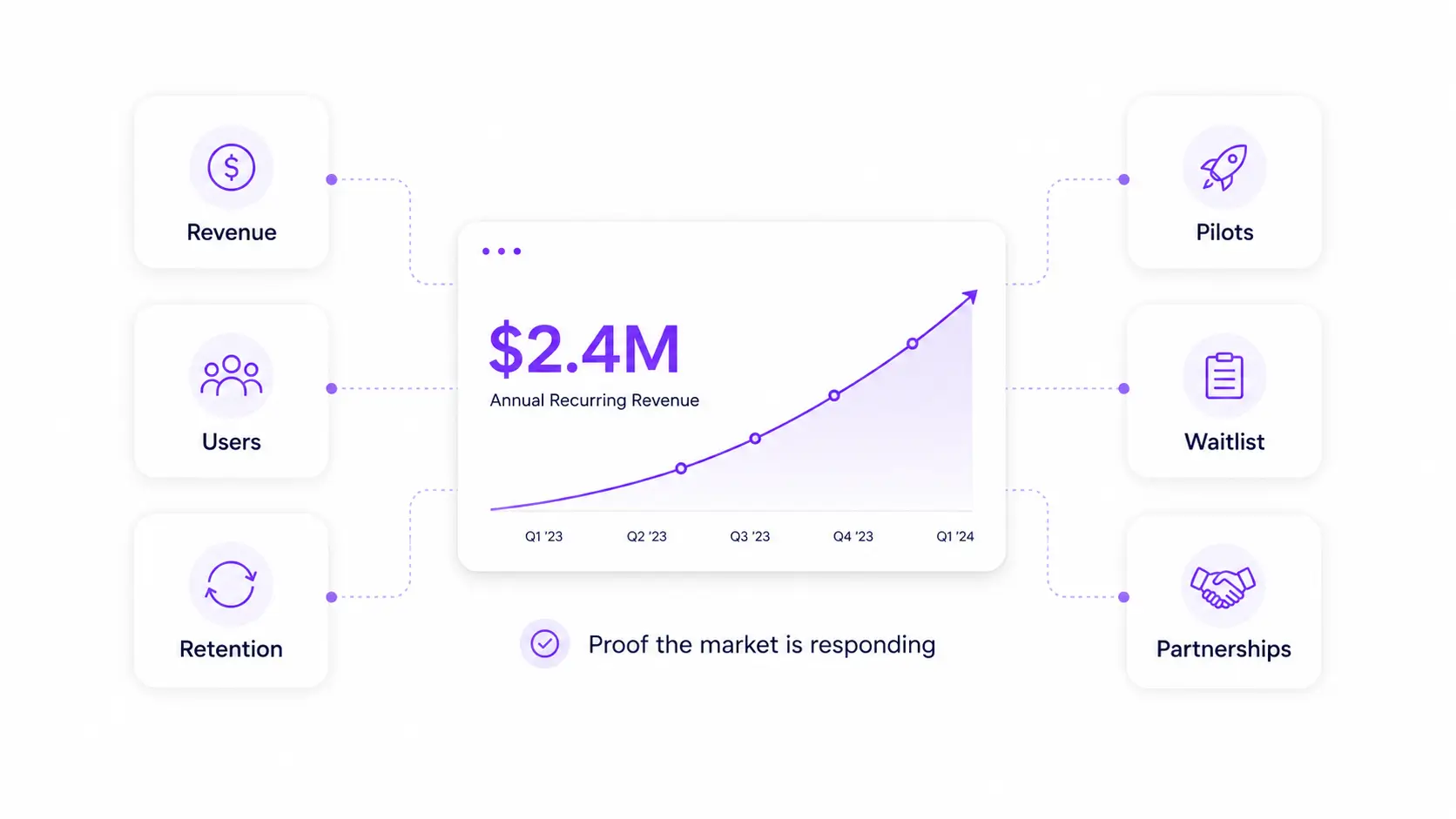
A traction slide is not just a place to show big numbers. It is the slide that proves the market is responding to your startup.
Investors do not only care about the size of the number. They care about what the number proves. A small but meaningful signal can be stronger than a large metric with no context. Showing real-world customer engagement is the most definitive way to prove you are actively capturing your serviceable obtainable market instead of just guessing its potential.
The best traction slide shows the right evidence for the startup’s stage, business model, and investor audience. For one company, that evidence may be revenue. For another, it may be retention, pilots, waitlist quality, usage growth, customer feedback, or signed interest.
Quick Answer: What Is a Traction Slide in a Pitch Deck?
A traction slide is the pitch deck slide that shows evidence your startup is making progress.
It can include revenue, user growth, retention, pilots, waitlists, partnerships, customer feedback, letters of intent, or engagement. The purpose is to prove that the market is responding. The best traction slide makes the strongest signal easy to understand quickly.
What Is a Traction Slide?
A traction slide is the slide in a pitch deck that shows startup momentum.
It gives investors evidence that the business is moving beyond theory. Instead of only saying the problem is real or the product matters, the traction slide shows that customers, users, partners, or the market are reacting.
This slide can help reduce investor risk because it supports the business story with proof.
A traction slide may show:
proof of demand
early validation
customer interest
revenue growth
product usage
retention
partnerships
pilot activity
market response
A traction slide is not only for startups with revenue. Pre-revenue startups can still show traction if the signals are credible and connected to market demand.
For example, a pre-seed founder may not have meaningful revenue yet, but they may have strong pilot interest, a high-quality waitlist, design partners, repeated product usage, letters of intent, or customer discovery that clearly supports the business case.
The key is honesty. The traction slide should show real progress, not make weak signals look stronger than they are.
What Does Traction Mean in a Pitch Deck?
Traction in a pitch deck means measurable or credible proof that the startup is progressing.
It shows that customers, users, partners, or the market are responding to the product, idea, or offer. If you are wondering what does traction mean in a pitch deck, the simplest answer is this: traction is evidence that the business is not just an idea.
Traction can include:
revenue
MRR
ARR
active users
retention
growth rate
waitlist quality
pilot customers
letters of intent
partnerships
customer feedback
usage growth
engagement
sales pipeline
The number matters less than what the number proves.
For example, 500 active users may be more meaningful than 20,000 signups if those 500 users return often, give strong feedback, and show real willingness to pay. A traction slide should help investors understand why the signal matters.
Why the Traction Slide Matters to Investors
The traction slide matters because investors use it to judge whether the startup is reducing risk.
Every early-stage startup has risk. There may be product risk, market risk, execution risk, business model risk, or timing risk. The traction slide helps show which risks are starting to reduce.
A strong traction slide can show:
proof of demand
proof of execution
proof of customer interest
proof of repeatability
proof that the market timing may be right
If the rest of the deck claims a large opportunity, the traction slide helps support that claim. It shows whether the market is actually reacting.
A weak traction slide can create doubts, especially if the founder claims the market is ready but does not show proof. Investors may wonder whether the problem is urgent, whether users care, or whether the business can grow.
The purpose is not to impress with noise. The purpose is to make momentum clear.
What Do Investors Look for on a Traction Slide?
Investors look for real progress that matches the startup’s stage and business model.
They do not need every metric. They need the right proof.
Investors often look for:
real progress, not surface-level activity
metrics that match the business model
growth over time
customer or user validation
retention or repeat usage
revenue quality if available
credible partnerships
pipeline or signed interest
evidence that traction connects to the problem and market
For a SaaS company, investors may care about MRR, retention, churn, paid customers, expansion revenue, or usage. For a marketplace, they may look at supply growth, demand growth, transaction volume, GMV, repeat usage, or take rate.
For a pre-seed startup, they may accept earlier signals, but those signals still need to be credible.
The traction slide should answer one simple investor question: is the market responding in a way that matters?
What Should You Include on a Traction Slide?
A traction slide should include the strongest proof that your startup is gaining momentum.
A clear structure usually works best:
One hero metric
Two or three supporting proof points
A short context line
A visual chart or clean metric layout
Optional credibility signals
The hero metric should be the strongest proof, not the biggest-looking number.
A large waitlist may look impressive, but if none of those people match the target customer, it may be weak proof. A smaller group of paying customers, repeat users, or serious pilot partners may say more about market demand.
Examples by business model:
SaaS may lead with MRR, ARR, retention, churn, expansion revenue, paid customers, or product usage.
Marketplace startups may lead with GMV, transaction volume, supply growth, demand growth, repeat usage, or take rate.
Consumer apps may lead with active users, retention, engagement, daily usage, sharing, or growth rate.
Fintech startups may lead with transaction volume, active accounts, compliance progress, trusted partners, retained users, or verified demand.
Edtech startups may lead with active learners, completion rates, retention, learning outcomes, community growth, or repeat engagement.
The slide should make one insight obvious. Do not make investors search for the point.
Best Traction Metrics to Show by Startup Type
The best traction metrics depend on the startup’s business model. A strong traction slide uses proof that matches how the company grows and makes money.
Startup Type | Useful Traction Metrics | What the Metric Proves |
SaaS | MRR, ARR, paid customers, retention, churn, product usage, expansion revenue | Customers are willing to pay and keep using the product |
Marketplace | GMV, transaction volume, supply growth, demand growth, repeat purchases, take rate | Both sides of the market are participating and transactions are happening |
Consumer app | Active users, daily usage, retention, engagement, referral growth, sharing | Users care enough to return and interact with the product |
Fintech | Active accounts, transaction volume, retained users, trusted partners, compliance progress | Users trust the product and financial activity is happening |
Edtech | Active learners, completion rates, retention, community activity, learning outcomes | Users are learning, returning, and receiving value |
Healthtech | Pilot customers, clinical partners, patient engagement, provider interest, validation milestones | The product has credible adoption signals in a sensitive market |
AI startup | Active users, workflow adoption, time saved, paid pilots, enterprise interest, usage depth | The AI product solves a real workflow problem |
B2B service or agency-style startup | Revenue, signed clients, repeat customers, pipeline, retention, case study proof | Customers are paying and the service can be repeated |
Creator or media startup | Audience growth, engagement rate, sponsor interest, newsletter subscribers, revenue | Attention can become a business asset |
The best metric is the one that proves the most important part of your business story.
Quantitative vs Qualitative Traction
Quantitative traction is measurable proof. It uses numbers to show progress.
Examples include revenue, MRR, ARR, active users, retention, churn, CAC, LTV, GMV, pipeline, conversion rate, transaction volume, or usage growth.
Qualitative traction is proof that shows interest, credibility, or customer value, even when the numbers are still early.
Examples include customer quotes, pilot interest, testimonials, partner logos, press mentions, expert feedback, advisory support, letters of intent, design partners, or waitlist quality.
Quantitative traction is usually stronger when available because it shows measurable progress. But qualitative traction can still help early-stage or pre-revenue startups if it is credible and connected to market demand.
For example, a letter of intent from a serious buyer may be more useful than a large but low-quality waitlist. A pilot with a clear customer problem may be stronger than generic social media attention.
The traction slide should show the strongest available evidence without overstating it.
What If You Have No Revenue Yet?
No revenue does not always mean no traction.
Many pre-seed startups are still testing the market, building an MVP, or validating customer demand. But the founder still needs some credible signal that the market cares.
Early traction can include:
customer discovery
waitlist quality
pilot customers
letters of intent
product usage
prototype testing
design partners
user interviews
paid tests
retention signals
expert validation
community engagement
The important question is not “Do we have revenue yet?” The better question is “What proof shows that real people care about this problem and solution?”
Pre-revenue traction should be presented carefully. Do not make interviews look like customers. Do not make a waitlist look like revenue. Do not make a prototype look like product-market fit.
Lynxify’s guide on What Investors Look for in a Pre-Seed Pitch Deck explains how early-stage founders can show proof before mature revenue exists.
Where Should the Traction Slide Go in a Pitch Deck?
The traction slide should go where it strengthens the investor story.
If traction is strong, it can appear early after the problem, solution, or market slide. Strong traction builds confidence quickly and gives investors a reason to keep paying attention.
If traction is still early, it may work better after the product or business model slide. This gives investors context before they evaluate the proof.
If traction is weak, do not hide it. Frame it honestly with milestones, learning, and next proof points.
A template may place traction in a fixed position, but the better choice depends on your story. The slide should appear where it helps investors understand why the business has momentum.
How to Design a Traction Slide
A good traction slide should make the strongest proof easy to understand in seconds.
From Lynxify’s perspective, the design should support the investor insight, not compete with it. The slide should not feel like a dashboard, spreadsheet, or random metric collection.
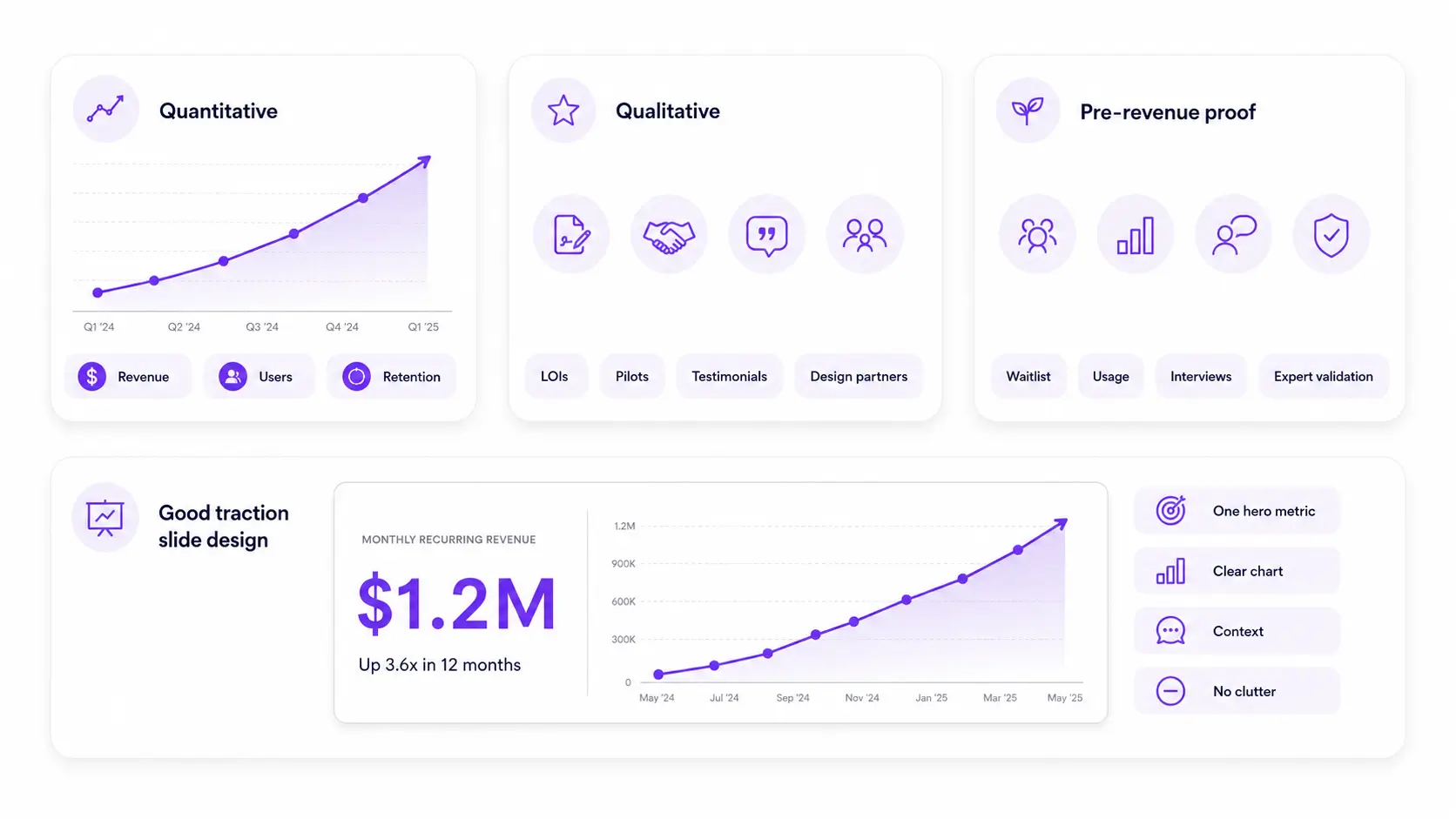
Good traction slide design usually follows these principles:
lead with the strongest metric
use one clear chart or metric system
avoid clutter
use simple visual hierarchy
show trend over time when possible
label charts clearly
avoid tiny spreadsheet screenshots
use logos carefully
avoid too many mixed metrics
make the insight clear in the headline
A good headline should explain the meaning, not just name the metric.
For example, a hypothetical headline could be:
“Paid users grew 3x in 6 months with 72% retention”
That line tells the investor what happened and why it matters. The chart below can then support the claim.
Avoid headlines like “Traction” with six unrelated charts underneath. The slide title should help the investor understand the takeaway before they study the details.
Traction Slide Best Practices
The best traction slide is focused, honest, and easy to understand quickly.
Use the traction slide to highlight the strongest signal, not every signal. One clear trend with context is usually stronger than a crowded slide full of disconnected numbers.
A strong traction slide should:
show the most meaningful proof first
connect the metric to customer demand or business progress
use a timeframe so the trend is clear
explain what the number proves
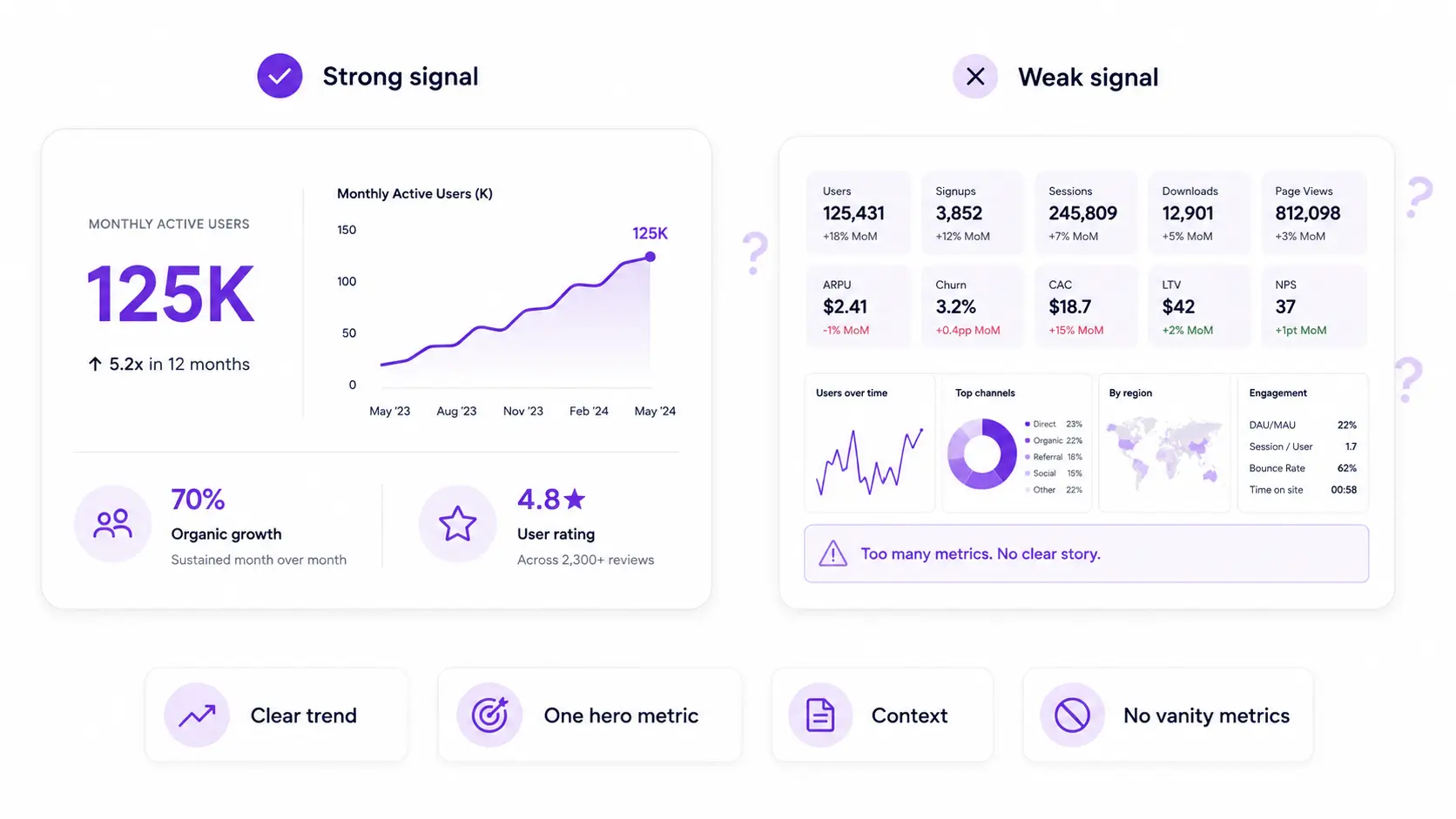
avoid vanity metrics unless they support a real insight
match the metric to the startup’s stage and business model
keep the design clean enough to understand in seconds
The goal is not to make the startup look bigger than it is. The goal is to make the progress easier to trust.
Common Traction Slide Mistakes to Avoid
The most common traction slide mistake is showing numbers without explaining what they prove.
A traction slide should create clarity, not confusion.
Common mistakes include:
using vanity metrics that do not prove demand
showing too many numbers on one slide
hiding the strongest metric
using metrics that do not match the business model
calling an MVP traction
using weak testimonials as proof of demand
showing growth without context
using old or outdated numbers
copying competitor traction slides
claiming product-market fit too early
making the slide look impressive but unclear
ignoring retention
forgetting to explain what the traction proves
Vanity metrics are especially dangerous. A large number of downloads, followers, impressions, or signups may look strong, but investors will ask what happened after that. Did users return? Did they pay? Did they refer to others? Did they use the product deeply?
Lynxify’s Common Pitch Deck Mistakes guide explains why unclear proof often weakens investor confidence, even when the deck looks polished.
Traction Slide Examples by Startup Stage
A traction slide should change as the startup matures.
Pre-seed, seed, and Series A startups should not show traction in the same way because investors expect different levels of proof at each stage.
Startup Stage | Possible Traction Signal | How to Present It |
Pre-seed | Waitlist quality, customer interviews, pilots, design partners, prototype usage, letters of intent | Show early validation and explain what it proves about demand |
Seed | Revenue, active users, retention, paid pilots, customer growth, usage, pipeline | Show stronger proof that the product works and customers care |
Series A | Revenue growth, retention, expansion, repeatable channels, unit economics, scalable sales motion | Show repeatability, revenue quality, and growth potential |
A pre-seed traction slide may show early validation. A seed traction slide should usually show stronger usage, revenue, pilots, retention, or customer proof. A Series A traction slide should show repeatability, growth channels, retention, revenue quality, and scalability. Mapping your current metrics to these early funding stages ensures you approach the right investors with the right proof points.
How to Talk About the Traction Slide During a Pitch
Do not read the traction slide during a pitch. Lead with the insight. Explain what the number proves. Then connect the traction to investor confidence.
Instead of saying:
“We have 10,000 users.”
Say something more meaningful:
“We reached 10,000 users through organic referrals, and 42% returned within the first month.”
The second version explains the source and quality of the traction. It gives investors more to evaluate.
Be ready to answer questions about:
source of the metric
time period
customer quality
retention
repeatability
acquisition channel
revenue quality
whether the trend can continue
The traction slide should start a better investor conversation. It should make investors ask sharper questions, not wonder what the numbers mean.
What Slides Should Be in a Pitch Deck?
A standard pitch deck often includes cover, problem, solution, market, product, traction, business model, go-to-market, competition, team, financials, and ask. The exact order depends on the startup stage, audience, business model, and strength of proof. If traction is strong, it may appear earlier. If the product needs more explanation, traction may come after the product or business model. Arranging these elements strategically is essential to mastering your pitch deck structure and keeping investors engaged.
Final Answer: What Makes a Strong Traction Slide?
A strong traction slide shows the most credible evidence that the market is responding. It should not show every number. It should show the proof that matters most for the startup’s stage, business model, and investor audience. The slide should make momentum easy to understand in seconds. It should answer what changed, why it matters, and what the traction proves about demand, execution, or growth potential.
If traction is strong, it may appear earlier. If the product needs more explanation, traction may come after the product or business model. Having proof is only half the battle; formatting it with strict visual hierarchy and a clear narrative arc is exactly how expert pitch deck design services transform complex startup data into fundable stories.


Frequently Asked Questions
Featured Blogs

Lynxify’s Evolution: From Pitch Decks to a Multidisciplinary Creative Company

Finance Slide in a Pitch Deck: What Investors Want to See

Go-To-Market Slide in a Pitch Deck: Guide & Examples

Market Size Slide in a Pitch Deck: TAM, SAM & SOM
How Many Slides Should a Pitch Deck Have? 10–15 Slides

Business Model Slide: Show Investors How You Make Money

Product Roadmap Slide in a Pitch Deck: What to Show Investors?

Team Slide in a Pitch Deck: What Investors Want to See

Pre-Seed vs Seed Funding: Amounts, Stage & Key Differences

How Long Should a Pitch Deck Be? Slide Count Guide

What Investors Look for in a Pre-Seed Stage Pitch Deck

10 Common Pitch Deck Mistakes Founders Should Avoid Before Investors See the Deck

How Much Does a Pitch Deck Design Cost?
How to Create a Pitch Deck for Investors
Traction Slide in a Pitch Deck: What Investors Want to See
Business Plan vs Pitch Deck: What Should Founders Use?