



Market Size Slide in a Pitch Deck: TAM, SAM & SOM
A market size slide is not a place to show the biggest possible market number. It is the slide that helps investors understand whether the opportunity is large, relevant, reachable, and connected to the startup’s actual customer segment.
Founders often think a bigger number makes the pitch stronger. Investors usually look for something more specific. They want to know which part of the market the startup can realistically serve, how the market size was calculated, and whether the opportunity connects to the product, pricing, business model, and go-to-market reality. A strong market size slide in a pitch deck makes the opportunity feel credible, not inflated.
Quick Answer: What Is a Market Size Slide in a Pitch Deck?
A market size slide is the pitch deck slide that shows how large and reachable the startup’s market opportunity is.
It usually explains the total market, the serviceable market, and the realistic share the startup can target. A strong market size slide connects market size to customer segment, business model, pricing, and go-to-market reality. The best market size slide makes the opportunity feel credible, not inflated.
What Is a Market Size Slide?
A market size slide is the slide that explains the size and relevance of the market opportunity.
It helps investors understand how many potential customers exist, how much revenue opportunity may be available, and which part of the market the startup can realistically reach.
A market size slide may include:
Market Opportunity
Customer Segment
TAM
SAM
SOM
Market Growth
Market Timing
Market Reachability
Bottom-Up Sizing
Investor Confidence
The slide should not simply show a huge industry number. A large market can be useful context, but it does not prove that the startup can reach, serve, or win that market.
For example, saying “healthcare is a trillion-dollar market” is too broad for most pitch decks. A stronger market size pitch deck slide would narrow the opportunity to a specific customer segment, workflow, geography, buyer, product category, or use case.
The investor should understand not only how big the market is, but which part of the market actually matters to this startup.
Why the Market Size Slide Matters to Investors
The market size slide matters because investors want to know whether the opportunity is large enough to support meaningful growth.
A startup can have a strong product and still be too narrow for some investors. The market size slide helps investors judge whether the business has room to grow, whether the target customer segment is attractive, and whether the startup can eventually become a larger company.
Investors use this slide to understand:
Size Of Opportunity
Market Timing
Growth Potential
Customer Demand
Business Model Fit
Revenue Potential
Go-To-Market Realism
Investor Return Potential
A strong market size slide helps investors understand why the market is worth entering now.
A weak market size slide can make the opportunity feel vague, inflated, or disconnected from the startup’s actual product. If the number is too broad, investors may question whether the founder truly understands the market.
The slide should make investors think, “This is a real opportunity, and the founder understands where to start.”
What Do Investors Look for on a Market Size Slide?
Investors look for a market size slide that is specific, credible, and connected to the business.
They do not need a giant number without explanation. They need to understand how the founder arrived at the market size and why the opportunity is realistic.
Investors often look for:
Credible Market Source
Clear Customer Segment
TAM, SAM, and SOM
Bottom-Up Logic
Market Growth Or Trend
Reachable Market
Connection To Pricing
Connection To Business Model
Connection To Go-To-Market
Clear Assumptions
Specific Niche Or Beachhead Market
Why Now
The strongest market size slides usually show both ambition and discipline.
Ambition tells investors the market can become large. Discipline tells investors the founder understands the starting point, customer segment, pricing logic, and realistic path into the market.
A market size slide should not feel like a research report. It should feel like a clear investor argument.
What Should You Include on a Market Size Slide?
A market size slide should include the most important information needed to understand the opportunity.
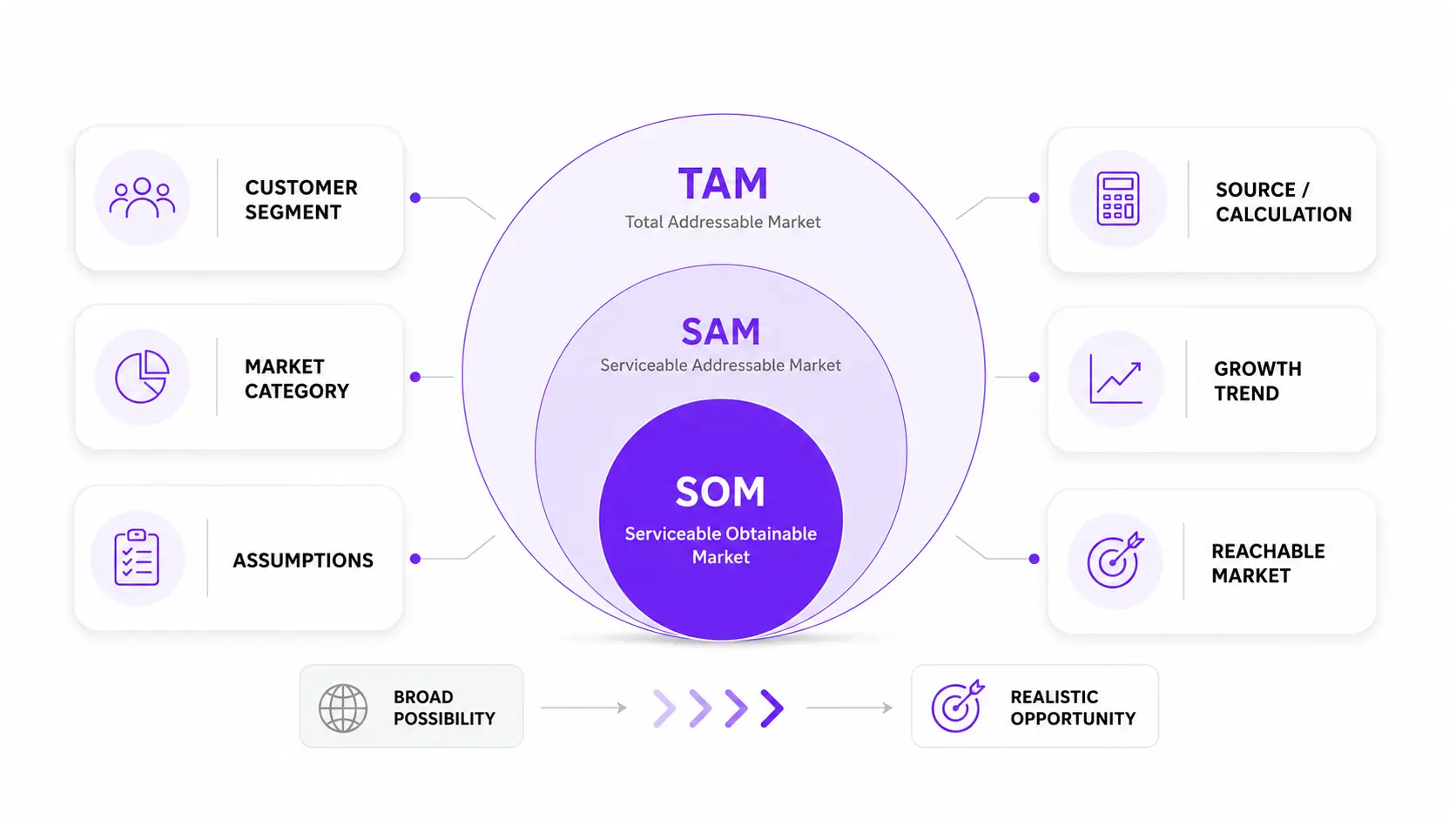
A clear structure usually includes:
Target customer segment
Market category
TAM, SAM, and SOM
Market sizing method
Key assumptions
Market growth or trend
Source or calculation note
Why the market is reachable
The slide should explain the opportunity clearly, not overload investors with research notes.
A simple structure can work well:
Element | What to Show |
Customer segment | Who the startup is targeting |
Market category | The broader market or category |
TAM | The full addressable opportunity |
SAM | The part the startup can realistically serve |
SOM | The portion the startup can realistically capture |
Assumption | Pricing, customer count, usage, or frequency logic |
Source or calculation | Where the numbers came from or how they were calculated |
The best market size slides make the logic easy to follow. If the slide shows TAM, SAM, and SOM, the investor should understand what each number means and why the smaller, reachable market is still attractive.
TAM SAM SOM Analysis: What to Show on a Market Size Slide
TAM SAM SOM analysis is a simple market sizing framework that helps founders separate the full market from the realistic opportunity.
TAM means Total Addressable Market.
SAM means Serviceable Available Market.
SOM means Serviceable Obtainable Market.
These terms are useful, but only if they make the opportunity clearer. They should not be used to make the market look bigger than it really is.
Term | Meaning | Investor Question It Answers |
TAM | The full market opportunity if the company could serve everyone in the broad category | How large could the total category be? |
SAM | The part of the market the company can realistically serve based on geography, customer type, product scope, or business model | Which part of the market is actually relevant? |
SOM | The portion of SAM the company can realistically capture in the near to mid term | What can this startup realistically reach first? |
TAM gives investors the broad context.
SAM gives them the relevant opportunity.
SOM often matters most in a pitch deck because it shows practical reach.
For example, a founder may operate in a huge global software category, but the real starting market may be mid-market logistics companies in North America with a specific workflow problem. That narrower market may be more useful to investors than a broad global number.
A strong TAM SAM SOM analysis should help investors understand the difference between the full market, the relevant market, and the reachable market.
Bottom-Up vs Top-Down Market Sizing
Founders often use either top-down or bottom-up market sizing. Top-down sizing starts with a large industry number and narrows it down. It can help provide context, but it can feel weak if it is not connected to the startup’s actual customer. Bottom-up sizing starts with customer count, pricing, usage, purchase frequency, or reachable accounts. It is often stronger because it connects the market size to the business model.
Method | How It Works | Strength | Risk |
Top-down market sizing | Starts with a large industry number and narrows it to the startup’s segment | Useful for showing broad category context | Can feel inflated or generic if not connected to the customer |
Bottom-up market sizing | Starts with customers, pricing, usage, transactions, or reachable accounts | More connected to revenue logic and business model | Requires clear assumptions and honest calculations |
A strong market size slide may use both.
Top-down sizing can show that the market category is large and growing. Bottom-up sizing can show that the founder understands the customer, pricing, and reachable opportunity. For most investor decks, bottom-up logic makes the slide more credible because it connects the opportunity to how the company actually makes money.
Market Size Slide vs Market Opportunity Slide
A market size slide and a market opportunity slide are related, but they are not always the same. A market size slide focuses on how large and reachable the market is. A market opportunity slide may also explain market pain, timing, trends, gaps, and why now.
Slide Type | Main Purpose | Best Use |
Market size slide | Show the size, relevance, and reachability of the market | Explaining TAM, SAM, SOM, market segment, and market sizing logic |
Market opportunity slide | Show why the market is attractive now | Explaining timing, trends, pain, gaps, and market change |
Market slide in pitch deck | Combine market size and opportunity into one clear slide | Useful when the deck needs to stay short |
Some pitch decks combine market size and market opportunity into one slide, especially if the story is simple or the deck needs to stay short. If the market is complex, founders may need separate slides. One slide can explain the market size. Another can explain the market timing or opportunity.
Market Size Slide vs Go-To-Market Slide
A market size slide answers how big and reachable the opportunity is. A go-to-market slide answers how the startup will reach, acquire, and convert customers. The market size slide shows the opportunity. The go-to-market slide shows the execution path. They should connect, but they are not the same.
For example, if the market size slide says the startup is targeting 50,000 enterprise buyers, the go-to-market slide should later explain how the company will reach that type of buyer. But the market size slide should stay focused on the size, segment, and logic behind the opportunity. Do not turn the market size slide into a detailed sales plan. That belongs in the go-to-market section.
Market Size Slide Examples by Startup Type
Different startups should size their markets differently.
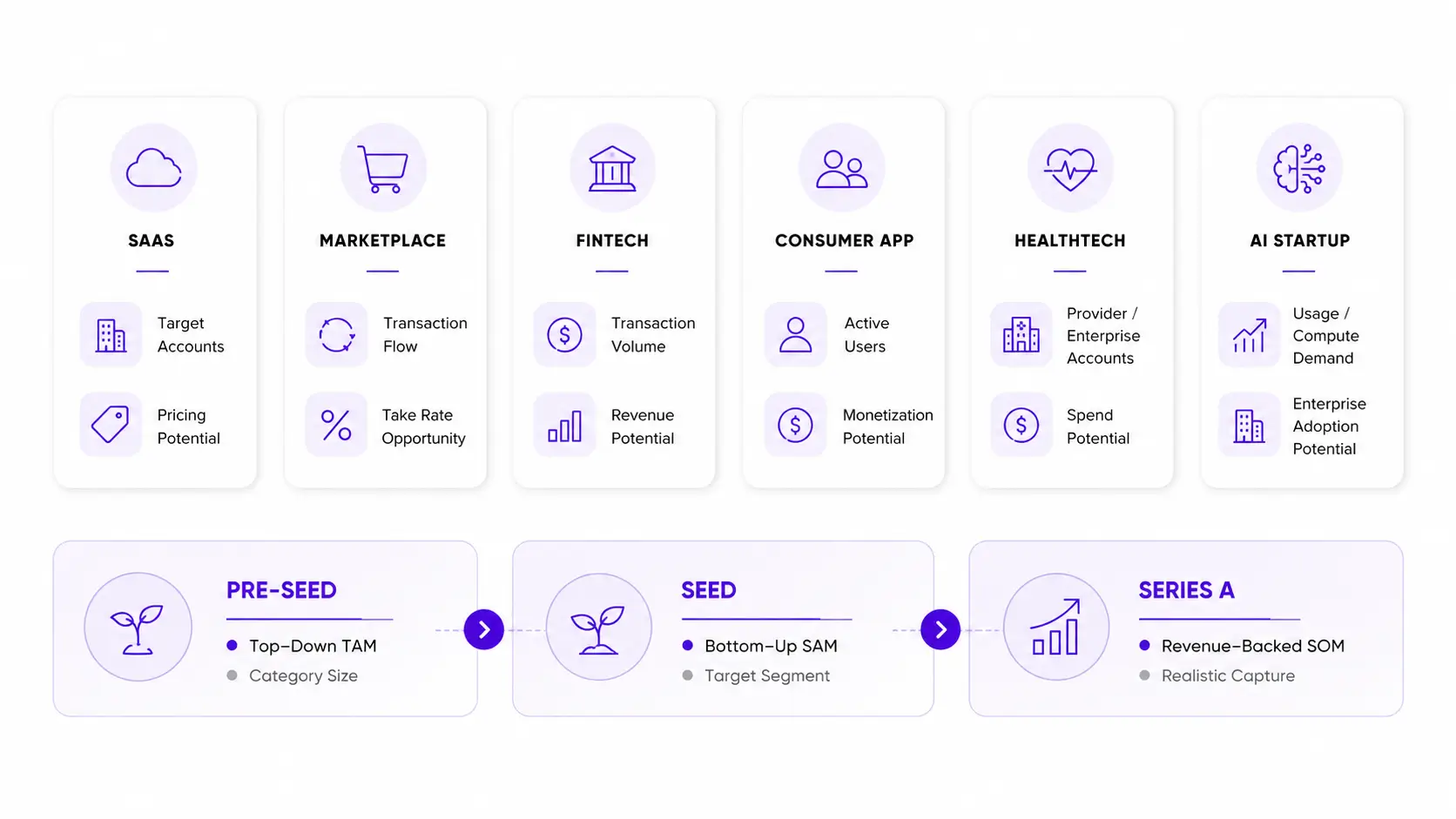
A SaaS startup, marketplace, fintech company, and AI startup should not all use the same market size logic.
Startup Type | Market Size Angle | What to Show |
SaaS | Target accounts, average contract value, reachable industries | Number of potential customers, pricing, segment size, expansion potential |
Marketplace | Buyer side, seller side, transaction volume, take rate | Market activity, transaction potential, supply and demand scale |
Consumer app | Audience size, usage behavior, monetization potential | Target user group, engagement category, revenue path |
Fintech | Transaction volume, account base, payment volume, compliance-defined market | Financial activity, reachable users, trust and regulatory boundaries |
Healthtech | Provider segment, patient population, workflow need, reimbursement or enterprise buyer | Specific healthcare segment, buyer type, clinical or workflow demand |
Edtech | Learner segment, institution type, course category, training spend | Target learners, schools, employers, or learning use case |
AI startup | Workflow category, number of target users, usage frequency, value per customer | Workflow size, reachable users, time or cost value |
B2B service or agency-style startup | Target business segment, service demand, contract value | Customer segment, average deal size, repeatability |
Creator or media startup | Audience segment, content category, sponsor demand, monetization potential | Audience reach, engagement category, revenue channels |
The best market size angle depends on how the startup earns revenue.
A marketplace should not only show number of users. It should also show transaction potential. A SaaS startup should not only show industry size. It should show target accounts and pricing logic. A fintech startup should make the financial activity and trust boundary clear.
Market Size Slide Examples by Startup Stage
A market size slide should change as the startup matures. Pre-seed, seed, and Series A investors may all care about market size, but they may expect different levels of proof and detail.
Startup Stage | What the Slide Should Emphasize | How to Present It |
Pre-seed | Customer segment, market logic, early assumptions, why the problem is worth solving | Show a clear market thesis and honest assumptions |
Seed | Bottom-up sizing, pricing connection, early traction, reachable customer segment | Show stronger logic between market, pricing, and early demand |
Series A | Expansion potential, segmentation, current wedge, and larger growth path | Show how the starting market can expand into a larger opportunity |
A pre-seed market size slide may focus on customer segment, market logic, and early assumptions. A seed market size slide should usually show stronger bottom-up sizing and a clearer connection to traction or pricing. A Series A market size slide should show expansion potential, market segmentation, and how the current wedge can grow into a larger opportunity.
The level of evidence investors expect also changes between pre-seed and seed funding, so the market size slide should become more detailed as the startup gains traction, pricing data, and clearer customer insight.
How Much Detail Should a Market Size Slide Show?
A pitch deck market size slide should be clear but not overloaded. It should show the main numbers and calculation logic, but it should not become a research report. A good market size slide should:
Show The Main Numbers
Show The Calculation Logic
Avoid Too Many Sources
Avoid Long Research Paragraphs
Avoid Showing Every Market Segment
Show Assumptions Clearly
Keep The Slide Readable
Move Detailed Research To The Appendix If Needed
If investors cannot understand the market logic in seconds, the slide needs simplification. For example, a slide with three clear market layers and one calculation note is often stronger than a slide filled with reports, charts, footnotes, and small text. The goal is not to prove every detail on one slide. The goal is to make the opportunity credible enough for the investor to understand and discuss.
Where Should the Market Size Slide Go in a Pitch Deck?
The market size slide usually works best after the problem and solution, or after the product if the product needs context. The investor should first understand what problem the startup solves. Then the market size slide can show how large and relevant the opportunity is.
The market size slide should usually appear before business model, go-to-market, or financials if those slides depend on the market size. A simple placement guide:
Situation | Best Placement |
Problem and solution are easy to understand | After problem and solution |
Product needs more explanation first | After product |
Market logic supports pricing | Before business model |
Market size supports growth plan | Before go-to-market and financials |
Market is the strongest reason to believe | Place earlier in the deck |
Place the market size slide where it helps investors understand why the opportunity is worth pursuing, not where a template says it belongs. Its position should support the wider investor story. When you decide on how to create an investor pitch deck, make sure the problem, solution, product, and market slides build on one another instead of feeling like separate pieces.
How to Design a Market Size Slide
A market size slide should make the opportunity easy to understand and trust. From Lynxify’s perspective, the design should support the market logic. It should not bury the investor in charts, sources, and broad claims. Good market size slide design usually follows these principles:
Use One Clear Market Sizing Framework
Make TAM, SAM, And SOM Easy To Compare
Avoid Huge Numbers With No Context
Use Simple Labels
Show Assumptions Clearly
Avoid Cluttered Charts
Avoid Tiny Source Notes
Use Visual Hierarchy
Make The Reachable Market Clear
Show The Investor Takeaway In The Headline
Whether the market size slide is designed in PowerPoint, Google Slides, or another presentation tool, the goal is the same: make the opportunity easy to understand and trust. A hypothetical headline could be:
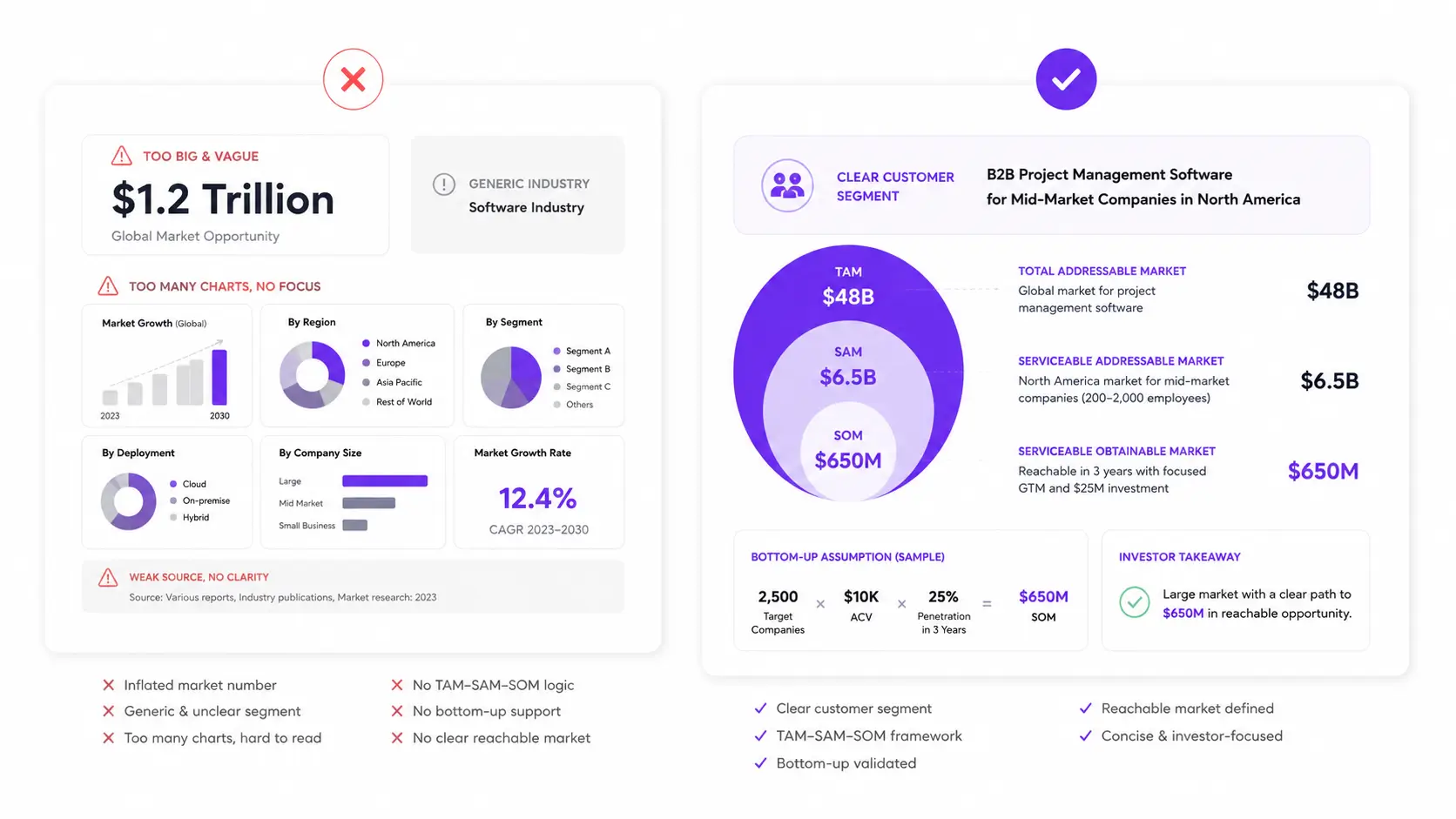
“$1.2B reachable market across 48,000 mid-market logistics teams”
That type of headline is stronger than simply saying “Large Market Opportunity” because it shows both size and specificity. The visual can then support the headline with TAM, SAM, SOM, customer segment, and calculation logic.
For founders, clear pitch deck design can make market logic easier to understand by turning TAM, SAM, SOM, assumptions, and customer segments into one focused slide.
Market Size Slide Best Practices
A strong market size slide should make investors think, “This is a meaningful opportunity and the founder understands the market.”
Best practices include:
Lead With The Relevant Market, Not Only The Biggest Market
Use Bottom-Up Logic When Possible
Show TAM, SAM, And SOM Clearly
Connect The Market To The Customer Segment
Connect The Market To Pricing
Show Assumptions Simply
Use Credible Sources Or Explain Calculation Logic
Avoid Exaggeration
Keep The Slide Visually Simple
Make The Market Feel Reachable
The best market size slides balance ambition with realism. If the market feels too small, investors may question growth potential. If the market feels too inflated, investors may question founder judgment. The slide should show that the founder understands both the big picture and the starting wedge.
Common Market Size Slide Mistakes to Avoid
The most common market size slide mistake is using a huge market number without context. A broad number may look impressive, but investors want to understand what part of that market the startup can actually reach.
Common mistakes include:
Using A Huge Market Number Without Context
Confusing TAM, SAM, And SOM
Showing TAM But No Reachable Market
Using Only Top-Down Research
Not Explaining Assumptions
Using Outdated Or Weak Sources
Making The Market Too Broad
Not Connecting Market Size To Pricing
Not Connecting Market Size To Go-To-Market
Ignoring Customer Segmentation
Using Too Many Charts
Making The Slide Look Like A Research Report
Hiding Uncertainty
Claiming The Startup Only Needs 1 Percent Of A Huge Market
Not Showing Why Now
The “we only need 1 percent” argument is especially weak because it avoids the harder question: how will the startup actually reach and win that share? A stronger slide explains the reachable segment, starting point, pricing logic, and market entry path. Broad market claims without clear assumptions are among the most common mistakes in a pitch deck because they can make investors question the founder’s understanding of the opportunity.
How to Talk About the Market Size Slide During a Pitch
Do not read every number on the market size slide. Lead with the market insight. Explain the target customer, the reachable opportunity, and the calculation logic. Then connect the market to pricing, business model, and go-to-market reality.
Instead of saying:
“This is a $50B market.”
Say something more useful:
“We are starting with 22,000 mid-market clinics that fit our workflow, which creates a reachable opportunity of around $600M based on our annual pricing assumption.”
The second version explains the customer segment, the logic, and the starting point. When presenting the market size slide, be ready to answer:
Who The Actual Customer Is
How The Market Was Calculated
Which Assumptions Matter Most
Whether The Market Is Growing
Why The Market Is Reachable
How The Market Connects To Pricing
How The Market Connects To Business Model
What Segment The Startup Will Enter First
The market size slide should make investors confident in the opportunity, not suspicious of inflated numbers.
What Slides Should Be in a Pitch Deck?
A standard pitch deck often includes cover, problem, solution, market size, product, traction, business model, go-to-market, competition, team, financials, roadmap, and ask.
The exact order depends on the startup stage, business model, investor audience, and strength of proof. Some decks combine market size with market opportunity. Others use separate slides if the market logic is complex.
Final Answer: What Makes a Strong Market Size Slide?
A strong market size slide shows that the opportunity is large, relevant, reachable, and credible. It should not rely on the biggest possible market number. It should explain TAM, SAM, SOM, the customer segment, the sizing logic, and why the market is worth pursuing.
The slide should make investors trust both the opportunity and the founder’s understanding of the market. The best version does not only show that the market is big. It shows which part of the market the startup can realistically reach, serve, and win.
Sum Up



FAQ
Frequently Asked Questions

What is a market size slide in a pitch deck?
A market size slide shows how large and reachable a startup’s market opportunity is. It usually explains the target customer segment, TAM, SAM, SOM, market growth, and the assumptions behind the sizing. Its purpose is to help investors judge whether the opportunity is both meaningful and realistic.
What should be included on a market size slide?
A market size slide should include the target customer segment, market category, TAM, SAM, SOM, key assumptions, the sizing method, and source or calculation logic. The focus should stay on the relevant and reachable market, not only the largest possible industry number.
What is TAM, SAM, and SOM analysis?
TAM, SAM, and SOM is a market-sizing framework. TAM represents the total possible demand, SAM represents the part of that market the startup can serve, and SOM represents the realistic share it may be able to target or capture within a defined period.
What is the difference between TAM, SAM, and SOM?
TAM is the full market opportunity. SAM is the portion the startup can serve based on factors such as geography, product, business model, or customer segment. SOM is the realistic share the startup may be able to reach based on its current resources, distribution, and go-to-market plan.
Should a market size slide use bottom-up or top-down sizing?
A market size slide can use both methods. Top-down sizing starts with a large industry figure and narrows it down. Bottom-up sizing starts with customer count, pricing, purchase behavior, or reachable accounts. Bottom-up sizing is often more persuasive when the assumptions are clear and defensible.
Is a market size slide the same as a market opportunity slide?
Is a market size slide the same as a market opportunity slide?
Where should the market size slide go in a pitch deck?
The market size slide often appears after the problem and solution, once investors understand what the company is solving and for whom. It may also come after the product slide when more context is needed. It should usually appear before the business model, go-to-market strategy, or financial projections rely on the market opportunity.
What are common market size slide mistakes?
Common mistakes include using a huge number without context, confusing TAM, SAM, and SOM, relying only on top-down research, failing to explain assumptions, defining the market too broadly, ignoring customer segments, and claiming the startup only needs one percent of a massive market.
