Team Slide in a Pitch Deck: What Investors Want to See
A team slide in the pitch deck is not just a place to list names, photos, and job titles. It is the slide that helps investors understand whether the right people are building the company.
Investors use the team slide to judge relevance, credibility, execution ability, and founder-market fit. They want to know why this team understands the problem, why the team can build the solution, and whether the team can learn, hire, sell, and execute.
A strong team slide does not feel like a resume wall. It shows why the people behind the startup are connected to the opportunity and capable of moving it forward.
Quick Answer: What Is a Team Slide in a Pitch Deck?
A team slide is the pitch deck slide that introduces the people building the company.
Its purpose is to show why the team is credible, relevant, and capable of executing the business. A strong team slide highlights founder-market fit, relevant experience, key roles, advisors if useful, and important hiring gaps. The best team slide makes investors understand why this team has a strong reason to win.
What Is a Team Slide?
A team slide is the section of a pitch deck that shows who is building the company and why they are qualified to do it.
It usually includes founders, key team members, relevant experience, role clarity, and sometimes advisors. In early-stage decks, it may also show team gaps or planned hires if those gaps matter to the next milestone.
The goal is not to show every job from every founder’s career. The goal is to connect the team to the startup’s problem, market, product, and execution plan.
A team slide may include:
founders
core team members
relevant experience
technical or commercial strengths
founder-market fit
advisors
hiring gaps
next key hires
The slide should answer a simple investor question: why are these the right people to build this company?
Why the Team Slide Matters to Investors
The team slide matters because early-stage startups often change.
The product may change. The go-to-market plan may change. The business model may change. Even the first target customer may evolve after more learning.
The team is one of the few things investors can judge early. Investors want to understand whether the founders can adapt, learn, build, sell, hire, and stay close to the market.
A strong team slide can reduce doubt around:
execution risk
founder-market fit
speed of learning
ability to hire
ability to sell
technical ability
industry credibility
resilience
trust
A strong team slide can help investors believe in the company even before every metric is mature.
A weak team slide can create concern even if the idea is strong. If investors cannot see why the founders are suited to the opportunity, they may question whether the company can survive the early uncertainty.
What Do Investors Look for on a Team Slide?
Investors look for relevant team proof, not long biographies.
They want to understand what each founder brings to the business and how the team reduces risk. Strong experience is useful only when it connects to the company’s market, customer, product, or execution plan.
Investors often look for:
relevant founder experience
deep market insight
technical or product capability
commercial ability
industry credibility
past execution
role clarity
complementary skills
advisors who add real credibility
important gaps and hiring plan
why this team is uniquely suited to the opportunity
Investors do not need every job from every founder’s career. They need the experience that explains why this team can solve this problem better than others.
For example, “ex-product lead at a healthcare software company” may be more useful than a long list of unrelated roles if the startup is building for healthcare teams.
What Should You Include on a Team Slide?
A team slide should include only the information that helps investors understand why the team matters.
A clean team slide usually includes:
Founder names and roles
Relevant experience
Founder-market fit
Key achievements or proof
Core team members
Advisors only if they add credibility
Hiring gaps or next hires if relevant
The slide should explain why each person matters to the company. Do not include irrelevant job history, long bios, or personal details that do not strengthen the investor story.
A simple structure can work well:
Element | What to Show |
Name | Founder or team member name |
Role | CEO, CTO, product, sales, operations, or another clear function |
Relevant proof | Prior experience, technical skill, industry background, execution history |
Why this person matters | How this person helps the startup win |
The best team slides are specific. They do not say “experienced leader” without context. They explain why that experience matters for this product, customer, market, or business model.

Founder-Market Fit: The Real Point of the Team Slide
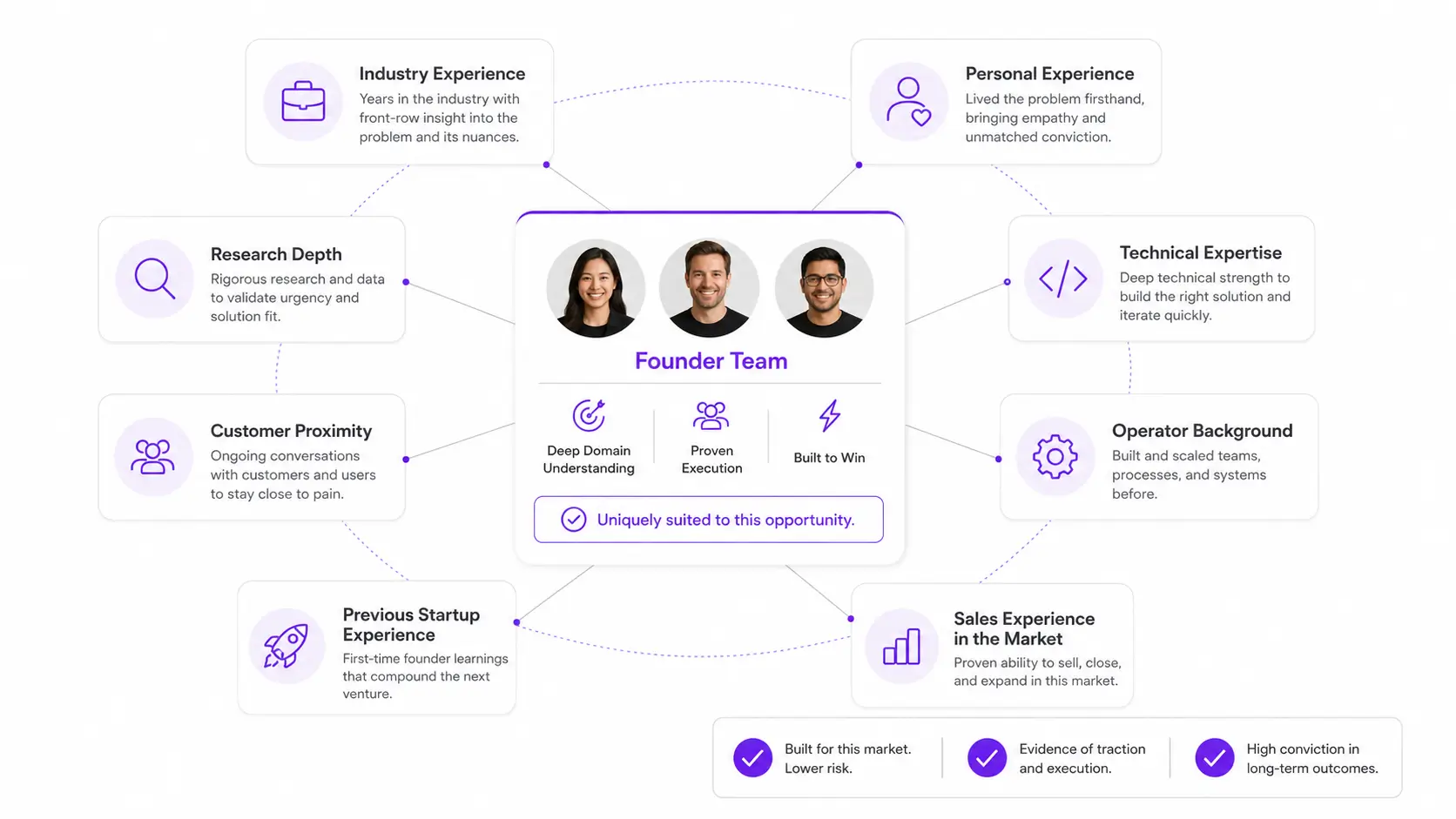
Founder-market fit is one of the most important ideas behind a strong team slide. Founder-market fit means the founder or team has a strong reason to understand the problem, customer, market, or technology. It helps investors believe the team has a sharper insight than an outsider. Founder-market fit may come from:
Industry Experience
Personal Experience
Technical Expertise
Operator Background
Customer Proximity
Research Depth
Previous Startup Experience
Sales Experience in the Market
Community or Audience Access
For example, a founder building software for logistics teams may have strong founder-market fit if they spent years working inside logistics operations. A founder building for nurses may have stronger credibility if the team includes healthcare operators or advisors with direct patient-care experience.
The team slide should not only say who the founders are. It should show why they are the right people for this opportunity. This matters even more at pre-seed, when revenue or traction may still be early. At that stage, pre-seed investors often look closely at founder insight, relevant experience, and the team’s ability to execute before mature proof exists.
Team Slide vs Meet the Team Slide
A meet the team slide usually introduces people. A team slide in a pitch deck should do more than that.
A simple meet the team layout can work, but only if the content proves relevance and execution ability. Photos, names, and job titles are not enough for an investor deck.
Slide Type | Main Purpose | Best Use |
Meet the team slide | Introduce people with names, photos, roles, and short bios | Company profiles, internal decks, agency decks, sales presentations |
Team slide in pitch deck | Show why the team is credible, relevant, and able to execute | Investor decks, fundraising decks, startup pitch decks |
Team structure slide | Show how roles, functions, advisors, or future hires are organized | Operationally complex, technical, regulated, or scaling startups |
A meet the team PowerPoint slide may look polished, but a pitch deck team slide needs stronger content. Investors should leave the slide understanding why the team is connected to the opportunity.
Team Structure Slide: When Do You Need One?
A team structure slide is useful when the startup has multiple functions, a growing team, or a business model that needs role clarity. Most early pitch decks do not need a complex org chart. A simple team slide is usually enough. But a team structure slide can help if the company is operationally complex, technical, regulated, or scaling quickly. A team structure slide may show:
Founders
Product
Engineering
Sales
Marketing
Operations
Advisors
Future Hires
For example, a healthtech startup may need to show clinical, product, regulatory, and commercial support. A marketplace startup may need to show who owns supply, demand, operations, and technology. The goal is clarity, not complexity. If the structure helps investors understand execution, include it. If it only adds visual clutter, keep the team slide simple.
Where Should the Team Slide Go in a Pitch Deck?
The team slide can appear near the end of many standard pitch decks, but placement should depend on the story. If the team’s credibility is one of the strongest reasons to believe, the slide can appear earlier.
This is common when the founders have deep industry experience, strong founder-market fit, or a track record that immediately strengthens the opportunity. If traction, product, or market proof is stronger, the team slide can come later after investors understand the business context.
A useful rule:
Situation | Best Placement |
Team credibility is the strongest proof | Place the team slide earlier |
Investors need problem and market context first | Place the team slide later |
The startup is pre-seed with limited traction | Use team credibility to support early belief |
The startup has strong traction | Let traction lead, then use team to support execution |
The team slide should not appear in the deck only because a template placed it there. It should sit where it strengthens the wider pitch deck structure and helps the investor story feel easier to follow.
Solo Founder Team Slide: What Should You Show?
A solo founder can still create a strong team slide. The slide should not try to hide the fact that the founder is solo. Investors may care more about self-awareness, execution ability, and a clear hiring plan than pretending the team is larger than it is. A solo founder team slide can show:
Founder-Market Fit
Relevant Experience
Technical Or Commercial Ability
Advisors
Contractors Or Early Collaborators
Hiring Plan
Skills That Are Missing And How They Will Be Filled
For example, a solo technical founder may show product depth, customer discovery, and planned sales hires. A solo commercial founder may show customer access, sales traction, and the plan to hire technical leadership. The strongest solo founder slides are honest. They show why the founder is credible now and what support the company needs next.
Advisors vs Core Team: What Belongs on the Slide?
Core team members should get priority on the team slide. Advisors should only appear if they add real credibility and are genuinely involved. A long row of advisor names can weaken the slide if investors cannot tell who is active or how they help.
Do not overload the slide with advisor logos or names. Do not list famous people who are not involved. Do not make advisors look like employees. A clean structure is:
Core team first
Advisors below or in a smaller section
Only include advisors who strengthen trust
Briefly explain the advisor’s relevance if needed
For example, an advisor may be useful if they bring regulatory knowledge, enterprise buyer access, technical review, clinical credibility, or industry relationships. The advisor section should support the team story, not distract from it.
What If Your Team Has Gaps?
Many early teams have gaps. The issue is not that the team is incomplete. The issue is whether the founder understands what is missing and has a plan. Common team gaps include:
Technical Gaps
Sales Gaps
Industry Gaps
Operations Gaps
Regulatory Gaps
Marketing Gaps
Finance Gaps
If the gap is important, acknowledge it briefly through the hiring plan, use of funds, or next milestone. Do not turn the team slide into a weakness slide, but do show that the founder is realistic. For example, if the company is a technical product with no senior engineering leader, investors may want to know how that gap will be filled. If the company is entering a regulated industry, they may want to see regulatory support or advisor credibility.
Investor expectations change as a startup moves from pre-seed to seed funding. A missing hire may be acceptable during early validation, but the same gap can feel harder to ignore once the company is asking investors to believe in stronger execution.
How to Design a Team Slide
A good team slide should make role clarity and team credibility easy to understand in seconds. From Lynxify’s perspective, design should help investors see why the team matters. Whether the team slide is designed in PowerPoint, Google Slides, or another presentation tool, the goal is the same: make role clarity and credibility easy to understand. It should not turn the slide into a crowded resume board. Good team slide design usually follows these principles:
Use clean headshots if available
Keep bios short
Show role clarity
Highlight only relevant experience
Use consistent layout
Avoid tiny text
Avoid long paragraphs
Avoid too many people
Separate core team from advisors
Use logos carefully
Make the investor takeaway clear in the headline
A strong headline can frame the team’s relevance. For example, a hypothetical headline could be:
“Built by operators with 12 years in healthcare procurement and enterprise sales”
That kind of headline gives the investor context before they read the team details. Avoid using company logos as decoration. Logos should only appear if they support relevant credibility. Too many logos can make the slide feel noisy or inflated.
Team Slide Best Practices
A strong team slide should make investors think, “This team understands the problem and can execute.” Best practices include:
Lead with why this team is relevant
Focus on credibility, not vanity
Show complementary skills
Connect experience to the startup’s market
Include advisors only when meaningful
Show gaps honestly
Avoid template-like bios
Keep the layout simple
Make the slide easy to understand in seconds
The best team slide is specific. It does not simply say the team is “experienced” or “passionate.” It shows what kind of experience matters and how that experience helps the company reduce risk. If the team has deep product experience, show how that helps the product. If the team has sales access, show how that supports go-to-market. If the team understands the customer personally, make that insight visible.
Common Team Slide Mistakes to Avoid
The most common team slide mistake is making it a resume wall. A pitch deck is not a LinkedIn profile collection. It is an investor communication tool. Common mistakes include:
Making It A Resume Wall
Using Long Bios
Listing Irrelevant Experience
Including Too Many People
Including Weak Advisors
Using Famous Advisors Who Are Not Active
Hiding Important Team Gaps
Not Showing Founder-Market Fit
Using Unclear Roles
Making Every Founder Sound The Same
Overusing Logos
Using Low-Quality Headshots
Placing The Team Slide Based Only On A Template
Not Explaining Why The Team Matters To The Opportunity
A team slide can look polished and still miss the point if it does not answer the investor’s real question: why this team? That is one of the common mistake in a pitch deck that can weaken confidence even when the design looks clean.
Team Slide Examples by Startup Stage
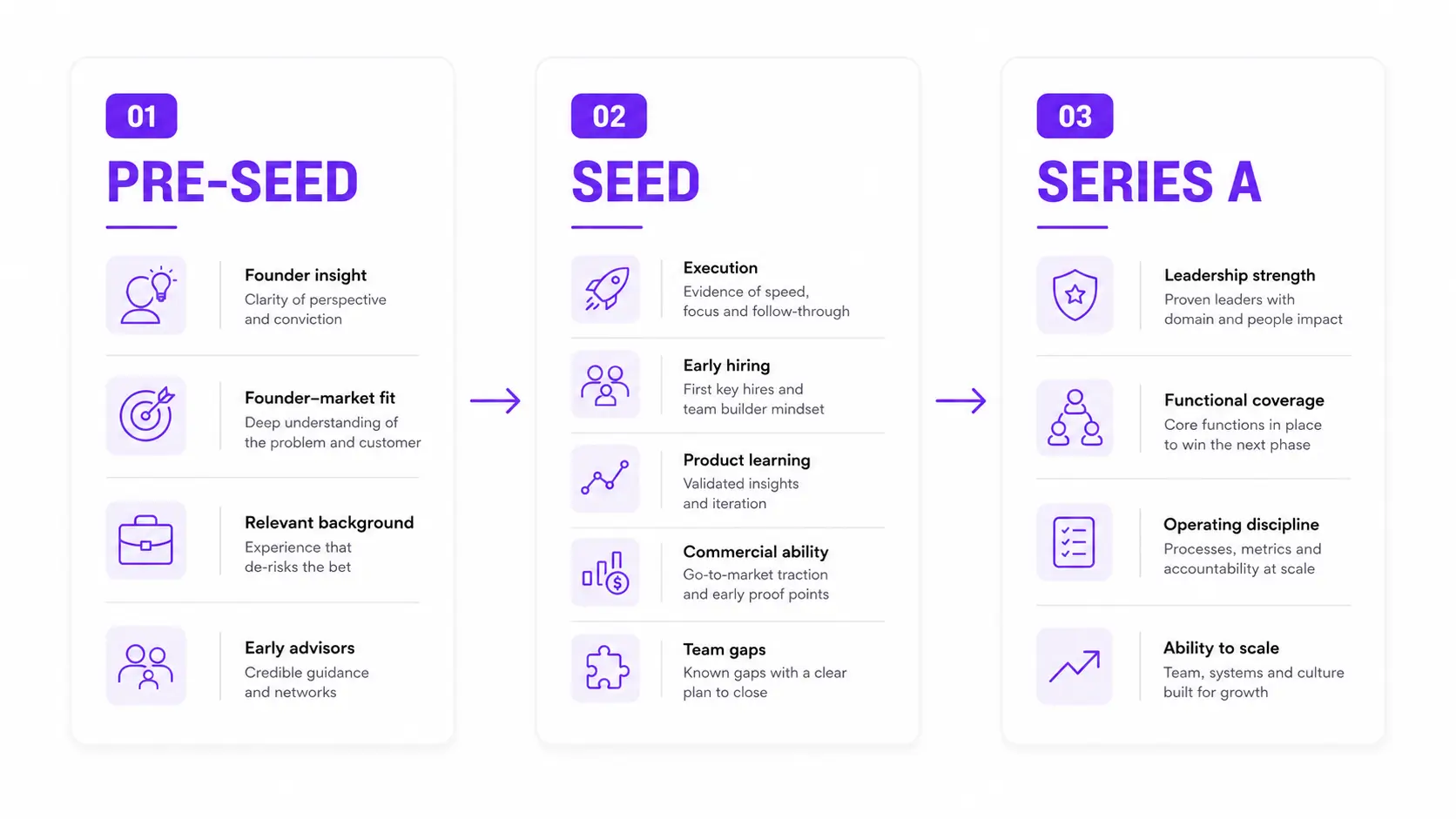
A team slide should change as the startup matures. Pre-seed, seed, and Series A companies do not need to prove the same thing. The stage affects how much investors expect from the team slide.
Startup Stage | What the Team Slide Should Emphasize | How to Present It |
Pre-seed | Founder insight, founder-market fit, relevant background, early advisors | Show why the founder understands the problem and can validate the opportunity |
Seed | Execution, early hiring, product learning, commercial ability, team gaps | Show how the team has learned from the market and can reach the next milestone |
Series A | Leadership strength, functional coverage, operating discipline, ability to scale | Show that the team can support growth, hiring, systems, and repeatable execution |
A pre-seed team slide may focus more on founder insight and relevant experience. A seed team slide should show execution, early team building, hiring plan, and proof of learning. A Series A team slide should show leadership strength, functional coverage, and ability to scale. The slide should match the investor expectation for the stage, not simply follow a fixed layout.
How to Talk About the Team Slide During a Pitch
Do not read every bio during the pitch.
Lead with why the team is relevant. Connect each key person to a business risk they reduce. Explain what is missing honestly if needed.
The team slide should help investors understand how the company can learn, build, sell, hire, and execute.
Instead of saying:
“Our CTO has 10 years of engineering experience.”
Say something more useful:
“Our CTO has spent the last 10 years building payment infrastructure, which matters because our product depends on secure transaction workflows.”
The second version connects experience to the business risk.
When presenting the team slide, focus on:
why each founder matters
what risk the team reduces
what experience is directly relevant
what the team has already learned
what key hires come next
why the team can execute this plan
The team slide should start a stronger investor conversation about execution, not a long career history discussion.
What Slides Should Be in a Pitch Deck?
A standard pitch deck often includes cover, problem, solution, market, product, traction, business model, go-to-market, competition, team, financials, and ask. The exact order depends on the startup stage, business model, audience, and strength of proof.
Final Answer: What Makes a Strong Team Slide?
A strong team slide shows why the right people are building the company. It should not simply list names, titles, and headshots. It should show founder-market fit, relevant experience, role clarity, execution ability, and honest awareness of team gaps.
The slide should help investors trust the team’s ability to learn, build, sell, hire, and execute. For founders who already have strong credibility but struggle to present it clearly, a professional pitch deck agency can help turn team proof into a clearer investor story.
FAQ
Frequently Asked Questions

What is a team slide in a pitch deck?
A team slide in a pitch deck introduces the founders, core team, and sometimes advisors. Its purpose is to show why the people behind the startup are credible, relevant, and capable of executing the business. A strong team slide connects the team’s experience to the problem, market, product, and growth plan.
What should be included on a team slide?
A team slide should include founder names, roles, relevant experience, founder-market fit, key achievements, and core team members. Advisors can be included if they add real credibility. The slide should focus on why each person matters to the startup, not every detail from their career history.
Where should the team slide go in a pitch deck?
The team slide usually appears near the end of a pitch deck, but placement depends on the story. If the team is one of the strongest reasons to believe in the company, it can appear earlier. If the product, market, or traction needs more context first, the team slide can come later.
Is a meet the team slide the same as a pitch deck team slide?
A meet the team slide usually introduces people with names, roles, photos, and short bios. A pitch deck team slide should do more than introduce the team. It should show investor-relevant credibility, founder-market fit, role clarity, execution ability, and why the team is suited to the opportunity.
Should advisors be included on a team slide?
Advisors should be included only if they add real credibility and are genuinely involved. Core team members should receive priority. Avoid listing famous names who are not active, and do not make advisors look like employees. If advisors are included, briefly show how they support the business.
How do you make a team slide if you are a solo founder?
How do you make a team slide if you are a solo founder?
What is founder-market fit?
Founder-market fit means the founder or team has a strong reason to understand the problem, customer, market, or technology. It can come from industry experience, personal experience, technical expertise, operator background, customer access, research depth, or previous startup experience in a relevant area.
What are common team slide mistakes?
Common team slide mistakes include writing long bios, listing irrelevant experience, using unclear roles, adding too many advisors, hiding important team gaps, making the slide look like a resume wall, and failing to show why the team is suited to the opportunity. The slide should prove relevance, not just introduce people.
Featured Blogs
Types of Video Editing: Styles, Cuts, Effects, and Services Explained

Lynxify’s Evolution: From Pitch Decks to a Multidisciplinary Creative Company

Finance Slide in a Pitch Deck: What Investors Want to See

Go-To-Market Slide in a Pitch Deck: Guide & Examples

Market Size Slide in a Pitch Deck: TAM, SAM & SOM

How Many Slides Should a Pitch Deck Have? 10–15 Slides

Business Model Slide: Show Investors How You Make Money

Product Roadmap Slide in a Pitch Deck: What to Show Investors?
Team Slide in a Pitch Deck: What Investors Want to See

Pre-Seed vs Seed Funding: Amounts, Stage & Key Differences

How Long Should a Pitch Deck Be? Slide Count Guide

What Investors Look for in a Pre-Seed Stage Pitch Deck

10 Common Pitch Deck Mistakes Founders Should Avoid Before Investors See the Deck

How Much Does a Pitch Deck Design Cost?

How to Create a Pitch Deck for Investors

Traction Slide in a Pitch Deck: What Investors Want to See

Business Plan vs Pitch Deck: What Should Founders Use?