10 Common Pitch Deck Mistakes Founders Should Avoid Before Investors See the Deck
Most pitch deck mistakes do not happen because the idea is bad. They happen because the story is unclear, the slides are overloaded, the market logic is weak, the traction is vague, or the funding ask is confusing. Investors move fast. They compare many opportunities, scan for risk, and look for reasons to keep reading or move on. A startup pitch deck should make the business easier to understand, not harder to evaluate.
The most common pitch deck mistakes usually come down to one problem: the founder knows the business too well, but the deck does not explain it well enough for someone seeing it for the first time.
The real issue is not that founders make mistakes. The issue is that most mistakes make investors do extra work to understand the opportunity. This guide breaks down 10 common pitch deck mistakes founders should avoid before investors see the deck, why each mistake hurts trust, and how to fix it before fundraising.
What Are the Most Common Pitch Deck Mistakes?
The most common pitch deck mistakes are unclear problem framing, overloaded slides, too many slides, weak market logic, vague traction, poor business model explanation, unrealistic financial projections, and an unclear funding ask.
Here is a quick summary before we go deeper.
Pitch Deck Mistake | Why It Hurts | How to Fix It |
|---|---|---|
Starting with the solution instead of the problem | Investors do not understand why the product matters | Show the customer pain before introducing the product |
Adding too much text and not enough story | Slides become slow to read and hard to scan | Use one idea per slide with clear slide titles |
Making the deck too technical | Investors may miss the business value | Translate features into customer value and use cases |
Using unrealistic market size numbers | Large claims without logic weaken trust | Use focused market sizing and explain the entry market |
Ignoring competition or saying there are no competitors | It makes the founder look unprepared | Show alternatives and explain your differentiation |
Showing vague traction without proof | Investors cannot tell if there is real demand | Use validation, usage data, revenue signals, pilots, or customer proof |
Having an unclear business model | Investors cannot see how the company may make money | Explain who pays, what they pay for, and how revenue works |
Overpromising financial projections | Unrealistic numbers reduce credibility | Keep assumptions simple, realistic, and tied to milestones |
Making the team slide too generic | Investors cannot see why this team can execute | Show founder-market fit, relevant experience, and execution ability |
Ending without a clear ask or use of funds | The round feels unplanned | State the funding ask, use of funds, runway, and next milestones |
These are not small presentation errors. They are investor pitch deck red flags because they make the business feel less ready, less focused, or harder to trust.
Why Pitch Deck Mistakes Matter More Than Founders Think
Pitch deck mistakes matter because investors usually do not have time to decode the business.
Investor guidance often emphasizes clear storytelling, concise slides, market logic, traction quality, and a specific funding ask. Investors often scan decks quickly, so slides need to be structured, simple to follow, and easy to understand without a long explanation.
A pitch deck is often the first serious filter before a meeting, follow-up, or deeper review. If the deck creates confusion, the founder may never get the chance to explain the business properly.
That is why pitch deck errors can hurt even strong startups.
A good deck does not need to answer every possible question. It needs to answer the right first questions:
What problem are you solving?
Who has this problem?
Why does it matter now?
What are you building?
Why is the market worth attention?
What proof exists so far?
How will the business make money?
Why is this team credible?
What are you raising and what will it unlock?
When these answers are missing or buried, investors lose confidence.
1. Starting With the Solution Instead of the Problem
One of the most common pitch deck mistakes founders make is starting with the product before proving the pain.
Founders are often excited about what they built. They want to show the platform, features, workflow, dashboard, model, app, or technology. But investors first need to understand why the product matters.
If the problem is unclear, the solution feels optional.
A weak deck jumps straight into:
product features
screenshots
technology
platform modules
future roadmap
A stronger deck first explains:
who has the problem
why the problem is painful
what it costs in time, money, risk, or missed opportunity
why current solutions are not good enough
why the problem is worth solving now
For example, “We built an AI assistant for small businesses” is less useful than explaining the real pain first.
Better framing:
“Small business owners spend hours each week answering repeat customer questions, but most cannot afford full-time support teams or complex automation tools.”
Now the product has a reason to exist.
How to fix it
Start with the customer's pain. Then introduce the solution.
Your problem slide should make investors think, “Yes, this is real.” Your solution slide should then make them think, “This is a logical answer to that problem.”
2. Adding Too Much Text and Not Enough Story
Pitch decks fail when they read like documents.
Too much text slows investors down. It also makes the deck harder to present, harder to scan, and harder to remember. A pitch deck should not force the reader to study every slide like a report.
This is one of the most common pitch deck slide mistakes.
Overloaded slides often include:
long paragraphs
too many bullets
multiple ideas on one slide
tiny fonts
unclear charts
weak slide titles
no visual hierarchy
The issue is not only design. Too much text usually means the story is not focused enough.
A strong slide should have one job.
If a slide is about traction, it should prove traction. If it is about market size, it should explain the market opportunity. If it is about the team, it should show why the team can execute.
How to fix it
Use:
one idea per slide
short slide titles
simple body copy
clear visuals
strong section flow
speaker notes or appendix for details
A pitch deck should guide attention. Details can go into the appendix, business plan, data room, or follow-up materials. Keeping these assets separate prevents information overload, allowing you to master your startup fundraising documentation strategy without losing the core narrative of your pitch.

3. Making the Deck Too Technical
Technical founders often make the deck too complex.
This happens often in AI, SaaS, deep-tech, biotech, healthtech, infrastructure, and product-heavy startups. The founder understands the technology deeply, but the investor may not need every technical detail in the first deck.
Investors need to understand the business value, not only the technology.
A technical deck becomes weak when it focuses too much on:
algorithms
architecture
model performance
backend systems
scientific depth
product features
internal workflows
These details may matter later. But first, the deck must explain what the product does, who it helps, and why it creates value.
How to fix it
Translate technical features into customer value.
Instead of only saying:
“Our platform uses machine learning to automate workflow classification.”
Explain the value:
“Our platform helps operations teams sort high-volume requests faster, reducing manual review and improving response time.”
Use diagrams carefully. A simple workflow can help. A crowded system architecture slide may confuse the story too early.
For technical decks, the best question is:
Can a smart investor understand the commercial opportunity without being an expert in the technology?
4. Using Unrealistic Market Size Numbers
A weak market slide can damage trust fast.
Many founders use large market numbers because they want the opportunity to look big. But a huge TAM with no logic can feel inflated.
TAM means total addressable market. SAM means serviceable available market. SOM means serviceable obtainable market. In simple terms, these show the total market, the part you can realistically serve, and the part you may actually capture.
The mistake is showing a massive number without explaining how the startup enters the market.
A pitch deck market size mistake often looks like this:
“This is a $500B market”
no clear target customer
no entry segment
no bottom-up logic
no link to the business model
no explanation of how the company reaches buyers
Investors want ambition, but they also want market logic.
How to fix it
Start with a focused target market.
Show:
who the first customer is
what segment you are entering
why that segment is reachable
how the market can expand
how customer reach connects to the revenue model
Where possible, use bottom-up market sizing. This means estimating the opportunity based on real customer counts, pricing, adoption assumptions, or usage behavior instead of only quoting a large industry number.
A believable smaller market can be stronger than a huge number with no explanation.
5. Ignoring Competition or Saying There Are No Competitors
Saying “we have no competitors” is one of the most common investor pitch deck red flags.
Investors expect competition. If there are no direct competitors, there are usually indirect competitors or existing alternatives.
Competition can include:
direct competitors
indirect competitors
manual workflows
spreadsheets
agencies
internal tools
legacy software
doing nothing
For example, a startup may not have another company doing the exact same thing. But customers may already solve the problem with Excel, freelancers, internal staff, outdated software, or a slow manual process.
Ignoring competition can make the founder look unprepared.
How to fix it
Show the competitive landscape honestly.
Explain:
what alternatives exist
where those alternatives fall short
why your approach is different
why your timing is better
why customers may switch
what your moat or advantage could become
Your differentiation may come from product workflow, user experience, distribution, niche focus, pricing, data advantage, technical approach, or customer insight.
A good competition slide does not attack everyone else. It shows that you understand the market.
6. Showing Vague Traction Without Proof
Traction should show demand, learning, or momentum.
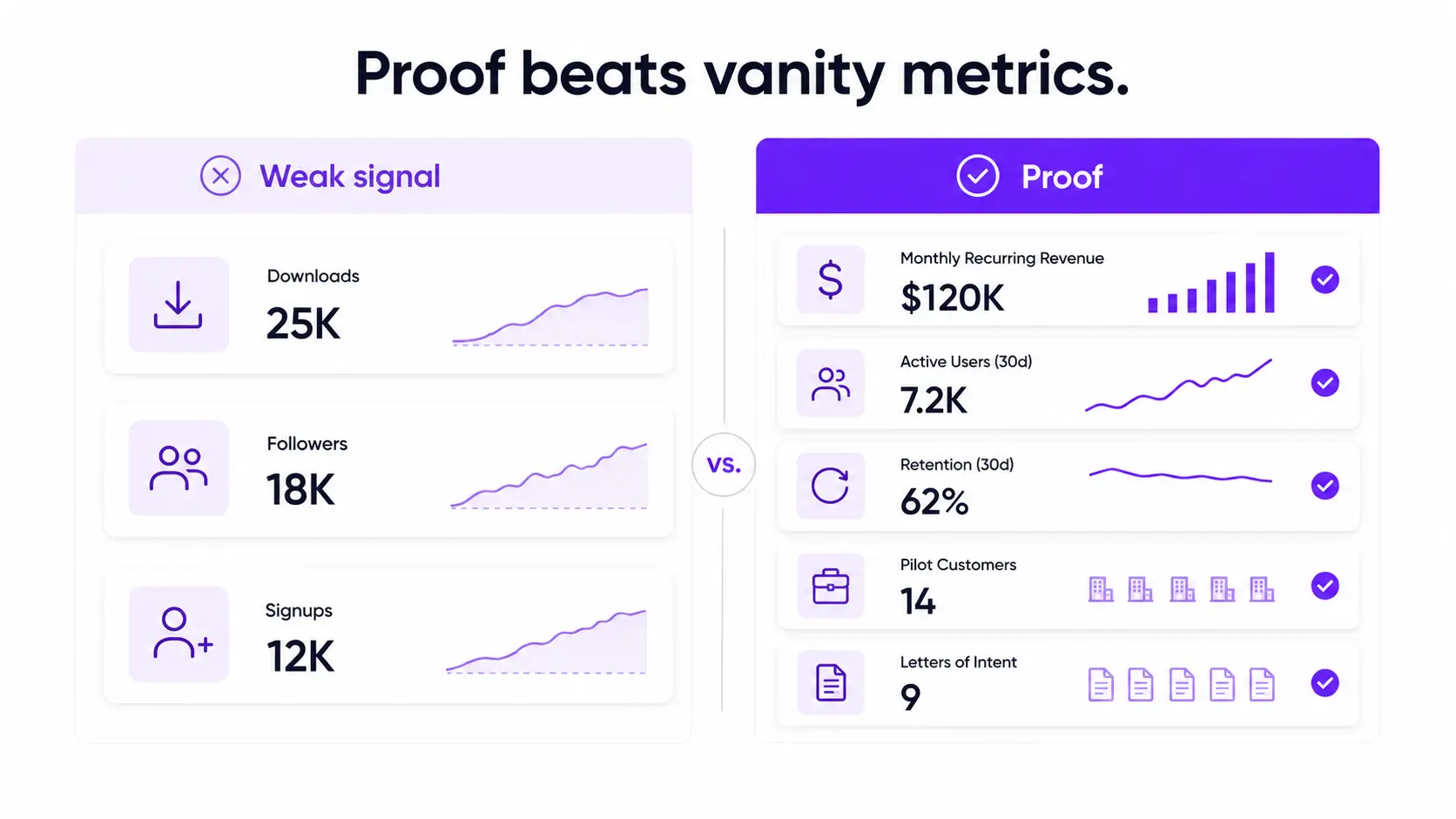
One of the biggest fundraising pitch deck mistakes is showing numbers that look good but do not prove anything. These are often called vanity metrics.
Examples include:
website visits without conversion
social followers without engagement
downloads without retention
waitlist numbers with no quality
revenue claims without context
partnerships that are not active
Investors want to know what the traction actually means.
For a pre-seed pitch deck, traction does not always mean revenue. But it should show real validation.
How to fix it
Show proof that connects to the business.
Useful traction can include:
customer interviews
pilot users
waitlist quality
letters of intent
early customers
MRR if available
usage data
retention
partnership interest
product testing
MVP feedback
repeat usage
customer validation
A weak traction slide says:
“5,000 users.”
A stronger traction slide says:
“5,000 signups, 38% weekly active users, and 12 pilot customers from the target segment.”
The second version gives investors something to evaluate.
7. Having an Unclear Business Model
Investors need to understand how the company may make money.
The business model does not need to be perfect at an early stage, but the revenue logic should be visible. If investors cannot understand who pays, what they pay for, and why they keep paying, the opportunity feels harder to trust.
An unclear business model slide often creates questions like:
Who is the customer?
Who is the buyer?
How does pricing work?
Is revenue recurring or one-time?
What drives growth?
How expensive is customer acquisition?
Can the model scale?
This matters for SaaS, marketplaces, consumer products, services, AI tools, and hardware businesses.
How to fix it
Explain the revenue model simply.
Cover:
who pays
what they pay for
pricing model
sales motion
recurring or one-time revenue
unit economics if relevant
CAC and LTV if available
retention logic if important
At an early stage, you can explain assumptions as assumptions. Investors do not expect every number to be proven, but they do expect the founder to understand how the business could work.
8. Overpromising Financial Projections
Unrealistic financial projections hurt trust.
At an early stage, projections should show thinking, not fantasy. Investors know forecasts will change. What they want to see is whether the assumptions are logical.
A bad financial slide often includes:
huge revenue growth with no explanation
fake precision
unclear cost assumptions
no link to customer acquisition
no runway thinking
no connection to milestones
no explanation of the next funding round
Financial projections should support the story. They should not feel like decoration.
How to fix it
Keep financial projections simple and believable.
Show:
key assumptions
revenue logic
main cost areas
runway
hiring plan if relevant
expected milestones
what the next round should help prove
For example, instead of showing a perfect five-year hockey-stick chart, explain what needs to happen in the next 12 to 18 months.
Investors do not need fake certainty. They need to understand how you think.
9. Making the Team Slide Too Generic
A team slide with names and job titles is not enough.
At pre-seed and seed stage, founder-market fit matters a lot. Investors want to know why this team is the right team for this problem.
A weak team slide shows:
founder names
job titles
headshots
generic credentials
no connection to the business
A stronger team slide explains why the team can execute.
How to fix it
Show relevant credibility.
Include:
domain insight
technical ability
sales ability
product experience
industry experience
customer understanding
past execution
founder-market fit
advisory support if meaningful
If the founder has lived the problem, worked in the industry, built a similar product, sold to the target market, or has a clear unfair insight, the team slide should show it.
Investors are not only asking, “Who are these people?”
They are asking:
Why are these people likely to win here?
10. Ending Without a Clear Ask or Use of Funds
A pitch deck should not end with confusion.
The ask slide should explain how much you are raising, what the money will fund, and what milestone it should unlock. Without this, the investor does not know what the founder wants or how the round connects to the next stage.
A weak ask slide says:
“We are raising capital to grow.”
A stronger ask says:
“We are raising $1M to expand product development, hire two sales roles, complete 20 pilot programs, and reach the next revenue milestone within 18 months.”
The exact numbers depend on the company. The point is to connect funding to progress.
How to fix it
Your ask slide should include:
funding ask
use of funds
runway
key hires if relevant
product milestones
customer acquisition plan
next fundraising milestone if relevant
The use of funds slide does not need to show every expense. It needs to show that the founder has a plan.
Pre-Seed Pitch Deck Mistakes to Avoid
Pre-seed pitch deck mistakes are often different because the company is still early.
A pre-seed founder may not have strong revenue, a full product, or mature traction. That is normal. The mistake is pretending the company is more mature than it is or hiding the early proof that actually exists.
Common pre-seed pitch deck mistakes to avoid include:
trying to look more mature than the startup really is
hiding lack of traction instead of showing early validation
using big market claims without a focused entry point
overloading the deck with future features
not explaining the next milestone after funding
making the product sound complete when it is still an MVP
using design to cover unclear thinking
skipping founder-market fit
avoiding honest risk areas
At pre-seed, investors know the company is early. They are looking for clarity, learning speed, customer understanding, and signs that the founder can reduce risk with the next round of funding.
If you are preparing an early-stage deck, Lynxify’s What Investors Look for in a Pre-Seed Pitch Deck blog explains what investors usually expect before the company has strong traction.
Pitch Deck Design Mistakes That Make a Good Idea Look Weak
Pitch deck design mistakes are not only visual. They affect understanding.
A good idea can look weak if the slides are hard to read, poorly structured, or visually inconsistent. Design should guide the investor’s attention, not compete with the message.
Common pitch deck design mistakes include:
cluttered slides
weak visual hierarchy
inconsistent typography
unreadable charts
too many icons
generic templates
poor slide titles
no flow between sections
screenshots without explanation
data visuals that are hard to read
inconsistent spacing
random colors
slides that look polished but say very little
A strong deck should be scannable. Investors should be able to understand the main idea of each slide quickly.
One simple test helps: look only at the slide titles. Do they tell the story? If not, the deck may need stronger slide architecture.
For structure, Lynxify’s How to Create a Pitch Deck for Investors blog gives a useful foundation for building the deck before worrying about visual polish.
What Lynxify Has Seen Across Real Pitch Deck Mistakes
Across 5,000+ pitch deck and presentation projects, Lynxify often sees the same issue: the business idea may be strong, but the deck makes investors work too hard to understand it.
Lynxify’s investor deck experience includes funding-related presentation work across AI, SaaS, deep-tech, biotech, healthtech, consumer, real estate, co-living, and creator-led businesses, including projects connected to companies such as Necto, Satoshi Protocol, Parlay, Mammogen, Nesti, and DEAN AI.
The lessons are practical.
AI and SaaS decks often need technical ideas simplified. Investors need to understand the use case, business value, customer pain, and revenue logic, not only the model or product architecture.
Biotech and healthtech decks often need scientific proof translated into market logic. The science may be strong, but the deck still needs to explain validation, commercialization path, patient or customer need, and investor timing.
Consumer and marketplace decks often need sharper positioning. The deck should explain audience, demand, traction, distribution, margin logic, and why the brand or platform can grow.
Creator-led and sponsorship decks often need audience data, monetization, engagement quality, and sponsor value explained clearly. A large audience alone is not enough if the revenue model is unclear.
The pattern is simple: investors should not have to decode the business. The deck should guide them through the opportunity.
How to Fix Pitch Deck Mistakes Before Fundraising
The best way to fix pitch deck mistakes is to review the deck like an investor, not like the founder.
Founders often read their own decks with background knowledge. Investors do not have that context. That is why a deck should be tested for clarity before fundraising.
Use this checklist:
review the deck slide by slide
remove any slide that does not answer an investor question
rewrite vague slide titles
reduce text on overloaded slides
make the problem specific
make market logic believable
show proof clearly
make the competition slide honest
connect financials to assumptions
make the funding ask specific
check that the use of funds connects to milestones
test the deck with someone who does not know the business
A useful test is to give the deck to a smart person outside your company. If they cannot explain the business back to you in a few sentences, the deck is not ready.
A pitch deck should guide attention. Details can go into the appendix, business plan, data room, or follow-up materials. Budget is always a key factor, so it is highly practical to audit standard presentation design costs before deciding whether to build your slides internally or hire external specialists.

Final Answer: How to Avoid Common Pitch Deck Mistakes
The best pitch decks are clear, specific, honest, and easy to scan. Founders should avoid clutter, vague proof, unrealistic claims, weak market logic, unclear business models, generic team slides, and funding asks that do not connect to milestones.
A strong pitch deck does not need to prove everything. But it must make the business easier to understand and evaluate. The goal is not to impress investors with more slides. The goal is to help them understand the problem, believe the opportunity, trust the team, and see what funding will help unlock next.
FAQ
Frequently Asked Questions

What are the most common pitch deck mistakes?
The most common pitch deck mistakes include starting with the solution before the problem, adding too much text, using unrealistic market numbers, ignoring competition, showing vague traction, having an unclear business model, overpromising financial projections, making the team slide too generic, and ending without a clear funding ask.
Why do investors reject pitch decks?
Investors often reject pitch decks when the business is unclear, the market opportunity feels weak, traction lacks proof, the team does not appear credible, or the funding ask is not connected to clear milestones. Even a strong startup can be overlooked if the story is difficult to understand.
What should you avoid in a pitch deck?
Avoid long text blocks, vague market claims, unrealistic financial projections, unclear traction, weak competition analysis, generic team slides, and an unclear use of funds. Every slide should answer an investor question and make the business easier to evaluate.
How many slides should a pitch deck have?
Most startup pitch decks contain between 10 and 15 slides, although the ideal length depends on the company stage and business model. The deck should include enough information to explain the opportunity while remaining concise and easy to scan.
Is too much text a pitch deck mistake?
Yes. Too much text slows investors down and hides the main message. A strong pitch deck uses concise copy, clear slide titles, visual hierarchy, and one main idea per slide. Supporting details can be included in speaker notes or an appendix.
Should a pitch deck include competitors?
Should a pitch deck include competitors?
What are common pre-seed pitch deck mistakes to avoid?
Common pre-seed mistakes include exaggerating company maturity, relying on oversized market claims, hiding limited traction instead of showing early validation, overloading the deck with future features, skipping founder-market fit, and failing to explain what the funding will achieve.
How can founders fix pitch deck mistakes before fundraising?
Review the deck from an investor's perspective rather than the founder's. Simplify crowded slides, strengthen the narrative, support claims with evidence, make the market and business model easier to understand, and connect the funding ask directly to milestones. Testing the deck with someone unfamiliar with the business can also reveal areas that need clarification.
Featured Blogs

Lynxify’s Evolution: From Pitch Decks to a Multidisciplinary Creative Company

Finance Slide in a Pitch Deck: What Investors Want to See
Go-To-Market Slide in a Pitch Deck: Guide & Examples

Market Size Slide in a Pitch Deck: TAM, SAM & SOM
How Many Slides Should a Pitch Deck Have? 10–15 Slides
Business Model Slide: Show Investors How You Make Money

Product Roadmap Slide in a Pitch Deck: What to Show Investors?
Team Slide in a Pitch Deck: What Investors Want to See

Pre-Seed vs Seed Funding: Amounts, Stage & Key Differences
How Long Should a Pitch Deck Be? Slide Count Guide
What Investors Look for in a Pre-Seed Stage Pitch Deck
10 Common Pitch Deck Mistakes Founders Should Avoid Before Investors See the Deck
How Much Does a Pitch Deck Design Cost?
How to Create a Pitch Deck for Investors

Traction Slide in a Pitch Deck: What Investors Want to See
Business Plan vs Pitch Deck: What Should Founders Use?