



Go-To-Market Slide in a Pitch Deck: Guide & Examples
A go to market slide is not just a marketing slide. It is the pitch deck slide that shows investors how your startup will reach, acquire, convert, and retain customers. Investors use this slide to understand whether your market opportunity can turn into real customer demand. A strong GTM slide connects the target customer, acquisition channels, sales motion, pricing, and traction proof into one clear customer acquisition story.
The goal is not to list every channel you might use. The goal is to show the first believable path to customers and why that path can grow.
Quick Answer: What Is a Go-To-Market Slide in a Pitch Deck?
A go-to-market slide is the pitch deck slide that explains how the startup will reach and acquire customers.
It usually shows the target customer, first channels, sales or acquisition motion, conversion path, and growth strategy. A strong go-to-market slide connects customer acquisition to market size, pricing, revenue logic, and traction. The best GTM slide makes the path to customers feel realistic, not vague.
What Is a Go-To-Market Slide?
A go-to-market slide explains how a startup plans to enter the market and win customers.
It is not a generic list of marketing channels. It should explain the specific path the company will use to reach the right customer, create interest, convert that interest into customers, and grow from there.
A go-to-market slide may include:
Target Customer
Customer Acquisition
First Channels
Sales Motion
Marketing Motion
Distribution
Partnerships
Conversion Path
Retention
Launch Strategy
Growth Plan
GTM Strategy
The slide should answer a simple investor question: how will this company get customers?
For early-stage founders, the answer does not need to be perfect. But it should be focused. “We will use social media, paid ads, partnerships, referrals, content, and events” is not a strategy if the deck does not explain why those channels fit the customer.
A stronger slide shows a clear starting point. It explains the first customer segment, the first channel, why that channel makes sense, and what the startup will test or scale next.
Why the Go-To-Market Slide Matters to Investors
The go-to-market slide matters because investors want to know whether the startup can turn market opportunity into real customers.
A startup can have a strong product and a large market, but still struggle if it has no believable path to customer acquisition. Investors want to see how the founder thinks about reaching the market, converting demand, and making the growth motion repeatable.
The GTM slide helps investors judge:
Customer Acquisition Risk
Sales Motion
Channel Credibility
Distribution Advantage
Pricing Connection
Repeatability
Scalability
Market Entry
Sales Cycle
Customer Access
Growth Path
A strong go-to-market slide helps reduce investor doubt about execution. It shows that the founder understands who the customer is, where they can be reached, and how they make buying decisions.
A weak GTM slide can make the opportunity feel theoretical, even if the product and market are strong. If investors cannot see a clear customer acquisition path, they may question whether the startup can grow beyond early interest.
What Do Investors Look for on a Go-To-Market Slide?
Investors look for a focused customer acquisition plan that fits the market, price point, and revenue logic.
They do not need every future channel. They need to understand the first believable path to customers and why it can expand.
Investors often look for:
Clear Target Customer
Specific Beachhead Segment
First Acquisition Channels
Why those Channels fit the Customer
Sales or Marketing Motion
Conversion Path
Customer Acquisition Cost Awareness if Relevant
Sales Cycle Awareness
Distribution Advantage
Partnership Logic
Connection to Pricing
Connection to Revenue Logic
Connection to Traction
What will be Tested Next
The strongest GTM slides are specific. They do not say “we will target businesses.” They say which businesses, who inside those businesses, what pain they have, how the startup reaches them, and what happens after the first touchpoint. The slide should make the acquisition path easy to follow.
What Should You Include on a Go-To-Market Slide?
A go-to-market slide should show how the startup plans to reach and convert its first or next customers. A clear structure usually includes:
Target customer or beachhead segment
First acquisition channels
Sales or marketing motion
Conversion path
Key GTM milestones
Early proof or traction if available
Growth or expansion logic
The slide should show focus. Do not list every possible channel. Do not say “social media, SEO, paid ads, partnerships, and referrals” unless the strategy explains why those channels fit the customer.
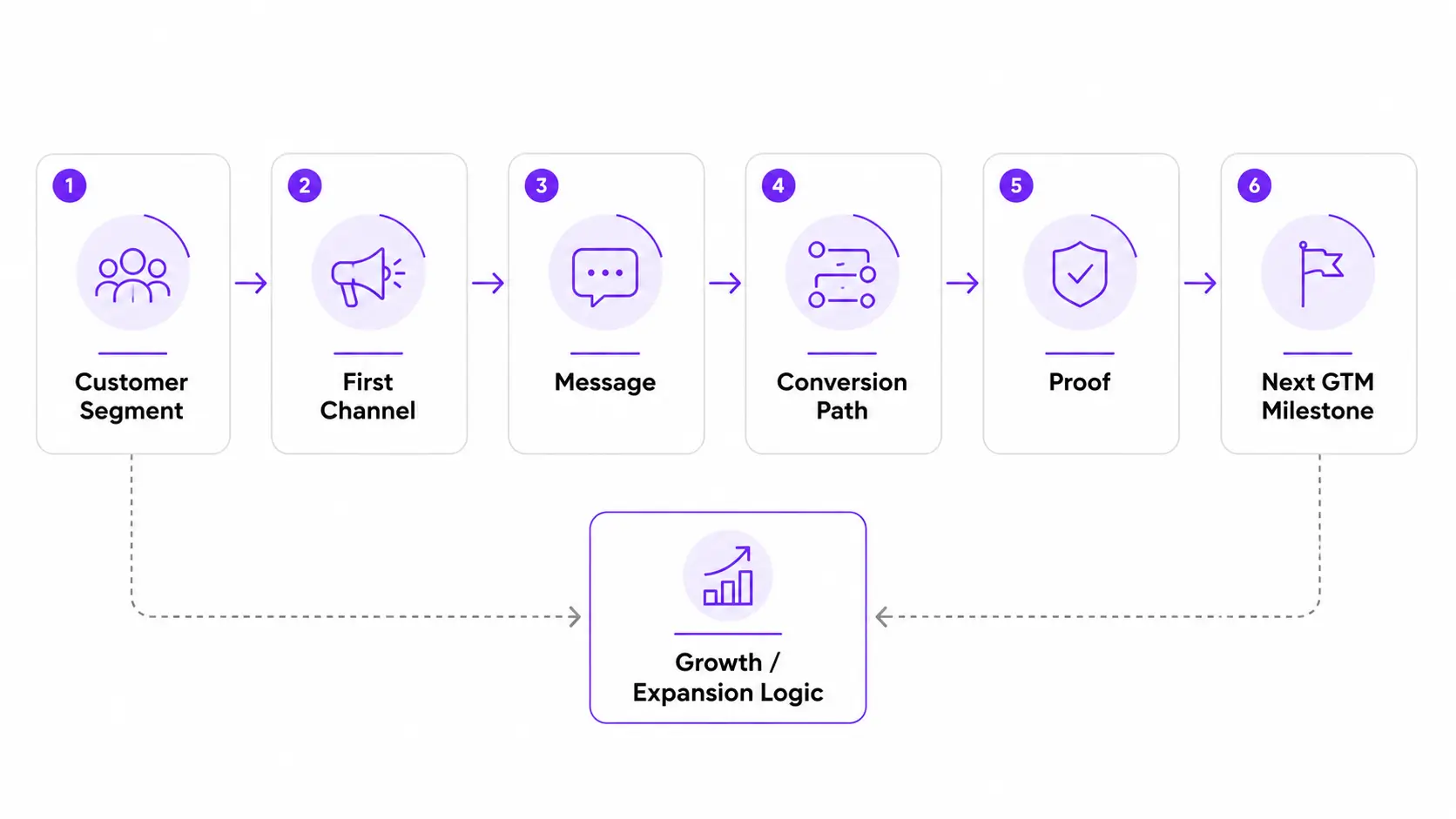
A simple structure can work well:
Element | What to Show |
Customer segment | Who the startup is targeting first |
Channel | How the startup will reach that customer |
Message | What pain or value will create interest |
Conversion path | How interest becomes a customer |
Proof | What has already been tested or learned |
Next GTM milestone | What the team will test, improve, or scale next |
The slide should help investors understand the customer acquisition logic in seconds.
Go-To-Market Strategy Slide: What to Show
A go-to-market strategy slide should show the strategy behind customer acquisition, not just the tactics.
The best GTM strategy slide explains why the chosen channel makes sense for the target customer. It connects customer behavior, sales motion, pricing, and positioning into a clear plan.
A strong go-to-market strategy slide may show:
Beachhead Customer
Channel Choice
Sales Motion
Buyer Journey
Positioning
Pricing Connection
Activation or Onboarding
Expansion Path
GTM Element | What It Means | Investor Question It Answers |
Target customer | The first customer segment the startup will focus on | Who are you selling to first? |
Channel | The path used to reach that customer | How will you get in front of them? |
Sales motion | The way customers are converted | Is this self-serve, founder-led, sales-led, partner-led, or product-led? |
Conversion path | The steps from awareness to customer | How does interest become revenue? |
GTM milestone | The next customer acquisition proof point | What will you test or prove next? |
Expansion path | How the motion grows over time | How can this become repeatable? |
The key is not to make the slide look busy. The key is to make the first customer acquisition motion believable.
Go-To-Market Slide vs Market Size Slide
A market size slide shows how large and reachable the opportunity is. A go-to-market slide shows how the startup will reach and convert that opportunity into customers.
The market size slide answers: how big is the opportunity?
The go-to-market slide answers: how will we reach customers?
They should connect, but they are not the same. If the market size slide says the startup is targeting mid-market healthcare providers, the GTM slide should explain how those providers will be reached, engaged, and converted. Keep the market size slide focused on opportunity. Keep the GTM slide focused on execution.
Go-To-Market Slide vs Market Opportunity Slide
A market opportunity slide may show trends, timing, pain, gaps, or why now. A go-to-market slide shows the execution path for reaching customers. The market opportunity slide explains why the market is attractive. The GTM slide explains how the startup will enter and grow in that market.
For example, a market opportunity slide may show that compliance pressure is increasing in a specific industry. The GTM slide should then explain how the startup will reach the buyers affected by that pressure. The two slides can support each other, but they should not repeat the same point.
Go-To-Market Slide vs Business Model Slide
The business model slide shows how the startup makes money. The go-to-market slide shows how the startup reaches customers who can create that revenue.
Slide Type | Main Question | Best Use |
Business model slide | How does the startup make money? | Explaining pricing, revenue streams, and monetization logic |
Go-to-market slide | How will the startup acquire customers? | Explaining channels, sales motion, and conversion path |
Traction slide | Is the market already responding? | Showing proof that customers, users, or partners care |
A business model explains the revenue logic. A GTM slide explains the customer acquisition path. A traction slide may show proof that the path is starting to work.
These slides should feel connected. If the revenue logic depends on enterprise contracts, the GTM slide should not only talk about social media growth. If the pricing model depends on self-serve subscriptions, the GTM slide should explain how users find, activate, and convert.
Common Go-To-Market Channels to Show
Founders should choose channels that fit the customer, price point, sales cycle, and revenue logic. Do not show channels just because they sound impressive. A channel is useful only if it gives the startup a believable path to the target customer.
Channel | Best For | What Investors Need to Believe |
Founder-led sales | Early B2B, enterprise, high-value customers | Founders can reach buyers, learn from sales, and close first customers |
Outbound sales | B2B products with defined buyer profiles | The target buyer is reachable and the message can create meetings |
Inbound content | Educational categories, search-driven demand, complex products | Customers actively research the problem and content can build trust |
Paid acquisition | Consumer apps, ecommerce, some SaaS models | CAC can be controlled and conversion can support revenue logic |
Partnerships | Fintech, healthtech, marketplaces, platform businesses | Partners have real access and the relationship is not just a vague idea |
Referrals | Products with trust, social use, or network effects | Customers have a reason to invite or recommend others |
Product-led growth | SaaS, tools, platforms, collaborative products | Users can discover value quickly and convert through product usage |
Community | Creator, edtech, consumer, developer, and niche B2B products | The audience is engaged and community can support adoption |
Events or webinars | B2B, enterprise, education, expert-led categories | Buyers need education and the format can create qualified demand |
Channel partners | Enterprise, hardware, fintech, healthcare, B2B services | Partners can sell, distribute, or influence adoption |
Enterprise sales | High-value B2B products with long sales cycles | The team understands buyer process, procurement, and relationship building |
App marketplace or platform distribution | SaaS, plugins, integrations, developer tools | Customers already search or buy through existing platforms |
A good GTM slide usually shows the first channel clearly, then shows how that channel can expand or support the next phase of growth.
Go-To-Market Slide Examples by Startup Type
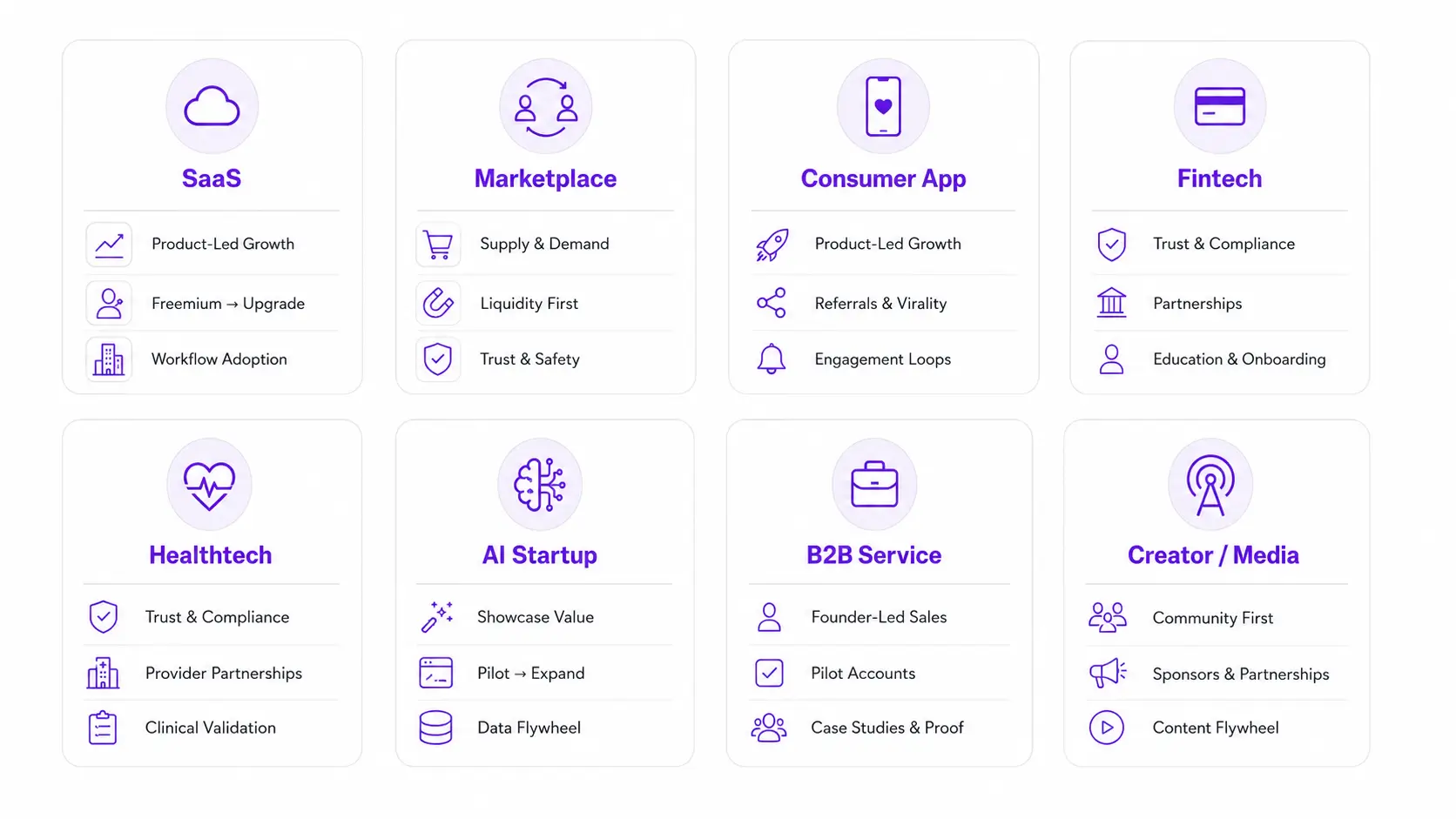
Different startups need different go-to-market plans. A SaaS startup, marketplace, fintech company, and healthtech startup should not all show the same GTM strategy.
Startup Type | GTM Focus | What to Show |
SaaS | Founder-led sales, outbound, product-led motion, content, integrations, partner channels | Target buyer, pricing fit, sales motion, onboarding, expansion path |
Marketplace | Supply acquisition, demand acquisition, liquidity-building, city or niche rollout | Which side starts first, how liquidity grows, how transactions repeat |
Consumer app | Audience growth, referrals, content, communities, app distribution, paid tests | User acquisition path, engagement loop, retention, monetization route |
Fintech | Trust-building, compliance-driven sales, partnerships, financial institutions, account activation | Buyer trust, regulated access, partner logic, activation path |
Healthtech | Provider access, pilots, clinical workflows, enterprise or payer relationships | Stakeholder path, pilot strategy, adoption barriers, workflow fit |
Edtech | Institutions, communities, creators, employers, direct learners, partnerships | Learner or buyer segment, distribution path, proof of engagement |
AI startup | Workflow-specific users, pilot accounts, enterprise adoption, usage expansion | Painful workflow, first users, value proof, expansion inside accounts |
B2B service or agency-style startup | Founder-led sales, referrals, niche positioning, content, partnerships | Repeatable lead source, service packaging, retention, upsell path |
Creator or media startup | Audience growth, community, sponsors, partnerships, newsletters, social distribution | Audience segment, engagement quality, monetization path |
The best GTM slide is shaped by how the customer behaves. If the buyer is a CFO at a mid-market company, the GTM plan will look different from a consumer app targeting college students. Investors want to see that the founder understands that difference.
Go-To-Market Slide Examples by Startup Stage
A go-to-market slide should change as the startup matures. Pre-seed, seed, and Series A startups should not show the same level of GTM proof.
Startup Stage | What the Slide Should Emphasize | How to Present It |
Pre-seed | Beachhead customer, early channels, testing assumptions | Show the first customer segment and what will be tested next |
Seed | Early proof, channel learning, pipeline, paid pilots, repeatable acquisition signals | Show what has been tested and which channel may become repeatable |
Series A | Scalable channels, sales efficiency, expansion, team structure, repeatability | Show how the GTM motion can support larger growth |
A pre-seed GTM slide may focus on the beachhead customer, first channels, and testing assumptions. A seed GTM slide should show early proof, channel learning, pipeline, paid pilots, or repeatable acquisition signals.
A Series A GTM slide should show scalable channels, sales efficiency, expansion, team structure, and repeatability. Because investor expectations change by stage, the amount of GTM evidence should change as well. The guide to pre-seed vs seed funding explains why seed-stage investors generally expect stronger proof of customer demand, channel learning, and execution than pre-seed investors.
How Much Detail Should a Go-To-Market Slide Show?
A pitch deck go-to-market slide should be clear but not overloaded. It should show the first customer segment, first channels, why those channels fit, and what the next GTM milestones are. It should not become a full marketing calendar or campaign plan.
A good go-to-market slide should:
show the first customer segment
show the first channels
show why those channels fit
avoid every future marketing idea
avoid full marketing calendars
avoid too many tactics
show near-term GTM milestones
move detailed campaign plans to appendix if needed
If investors cannot understand the acquisition path in seconds, the slide needs simplification. A focused slide with one customer segment and two believable channels is often stronger than a crowded slide with ten channels and no clear priority.
Where Should the Go-To-Market Slide Go in a Pitch Deck?
The go-to-market slide usually works best after market size, product, pricing, or traction. If the GTM plan depends on the market segment, place it after market size. This helps investors understand how the startup moves from opportunity to customer acquisition.
If the sales motion depends on pricing, place it after the pricing or revenue section. This makes the commercial logic clear before showing how customers will be reached. If the startup already has traction, place GTM after traction to explain how growth can continue. A simple placement guide:
Situation | Best Placement |
GTM depends on market segment | After market size |
GTM depends on pricing | After pricing or revenue logic |
Traction already proves early demand | After traction |
Product needs context first | After product |
GTM is tied to funding use | Near the ask or use of funds |
Place the go-to-market slide where it helps investors understand how the startup will reach customers, not where a template says it belongs.
How to Design a Go-To-Market Slide
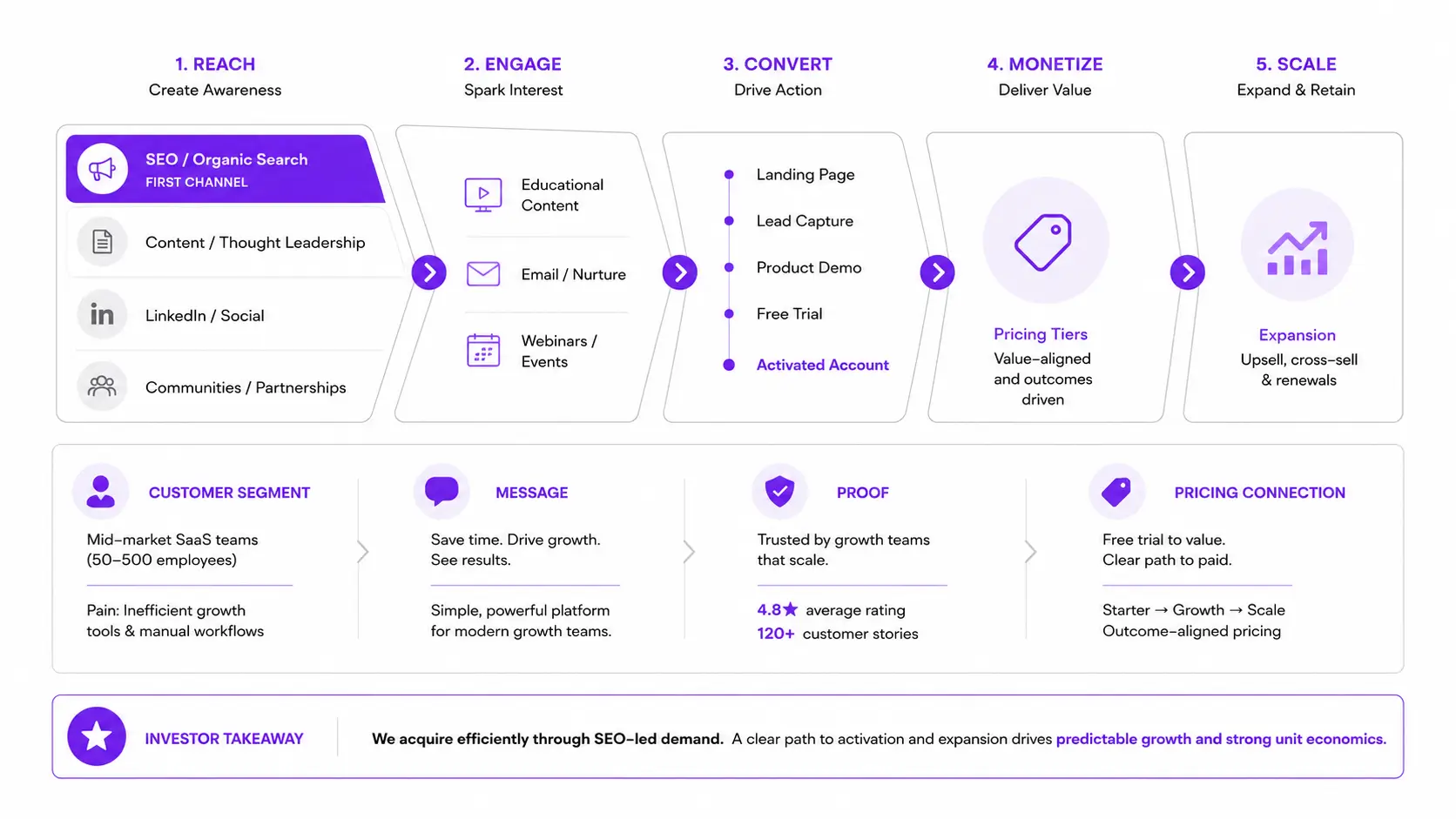
A go-to-market slide should make the customer acquisition path easy to understand. From Lynxify’s perspective, the design should show focus. The slide should not look like a cluttered marketing plan, a campaign calendar, or a collection of generic channel icons. Good GTM slide design usually follows these principles:
Show a Clear Customer Acquisition Path
Use a Simple Funnel, Phased Plan, or Channel Map
Avoid Too Many Arrows
Avoid Generic Channel Icons
Group Channels by Stage
Show the First Channel Clearly
Connect GTM to Customer Segment
Connect GTM to Pricing
Show the Investor Takeaway in the Headline
Avoid Tiny Text
Whether the go-to-market slide is designed in PowerPoint, Google Slides, or another presentation tool, the goal is the same: make the customer acquisition path easy to understand. A hypothetical headline could be:
“Founder-led sales first, then partner-led expansion into mid-market finance teams”
That headline gives investors the strategy before they study the visual. Avoid a headline like “Marketing Plan” with a long list of channels underneath. The headline should explain the GTM logic.
Go-To-Market Slide Best Practices
A strong go-to-market slide should make investors think, “This team knows how to reach the customer.” Best practices include:
Lead With The Target Customer
Show The First Channel Clearly
Connect Channel Choice To Customer Behavior
Avoid Listing Every Marketing Tactic
Show What Has Been Tested If Possible
Connect GTM To Pricing And Revenue Logic
Show Near-term Milestones
Be Honest About Assumptions
Show How The GTM Motion Can Expand
Keep The Slide Visually Simple
The GTM slide should be specific. “We will grow through partnerships” is weak if the deck does not explain which partners, why they would care, and how the partnership creates customers. “Initial growth through compliance consultants already serving target buyers” is stronger because it explains why the channel fits. The more specific the GTM logic is, the easier it is for investors to evaluate.
Common Go-To-Market Slide Mistakes to Avoid
The most common go-to-market slide mistake is listing every possible channel without showing a focused acquisition strategy. A GTM slide should make the path to customers clearer, not broader and more confusing.
Common mistakes include:
Listing Every Possible Channel
Using Generic Marketing Language
Not Defining The Target Customer
Not Showing A Beachhead Segment
Confusing Market Size With GTM
Confusing Brand Awareness With Customer Acquisition
Not Explaining Why Channels Fit The Customer
Showing Paid Ads Without CAC Logic
Showing Enterprise Sales Without Sales Cycle Awareness
Using Partnerships As A Vague Shortcut
Not Connecting GTM To Pricing
Not Connecting GTM To Revenue Logic
Not Connecting GTM To Traction
Making The Slide Look Like A Marketing Calendar
Promising Scale Before Testing The Channel
Paid ads, partnerships, content, and referrals can all be useful. But they are not automatically strong. Investors want to know why a channel is believable for this customer and whether the startup has any early evidence or logical reason to start there.
The same principle applies across the full deck. Vague claims, unsupported assumptions, and overloaded slides make an investor story harder to trust. The guide to common pitch deck mistakes explains how these problems can weaken an otherwise promising business presentation.
How to Talk About the Go-To-Market Slide During a Pitch
Do not read every channel on the slide. Lead with the target customer and first acquisition motion. Explain why this channel fits the customer. Then connect the plan to traction, pricing, revenue logic, or market size.
Be honest about what is tested and what is still an assumption.
Instead of saying:
“We will use paid ads, SEO, partnerships, and social media.”
Say something more useful:
“We are starting with founder-led outbound to compliance leaders because the buyer is specific, high-value, and already reachable through industry lists and warm introductions.”
The second version explains the customer, channel, reason, and starting logic.
When presenting the GTM slide, be ready to answer:
Who The First Customer Is
Why That Customer Segment Comes First
How The Startup Reaches Them
What Channel Has Been Tested
What Is Still An Assumption
How The Sales Cycle Works
How Pricing Fits The Motion
How The Channel Can Become Repeatable
What Funding Helps Test Or Scale Next
The GTM slide should make investors confident in customer acquisition, not overwhelmed by tactics.
What Slides Should Be in a Pitch Deck?
A standard pitch deck often includes cover, problem, solution, market size, product, traction, business model, go-to-market, competition, team, financials, roadmap, and ask.
The exact order depends on the startup stage, revenue model, investor audience, and strongest available evidence. Some decks need a detailed GTM slide because customer acquisition remains one of the biggest risks. Other decks can keep it more concise when traction already shows that the acquisition motion is working.
The go-to-market slide should sit where it connects naturally with the evidence around it. It may follow market size, product, pricing, business model, or traction depending on which information investors need before evaluating the acquisition strategy. For a complete sequence, the guide to creating a pitch deck explains how these slides can work together as one investor narrative rather than as separate pieces of information.
Final Answer: What Makes a Strong Go-To-Market Slide?
A strong go-to-market slide shows how the startup will reach, acquire, convert, and retain customers. It should not list every marketing channel. It should explain the target customer, first channel, sales or acquisition motion, conversion path, and how the GTM strategy connects to market size, pricing, revenue logic, and traction.
The slide should make investors trust the customer acquisition path. Clear pitch deck design can turn GTM thinking into a sharper investor story by making the customer segment, channel strategy, and acquisition path easier to understand.
Sum Up



FAQ
Frequently Asked Questions

What is a go-to-market slide in a pitch deck?
A go-to-market slide explains how a startup plans to reach, acquire, convert, and retain customers. It normally shows the target customer, beachhead segment, first acquisition channels, sales or marketing motion, conversion path, and near-term growth milestones. Its purpose is to make the customer acquisition strategy feel focused and realistic.
What should be included on a go-to-market slide?
A go-to-market slide should include the target customer, first acquisition channels, reasons those channels fit, sales or marketing motion, conversion path, early proof where available, and the next GTM milestone. Focus on the first believable route to customers rather than listing every possible marketing tactic.
How detailed should a go-to-market slide be?
A go-to-market slide should provide enough detail for investors to understand the customer segment, priority channels, acquisition motion, and next milestones within seconds. It should not become a complete marketing calendar. One defined customer segment and a few well-explained channels are usually stronger than a crowded list of tactics.
Where should the go-to-market slide go in a pitch deck?
The go-to-market slide usually appears after the market size, product, business model, pricing, or traction section. Its placement should follow the information investors need first. Place it after market size when the strategy depends on the customer segment, or after traction when early demand already supports the acquisition plan.
Is a go-to-market slide the same as a market size slide?
No. A market size slide explains how large and reachable the opportunity may be. A go-to-market slide explains how the startup plans to reach and convert customers within that opportunity. The two slides should connect, but the market size slide focuses on opportunity while the GTM slide focuses on execution.
Is a go-to-market slide the same as a business model slide?
Is a go-to-market slide the same as a business model slide?
What are common go-to-market slide mistakes?
Common mistakes include listing too many channels, using vague marketing language, failing to define the first customer, presenting partnerships without clear logic, and ignoring pricing or sales-cycle realities. Another mistake is overcrowding the slide with tactics instead of showing one focused and believable path from customer awareness to conversion.
What is the difference between sales strategy and go-to-market strategy?
Sales strategy is one part of go-to-market strategy. Sales strategy focuses on how prospects are contacted, qualified, and converted. Go-to-market strategy is broader and may include the target customer, positioning, marketing channels, distribution, sales motion, onboarding, activation, retention, partnerships, and the plan for expanding customer acquisition over time.
