Product Roadmap Slide in a Pitch Deck: What to Show Investors?
A product roadmap slide in a pitch deck is not a feature wishlist. It is the slide that shows investors how the product will evolve, what milestones matter, and how the next phase of product work supports customer value, traction, revenue, or market expansion.
Founders often use roadmap slides to show ambition. That is useful, but ambition alone is not enough. Investors want to understand what exists today, what comes next, what will be validated, and how the roadmap connects to the business story. A strong product roadmap slide in a pitch deck helps investors see that the team knows what to build next and why it matters.
Quick Answer: What Is a Product Roadmap Slide in a Pitch Deck?
A product roadmap slide is the pitch deck slide that shows how the product will develop over time. Its purpose is to show the next product milestones, planned improvements, validation steps, or major releases. A strong roadmap slide connects future product work to customer needs, traction, revenue, or market expansion. The best roadmap slide shows what comes next without overpromising too much detail.
What Is a Product Roadmap Slide?
A product roadmap slide is a high-level pitch deck slide that explains the future direction of the product. It shows where the product is today, what will be built or improved next, and which milestones matter most to the business. In an investor deck, this slide should not look like an internal product backlog or a long feature list. A product roadmap slide may show:
Product Direction
Future Milestones
Planned Releases
Customer Needs
Validation Steps
Product Strategy
Execution Plan
Funding Use
Market Expansion
Technical Milestones
The purpose is to help investors understand how the product moves from current state to stronger proof.
For example, an early SaaS startup may show MVP, beta, onboarding improvements, integrations, analytics, and enterprise controls. A marketplace may show supply tools, demand features, trust and safety, transaction flow, and geographic expansion. The slide should show the product path that matters to the business story. It should not show every idea the founder hopes to build.
What Is a Product Roadmap?
A product roadmap is a high-level plan that shows where a product is going, what will be built or improved, and which milestones matter over time. It can include product goals, features, releases, technical milestones, customer feedback, business objectives, time horizons, and priorities.
Inside a product team, a roadmap can be detailed. It may include backlog items, dependencies, sprint planning, owners, engineering notes, or internal deadlines. In a pitch deck, the product roadmap should be shorter, more strategic, and easier to understand. Investors do not need the full internal plan. They need to understand the key product milestones and why those milestones support customer value, traction, revenue, or growth. A good pitch deck roadmap is not only about what will be built. It is about what each phase helps prove.
Why the Product Roadmap Slide Matters to Investors
The product roadmap slide matters because investors use it to judge whether the team has a clear product direction and realistic next steps. A startup may have a promising product today, but investors still want to understand what comes next. They want to see how the team thinks about product maturity, customer learning, technical risk, funding use, and future growth. A roadmap slide can help investors evaluate:
execution clarity
product maturity
future milestones
use of funds
technical risk
customer validation
scalability
market expansion
timeline realism
The roadmap helps investors understand how the product moves from current state to stronger proof.
For early-stage startups, the roadmap may show how the team will test demand and build an MVP. For seed-stage startups, it may show how product improvements support retention, paid onboarding, revenue, or go-to-market learning. For later-stage startups, it may show how the product becomes more scalable, defensible, or enterprise-ready.
The roadmap slide should make the next phase feel intentional, not random.
What Do Investors Look for on a Product Roadmap Slide?
Investors look for product direction, realistic priorities, and a clear link between future work and business progress. They do not need every backlog item. They need to understand why the next steps matter. Investors often look for:
Current Product Stage
Clear Next Milestones
Realistic Timeline
Customer-Driven Priorities
Connection To Traction Or Revenue
Technical Feasibility
Major Dependencies
Use Of Funds
What Will Be Tested Or Validated Next
How The Roadmap Supports Growth
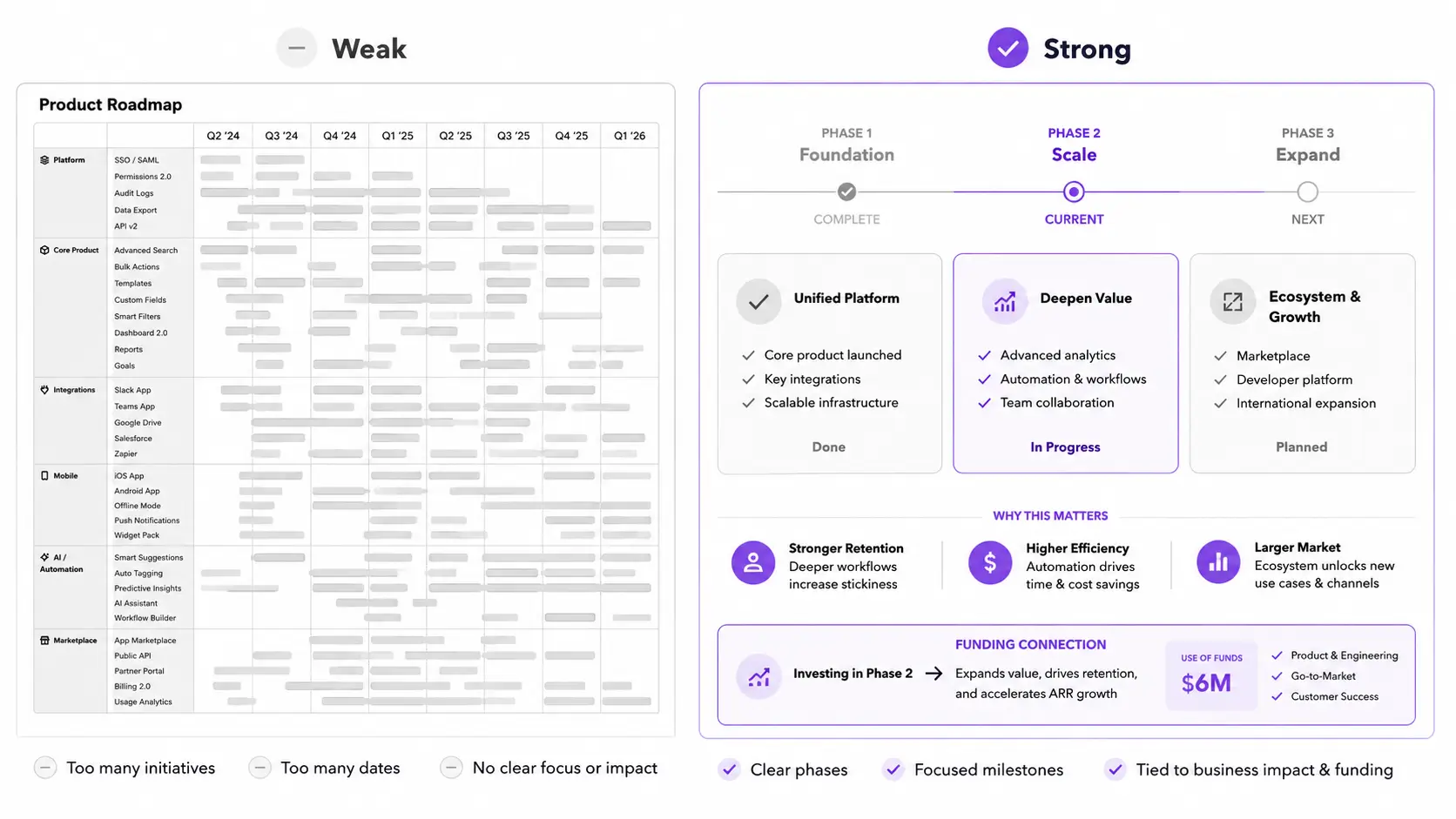
A weak roadmap slide creates more questions than confidence. It may show too many features, unrealistic timelines, or future plans that are not connected to customer needs.
A strong roadmap slide answers a better question: what product work matters most next, and how does it help the company become more valuable?
What Should You Include on a Product Roadmap Slide?
A product roadmap slide should include the most important milestones that explain what comes next. A clear structure usually includes:
Current product stage
Three to five major milestones
Timeline or phase structure
Customer or business reason for each milestone
Key validation points
Optional funding connection
The roadmap should show priorities, not every feature. A founder may use different formats depending on the startup stage and level of certainty.
Now, Next, Later
This format works well when exact dates are uncertain. It shows product direction without creating false precision. Use it when the startup is early, customer learning is still active, or the roadmap may change based on validation.
MVP, Beta, Launch, Scale
This format works well for pre-seed or seed startups. It shows how the product moves from early build to market learning and then into growth.,Use it when investors need to understand the product journey from early proof to broader release.
Q1, Q2, Q3, Q4
This format works when the timeline is more defined and the team can defend it.
Use it carefully. If the dates are uncertain, phases may be better than calendar promises.
The key is to show what matters, why it matters, and how the product roadmap supports the investor story.

Product Roadmap Slide vs Strategic Roadmap Slide
A product roadmap slide and a strategic roadmap slide are related, but they are not the same. In a startup pitch deck, this is different from a career roadmap, consulting roadmap, or internal project roadmap. The focus should stay on product milestones, customer value, validation, and what the next stage of the business needs to prove.
A product roadmap slide focuses on how the product will evolve. A strategic roadmap slide may show the broader direction of the company, market, product, or business.
Roadmap Type | Main Focus | Best Use |
Product roadmap slide | Product milestones, releases, validation, and product direction | Showing how the product will evolve in a pitch deck |
Strategic roadmap slide | Company direction, market expansion, business priorities, and growth path | Showing broader business strategy |
Future roadmap slide | Major next steps over time | Showing what the company plans to achieve next |
High-level roadmap slide | Phases and milestones without too much detail | Keeping the investor story simple |
Presentation roadmap slide | Visual roadmap for a presentation audience | Explaining direction clearly in a deck format |
In a pitch deck, the roadmap should be strategic enough for investors, but specific enough to show execution clarity. If the slide is too broad, investors may not understand what the team will actually build. If it is too detailed, the slide can feel like a project management board.
High-Level Roadmap Slide: How Much Detail Should You Show?
A pitch deck roadmap should usually be high-level. Too much detail can make the slide hard to read and create unnecessary questions. Investors do not need every task, dependency, feature request, sprint, or engineering note.
A high-level roadmap slide should:
show milestones, not every task
show product direction, not the full backlog
show timing carefully
avoid exact dates unless necessary
use phases if dates are uncertain
connect roadmap to proof and growth
The roadmap should build confidence, not create a promise the team cannot defend.
For example, “Enterprise integrations” is usually better than listing every integration in detail. “Pilot validation with healthcare providers” is usually better than showing every research step on one slide.
Investors should understand the roadmap in seconds. If the slide needs a long explanation before it makes sense, it is probably too detailed.
Product Roadmap Slide Examples by Startup Stage
A product roadmap slide should change as the startup matures.
A pre-seed roadmap, seed roadmap, and Series A roadmap should not show the same level of detail because investor expectations change by stage.
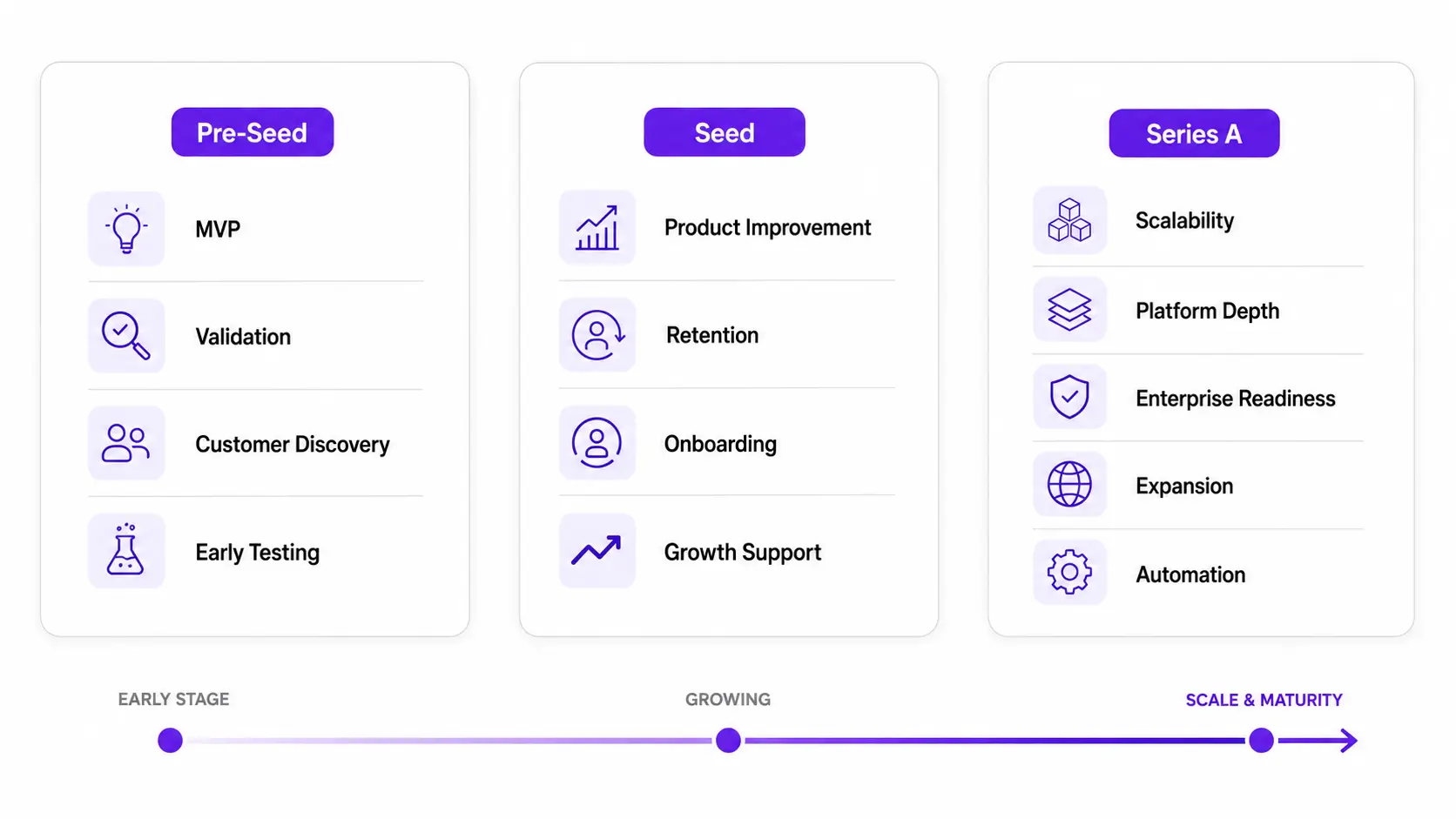
Startup Stage | What the Roadmap Should Emphasize | How to Present It |
Pre-seed | MVP, prototype, validation, customer discovery, early testing | Show what will be built and what the team needs to prove next |
Seed | Product improvement, customer learning, onboarding, retention, growth support | Show how product work supports traction and go-to-market learning |
Series A | Scalability, platform depth, enterprise readiness, expansion, automation | Show how the product can support growth, larger customers, and repeatability |
A pre-seed roadmap may show MVP and validation milestones. A seed roadmap should usually show product improvement, customer learning, and growth support. A Series A roadmap should show scalability, expansion, platform depth, or enterprise readiness.
Investor expectations change between pre-seed and seed funding. At pre-seed, the roadmap may focus more on MVP, validation, and customer discovery. At seed, investors usually expect the roadmap to connect more clearly to product improvement, retention, revenue, and go-to-market learning.
Product Roadmap Slide Examples by Startup Type
Different startups need different roadmap priorities. A SaaS roadmap, marketplace roadmap, fintech roadmap, and AI roadmap should not all show the same milestones.
Startup Type | Useful Roadmap Milestones | What Investors Learn |
SaaS | MVP, onboarding, integrations, analytics, retention features, enterprise controls | The product can improve usage, retention, and customer value |
Marketplace | Supply tools, demand growth features, transaction flow, trust and safety, geographic expansion | The team understands both sides of the market |
Consumer app | Core experience, engagement loops, retention features, sharing, monetization tests | The product can build repeat behavior and audience value |
Fintech | Compliance steps, account features, transaction workflows, security milestones, partner integrations | The team understands trust, regulation, and adoption |
Healthtech | Clinical workflow, pilot validation, provider tools, compliance, patient or user outcomes | The product can fit sensitive workflows and validation needs |
Edtech | Learning pathways, assessments, community, progress tracking, outcomes reporting | The product supports learning behavior and measurable value |
AI startup | Model improvement, workflow integration, data pipeline, human review, enterprise deployment | The product can move from technical capability to real workflow value |
B2B service or agency-style startup | Service system, client onboarding, repeatable delivery, reporting, automation | The business can become more structured and scalable |
Creator or media startup | Content system, audience features, monetization, sponsor tools, community engagement | Attention can become a repeatable business asset |
The best roadmap milestones are the ones that connect product development to business progress.
If a milestone does not support customer value, traction, revenue, or market expansion, it may not belong on the investor-facing roadmap slide.
Where Should the Product Roadmap Slide Go in a Pitch Deck?
The product roadmap slide usually works best after the product, traction, or business model section.
If the product is complex, the roadmap may come after the product slide so investors can understand the current product before seeing what comes next.
If the roadmap is tied to the funding ask, it can appear near the ask or use of funds slide. This helps investors understand what the round will unlock.
If the product is already mature, the roadmap can support growth and expansion after traction or business model slides.
A simple placement guide:
Situation | Best Placement |
Product is complex | After the product slide |
Roadmap supports traction | After traction |
Roadmap explains revenue growth | After business model |
Roadmap is tied to funding use | Near the ask or use of funds |
Roadmap shows expansion | After go-to-market or growth plan |
Place the roadmap where it helps investors understand what comes next, not where a template says it belongs. Place the roadmap where it helps the investor story, not where a template says it belongs. In a stronger pitch deck structure, each slide earns its position by making the business easier to understand.
How to Design a Product Roadmap Slide
A product roadmap slide should be simple enough to understand quickly.
From Lynxify’s perspective, the design should make the product direction clear. The slide should not feel like a crowded calendar, internal roadmap tool, or project management board.
Good roadmap slide design usually follows these principles:
use a clean timeline or phased layout
keep milestones short
use simple labels
avoid too many dates
avoid feature overload
group milestones by priority
show current stage clearly
make the next milestone obvious
use icons carefully
avoid tiny text
make the investor takeaway clear in the headline
Whether the roadmap is designed in PowerPoint, Google Slides, or another presentation tool, the goal is the same: make the next product milestones easy to understand.
A hypothetical headline could be:
“Next 12 months focused on paid onboarding, analytics, and enterprise integrations”
That kind of headline tells investors what the roadmap is really about. The visual layout can then support the message.
Avoid a slide title like “Product Roadmap” with a crowded timeline underneath. The headline should communicate the takeaway, not only label the slide.
Product Roadmap Slide Best Practices
A strong product roadmap slide should make investors think, “This team knows what to build next and why.”
Best practices include:
lead with the product strategy
show milestones, not every feature
connect roadmap to customer need
show how roadmap supports traction or revenue
use realistic timing
make dependencies clear if needed
avoid overpromising
keep it visually simple
align the roadmap with funding use
show what will be validated next
The roadmap should show confidence without pretending every future detail is fixed.
It is okay for a roadmap to evolve. Startups learn from customers, pilots, usage data, technical constraints, and market feedback. Investors understand this. What they need to see is that the founder has a clear product direction and knows which milestones matter next.
Common Product Roadmap Slide Mistakes to Avoid
The most common product roadmap slide mistake is turning the roadmap into a feature wishlist.
A roadmap slide should not show everything the founder hopes to build. It should show the milestones that matter to the business story.
Common mistakes include:
Turning The Roadmap Into A Feature Wishlist
Showing Too Many Milestones
Using Exact Dates Without Confidence
Making The Timeline Unrealistic
Not Showing The Current Product Stage
Not Connecting Roadmap To Customer Needs
Not Connecting Roadmap To Business Goals
Hiding Technical Or Regulatory Dependencies
Using Tiny Text
Making The Slide Look Like A Project Management Board
Copying Roadmap Templates Without Adapting Them
Promising Too Much Before Validation
Not Explaining What Funding Will Unlock
A roadmap can look polished and still fail if investors do not understand why the next milestones matter. A roadmap can look polished and still weaken the pitch if it feels unrealistic, overcrowded, or disconnected from the business story. This is one of the frequent pitch deck pitfalls founders make when a slide looks designed but does not make the investor more confident.
How to Talk About the Product Roadmap Slide During a Pitch
Do not read every milestone on the roadmap slide.
Lead with the product strategy. Explain what is live now, what comes next, and why the next milestone matters. Then connect the roadmap to customer learning, traction, revenue, or funding use.
Instead of saying:
“We will add 20 new features.”
Say something more useful:
“Our next roadmap phase focuses on three features requested by pilot customers because they unlock paid onboarding.”
The second version explains why the roadmap matters.
When presenting the roadmap, be ready to answer:
what is live now
what is being tested next
which customer needs shaped the roadmap
which milestones affect revenue or traction
what funding helps unlock
what assumptions still need validation
what technical or regulatory dependencies exist
The roadmap slide should make investors confident in product direction, not overwhelmed by future promises.
What Slides Should Be in a Pitch Deck?
A standard pitch deck often includes cover, problem, solution, market, product, traction, business model, go-to-market, competition, team, financials, roadmap, and ask.
The exact order depends on the startup stage, business model, investor audience, and strength of proof. Some decks may not need a separate roadmap slide if the product is simple or the future plan is already clear. Other decks need one because the product path is central to the investor story.
A roadmap slide should support the full investor narrative, not sit in the deck as a disconnected planning slide. If the deck already covers the product, traction, business model, and asks clearly, the roadmap can show what the next phase unlocks.
Final Answer: What Makes a Strong Product Roadmap Slide?
A strong product roadmap slide shows what comes next and why it matters.
It should not show every feature. It should show the milestones that connect product development to customer value, traction, growth, revenue, or funding use.
The slide should make the product direction easy to trust. Investors should understand where the product is today, what the team will build next, what will be validated, and how the roadmap supports the business story.
Founders often know the product plan, but the roadmap becomes harder to explain once it has to fit into one investor-facing slide. A presentation design partner can help turn roadmap thinking into a clearer slide structure, stronger hierarchy, and a more investor-ready presentation.
FAQ
Frequently Asked Questions

What is a product roadmap slide in a pitch deck?
A product roadmap slide in a pitch deck shows how the product will develop over time. It highlights the next product milestones, major releases, validation steps, or improvements that matter to the business. Its purpose is to help investors understand what comes next and why the roadmap supports growth.
What is a product roadmap?
A product roadmap is a high-level plan that shows where a product is going, what will be built or improved, and which milestones matter over time. In a pitch deck, the roadmap should be shorter and more strategic than an internal product roadmap.
What should be included on a product roadmap slide?
A product roadmap slide should include the current product stage, major upcoming milestones, a simple timeline or phase structure, and the reason each milestone matters. It may also show validation points, customer needs, technical dependencies, or what funding will help unlock.
Where should the product roadmap slide go in a pitch deck?
The product roadmap slide usually works best after the product, traction, or business model section. If the roadmap is closely tied to the funding ask, it can also appear near the use of funds or ask slide. Placement should support the investor story.
Is a product roadmap slide the same as a strategic roadmap slide?
No. A product roadmap slide focuses on how the product will evolve. A strategic roadmap slide may show broader company, market, product, or business direction. In a pitch deck, the roadmap should be strategic enough for investors but specific enough to show execution clarity.
Should a product roadmap slide include exact dates?
Should a product roadmap slide include exact dates?
What is a high-level roadmap slide?
A high-level roadmap slide shows major phases, milestones, or priorities without listing every task or feature. In a pitch deck, this is usually better than a detailed roadmap because investors need to understand product direction, not the full internal backlog.
What are common product roadmap slide mistakes?
Common product roadmap slide mistakes include showing too many features, using unrealistic dates, hiding the current product stage, making the slide look like a project management board, not connecting milestones to customer needs, and promising too much before validation.
Featured Blogs
Types of Video Editing: Styles, Cuts, Effects, and Services Explained

Lynxify’s Evolution: From Pitch Decks to a Multidisciplinary Creative Company

Finance Slide in a Pitch Deck: What Investors Want to See

Go-To-Market Slide in a Pitch Deck: Guide & Examples

Market Size Slide in a Pitch Deck: TAM, SAM & SOM

How Many Slides Should a Pitch Deck Have? 10–15 Slides

Business Model Slide: Show Investors How You Make Money
Product Roadmap Slide in a Pitch Deck: What to Show Investors?

Team Slide in a Pitch Deck: What Investors Want to See

Pre-Seed vs Seed Funding: Amounts, Stage & Key Differences

How Long Should a Pitch Deck Be? Slide Count Guide
What Investors Look for in a Pre-Seed Stage Pitch Deck

10 Common Pitch Deck Mistakes Founders Should Avoid Before Investors See the Deck
How Much Does a Pitch Deck Design Cost?

How to Create a Pitch Deck for Investors

Traction Slide in a Pitch Deck: What Investors Want to See
Business Plan vs Pitch Deck: What Should Founders Use?