Finance Slide in a Pitch Deck: What Investors Want to See
A financial slide in a pitch deck is not just a spreadsheet or forecast. It shows how the startup expects revenue, costs, runway, and growth to work.
Investors use the financial slide to judge whether the business model is financially believable. They want to understand how revenue may grow, what costs matter, how much runway the funding creates, and whether the founder understands the assumptions behind the plan.
Quick Answer: What Is a Financial Slide in a Pitch Deck?
A financial slide in a pitch deck summarizes the startup’s financial projections, revenue, costs, runway, and key assumptions. It helps investors understand how the business expects to grow, how funding will be used, and whether the plan is financially believable. A strong financial slide builds investor confidence without becoming a full spreadsheet.
What Is a Financial Slide?
A financial slide is the part of an investor pitch deck that explains the startup’s financial overview.
It summarizes financial performance, future projections, revenue forecast, cost structure, burn rate, runway, key assumptions, and sometimes unit economics. For early-stage startups, it may include assumptions instead of mature historical revenue.
A financial slide may include revenue forecast, historical revenue if available, operating expenses, gross margin, burn rate, runway, cash flow logic, use of funds, growth assumptions, and key financial metrics.
The financial slide is not the same as the full financial model. A financial model is usually more detailed and may include profit and loss, cash flow, balance sheet assumptions, hiring plans, and scenario planning.
The pitch deck financials slide should simplify the most important numbers so investors can understand the financial story quickly.
Why the Financial Slide Matters to Investors
The financial slide matters because investors want to know whether the startup has a believable financial plan.
A strong product, large market, and clear go-to-market plan still need financial logic. Investors want to see how customer demand becomes revenue, how costs grow, how much funding is needed, and what the company expects to prove before the next milestone.
The financial slide helps investors evaluate revenue potential, cost awareness, burn rate, runway, growth expectations, business model strength, use of funds, and investor risk.
A weak financial slide can create doubt even when the product and market look strong. If projections look unrealistic, assumptions are missing, or the founder cannot explain the numbers, investors may question the full business story.
What Do Investors Look for on a Financial Slide?
Investors look for clarity, discipline, and believable financial logic.
They do not need every row from the financial model on one slide. They need to understand the main financial story and the assumptions behind it.
Investors often look for clear revenue forecasts, realistic assumptions, cost awareness, burn rate, runway, gross margin, unit economics if relevant, historical revenue if available, connection to the business model, connection to use of funds, and clarity over complexity.
For a SaaS startup, investors may look for MRR, ARR, churn, CAC, LTV, gross margin, and expansion revenue. For a marketplace, they may focus on GMV, take rate, transaction volume, and active buyers or sellers.
For a pre-seed startup, investors may accept more assumptions. For a seed-stage startup, they usually expect stronger early proof. For later rounds, the financial slide should show more repeatability and clearer operating discipline.
What Should You Include on a Financial Slide?
A financial slide should include the numbers that help investors understand the startup’s financial direction. It should not try to show the entire spreadsheet.
Element | What to Show | Why Investors Care |
Revenue forecast | Expected revenue by period | Shows growth logic |
Costs | Team, product, sales, marketing, or operations costs | Shows cost awareness |
Gross margin | Revenue after direct costs if relevant | Shows business quality |
Burn rate | Monthly cash spend | Shows how quickly funding is used |
Runway | How long funding lasts | Shows whether the company can reach milestones |
Key assumptions | Pricing, CAC, churn, hiring, usage, or conversion | Shows how the forecast was built |
Use of funds | Where the money will go | Shows whether funding supports priorities |
Milestones | Product, revenue, hiring, or GTM goals | Shows what the funding should unlock |
A clean financial overview slide often works better than a dense spreadsheet screenshot.

Financial Slide vs Financial Model
A financial slide and a financial model are related, but they are not the same.
Item | Main Purpose | Best Use |
Financial slide | Summarizes forecast, costs, runway, and assumptions | Investor pitch deck |
Financial model | Shows detailed calculations and scenarios | Data room, planning, due diligence |
Financial projections slide | Focuses on future revenue, costs, and growth | Showing 3 to 5 year direction |
Business model slide | Explains how the startup makes money | Showing revenue streams and pricing logic |
The business model slide explains how the company makes money. The financial slide shows what the numbers look like. The financial model supports the details behind the slide. A pitch deck should show enough to start the right conversation, not force investors to read a full model during the presentation.
Financial Slide vs Business Model Slide
The business model slide explains what the company sells, who pays, how pricing works, and which revenue streams matter. The financial slide explains how much revenue the company may generate, what costs matter, how long the runway is, and what assumptions drive the forecast.
A simple way to separate them:
Business model slide: how the company makes money
Financial slide: what the financial plan looks like
Traction slide: proof that the model is starting to work
For example, a SaaS business model slide may show subscription tiers and expansion revenue. The financial slide may show projected MRR, ARR, gross margin, burn rate, and runway.
If the revenue logic is not clear yet, define it on the business model slide before asking investors to evaluate the financial projections. Early revenue, customer growth, paid pilots, and usage evidence usually belong on the traction slide, where they can support the assumptions used in the financial forecast.
Financial Slide vs Financial Disclosure Slide
A startup financial slide is different from a financial disclosure slide used in corporate reporting, legal documents, or public company presentations.
A financial disclosure slide may focus on compliance, risk notes, accounting details, or historical statements. A startup pitch deck financial slide is more focused on future growth, runway, assumptions, and use of funds.
The same applies to a financial highlights slide or financial impact slide in a corporate presentation. In a startup investor deck, the financial slide should explain how the business expects to grow and what the funding helps unlock.
What Financial Metrics Should Founders Show?
The right financial metrics depend on the startup’s business model.
Startup Type | Useful Metrics |
SaaS | MRR, ARR, churn, CAC, LTV, gross margin |
Marketplace | GMV, take rate, transaction volume, active buyers, active sellers |
Consumer app | Users, paid conversion, retention, ARPU |
Fintech | Transaction volume, revenue per transaction, CAC, compliance costs |
Hardware | Production cost, margin, inventory, payback period |
Services or agency-style startup | Revenue, margin, repeat clients, retainers, pipeline |
Do not show CAC, LTV, MRR, or ARR just because they sound investor-friendly. Show them only if they are relevant and you can explain them.
Financial Slide Examples by Startup Stage
A financial slide should change as the startup matures.
Stage | What to Show | How to Present It |
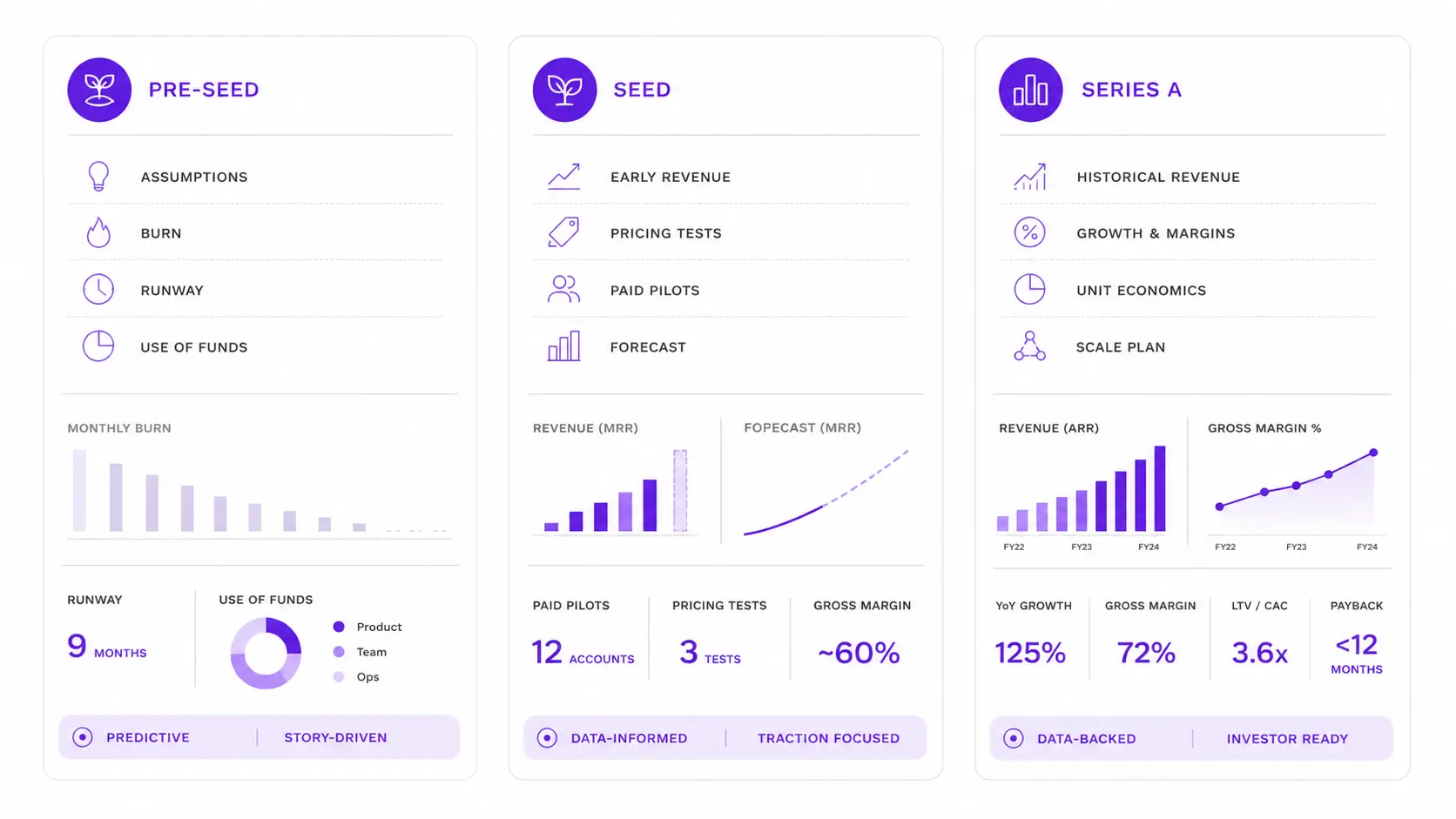
Pre-seed | Revenue assumptions, cost plan, burn rate, runway, use of funds | Show disciplined thinking without pretending the numbers are certain |
Seed | Early revenue, pricing tests, paid pilots, runway, forecast | Show how early proof supports the forecast |
Series A | Historical revenue, growth rate, margins, unit economics, cash use | Show repeatability and scale potential |
At pre-seed, the financial slide may rely more on assumptions. At seed, investors usually expect more evidence, such as early revenue, pricing tests, paid customers, or signed pilots. At Series A, the slide should show growth, margins, repeatability, and scale. Financial expectations also change between pre-seed and seed funding, as investors look for different levels of evidence, revenue validation, and operating discipline.
How Many Years of Financial Projections Should a Pitch Deck Show?
Many startup pitch decks show 3 to 5 years of financial projections, but the right level depends on the stage, business model, and investor expectations.
Early-stage projections are not about being perfectly accurate. They are about showing logic, assumptions, and planning discipline.
For a pre-seed startup, the financial projection slide may focus on runway, use of funds, hiring, product development, and early revenue assumptions. For later stages, investors may expect more detail around revenue growth, gross margin, operating expenses, cash flow, unit economics, and path toward break-even.
How Detailed Should a Financial Slide Be?
A financial slide should be simple enough for investors to understand quickly.
Detailed spreadsheets belong in the financial model, appendix, or data room. The pitch deck slide should summarize the main numbers, key assumptions, and investor takeaway.
A Practical Rule is:
Show the main numbers, the key assumptions, and the investor takeaway.
Avoid tiny spreadsheet screenshots, too many rows, unsupported hockey-stick growth, unclear cost categories, projections without assumptions, and numbers the founder cannot explain.
Sample Financial Slide Layout
A strong financial slide usually has one clear takeaway, one simple visual, and a few supporting assumptions.
Slide Area | Example Content |
Takeaway headline | 18-month runway supports product growth and first enterprise sales |
Main visual | Revenue forecast chart by year or quarter |
Key numbers | Revenue, expenses, burn rate, runway, gross margin |
Assumptions | Pricing, customer growth, CAC, churn, hiring |
Funding connection | Round supports product, sales, and milestone growth |
A SaaS financial slide might show projected ARR, monthly burn, runway, gross margin, and the number of customers needed to reach the next milestone. The layout should always match the business model.
Where Should the Financial Slide Go in a Pitch Deck?
The financial slide usually works best after investors understand the product, market, business model, traction, and go-to-market plan. It often appears before the funding is asked because the financials explain why the company is raising money and what the funding should unlock.
Situation | Best Placement |
Business model needs context first | After the business model slide |
Traction supports the forecast | After the traction slide |
GTM plan drives growth | After the go-to-market slide |
Financials support the raise | Before the ask or use of funds slide |
The financial slide should also fit the wider pitch deck structure, appearing after investors understand the business model, traction, and growth plan.
How to Design a Financial Slide
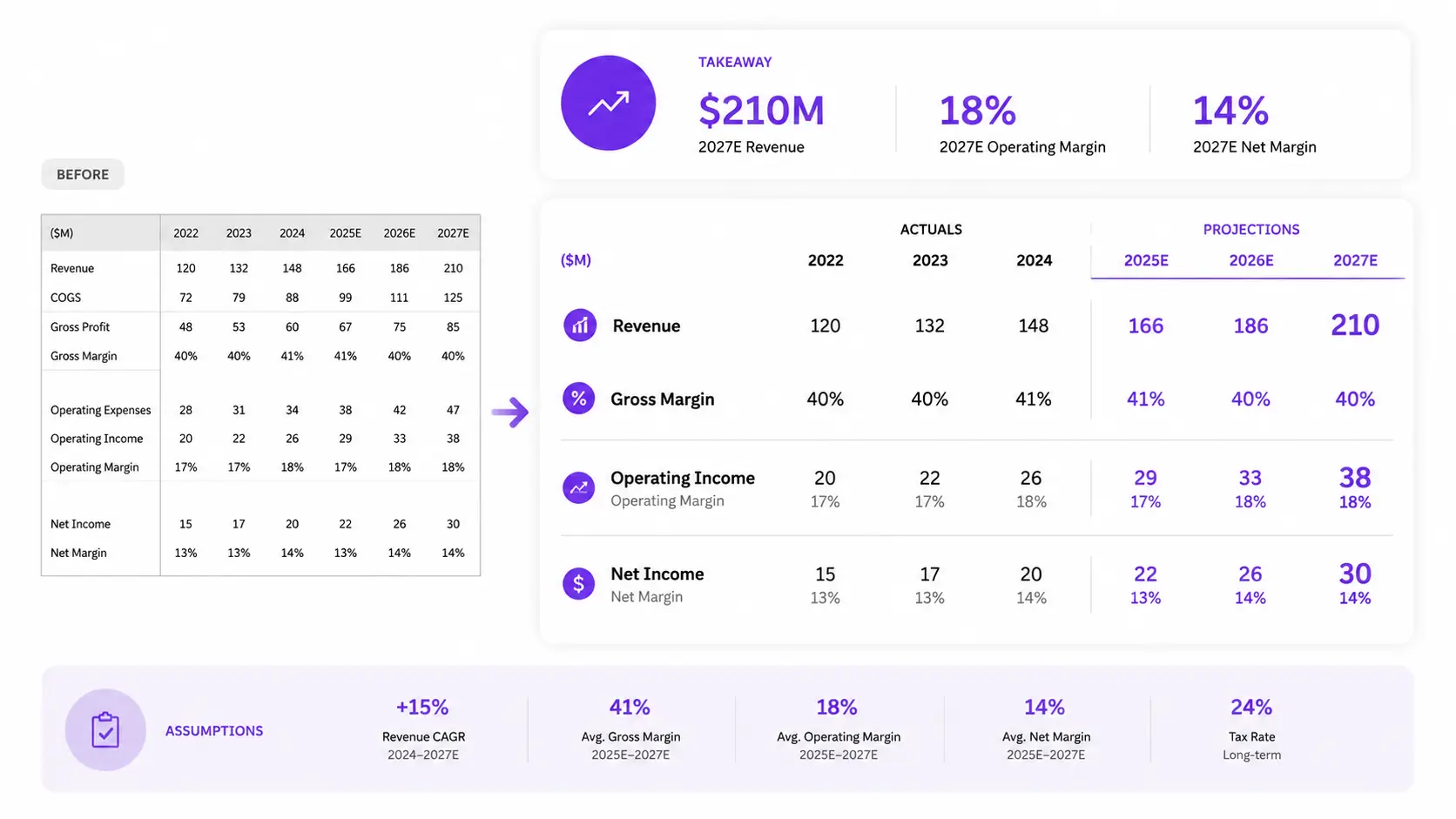
A financial slide should make the numbers easier to understand, not harder. From Lynxify’s design perspective, the financial slide needs strong visual hierarchy. Investors should immediately see the financial story, then the supporting numbers.
A good financial slide design usually includes a clear takeaway headline, clean table or chart, limited rows, simple labels, visible assumptions, separated actuals and projections, readable numbers, and enough spacing.
The headline should explain the financial story, not just say “Financials.”
Best Practices for a Pitch Deck Financials Slide
A strong pitch deck financials slide should make the financial story clear and believable.
Best practices include keeping assumptions visible, showing realistic growth, connecting numbers to the business model, connecting funding ask to runway, showing cost awareness, separating actuals from projections, avoiding overcomplicated spreadsheets, making the investor takeaway clear, and being ready to explain every number.
The financial slide should connect to the business model, traction, go-to-market, and funding ask.
Common Financial Slide Mistakes to Avoid
The most common financial slide mistake is showing numbers without explaining the logic behind them.
Common mistakes include unrealistic hockey-stick projections, no assumptions, confusing revenue with profit, hiding burn rate, showing too many numbers, using tiny spreadsheet screenshots, not connecting financials to the business model, not showing runway, using vague cost categories, showing projections with no logic, and not knowing how numbers were calculated.
Investors understand that projections are uncertain, especially at early stages. What they want is a financial forecast that shows reasonable thinking, not false certainty. Unsupported projections are one of several pitch deck mistakes that can make investors question the credibility of the wider business story.
How to Present Financial Slides to Investors
Present financial slides by explaining the financial story, not by reading every number. Founders should explain the main forecast, the assumptions behind it, the key risks, and how the funding supports milestones.
Instead of saying, “Revenue will grow and costs will increase as we hire,” explain what drives the forecast, why the hiring plan supports growth, and how the round creates a runway to reach the next milestone. The best slides to show during a financial presentation are the slides that help investors understand the logic behind the numbers.
Final Answer: What Makes a Strong Financial Slide?
A strong financial slide in a pitch deck shows revenue, costs, runway, assumptions, and growth logic in a simple investor-friendly way.
It should not overwhelm investors with every number from the financial model. It should create confidence by showing how revenue grows, how costs are managed, what the funding supports, and what assumptions drive the plan.
When the numbers are sound but difficult to present, a pitch deck design agency can simplify the financial story without removing the assumptions investors need to evaluate it.
FAQ
Frequently Asked Questions

What is a financial slide in a pitch deck?
A financial slide in a pitch deck summarizes the startup’s revenue projections, costs, burn rate, runway, key assumptions, and other financial metrics investors need to understand the business plan. It should simplify the financial story without turning the slide into a full spreadsheet or financial model.
What should be included on a financial slide?
A financial slide should include the most relevant numbers for the business, such as revenue forecast, costs, gross margin, burn rate, runway, key assumptions, use of funds, and important milestones. The exact metrics should match the startup’s business model and stage.
Is a financial slide the same as a financial model?
No. A financial slide is a simplified summary designed for the pitch deck, while a financial model contains the detailed calculations behind the projections. The slide should show the investor takeaway, while the financial model supports deeper planning, due diligence, and scenario analysis.
How many years of financial projections should a pitch deck include?
Many pitch decks show around three to five years of financial projections. The right range depends on the startup stage, business model, and investor expectations. Early-stage companies should focus more on believable assumptions, runway, milestones, and growth logic than on overly precise long-term forecasts.
Should a pre-seed pitch deck include financial projections?
Yes. A pre-seed pitch deck can include simple financial projections even when historical revenue is limited. The slide may focus on estimated revenue, operating costs, burn rate, runway, hiring plans, use of funds, and the assumptions the startup expects to test with the next round of funding.
How do you present financial slides to investors?
How do you present financial slides to investors?
What financial metrics do investors expect to see?
The right metrics depend on the business model. SaaS startups may show MRR, ARR, churn, CAC, LTV, and gross margin, while marketplaces may focus on GMV, take rate, and transaction volume. Investors generally want metrics that clearly connect growth, costs, revenue, and financial sustainability.
Where should the financial slide appear in a pitch deck?
The financial slide usually appears after investors understand the product, market, business model, traction, and go-to-market plan. It often comes before the funding ask or use-of-funds slide because the financials help explain how much capital is needed and what the round is expected to achieve.
Featured Blogs

Lynxify’s Evolution: From Pitch Decks to a Multidisciplinary Creative Company
Finance Slide in a Pitch Deck: What Investors Want to See

Go-To-Market Slide in a Pitch Deck: Guide & Examples

Market Size Slide in a Pitch Deck: TAM, SAM & SOM

How Many Slides Should a Pitch Deck Have? 10–15 Slides

Business Model Slide: Show Investors How You Make Money

Product Roadmap Slide in a Pitch Deck: What to Show Investors?

Team Slide in a Pitch Deck: What Investors Want to See

Pre-Seed vs Seed Funding: Amounts, Stage & Key Differences

How Long Should a Pitch Deck Be? Slide Count Guide

What Investors Look for in a Pre-Seed Stage Pitch Deck

10 Common Pitch Deck Mistakes Founders Should Avoid Before Investors See the Deck

How Much Does a Pitch Deck Design Cost?

How to Create a Pitch Deck for Investors

Traction Slide in a Pitch Deck: What Investors Want to See

Business Plan vs Pitch Deck: What Should Founders Use?