How Many Slides Should a Pitch Deck Have? 10–15 Slides
Founders often ask how many slides should a pitch deck have because they are worried about two things at the same time. They do not want the deck to feel too short and incomplete, but they also do not want investors to lose interest before the story becomes clear.
The right number depends on the pitch context, startup stage, category, and how much proof the founder has. A startup preparing a pre-seed pitch deck may not need the same slide count as a seed-stage company with stronger traction, financials, and a more detailed go-to-market plan.
So, what is the practical answer?
So, what's the Right Number?
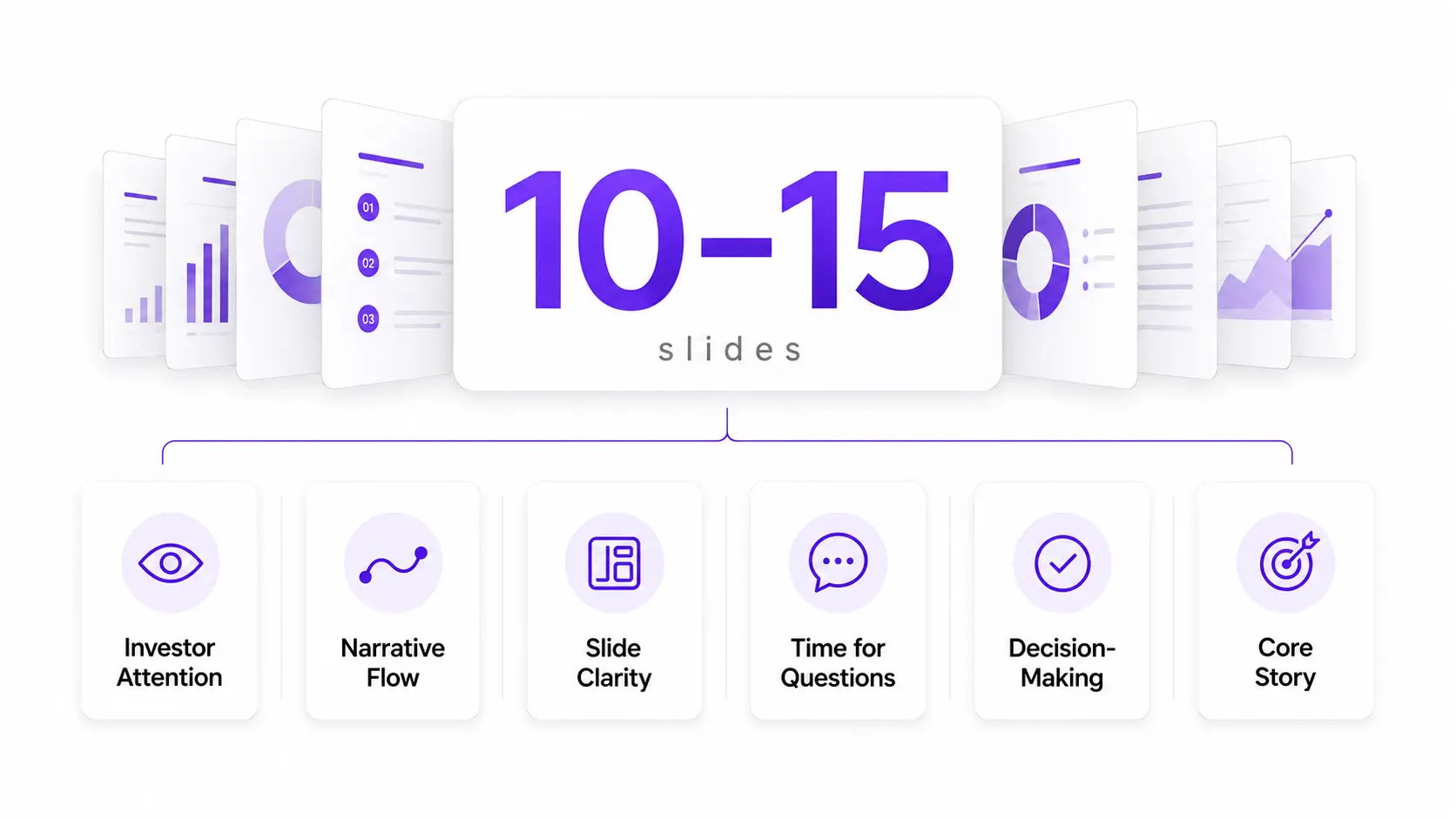
Most investor pitch decks should have 10 to 15 core slides, which is usually the safest pitch deck slide count for a clear investor story.
A live pitch deck should usually stay closer to 10 slides. A send-ahead deck can be closer to 12 to 15 slides if it remains clear and scannable. Anything beyond that should usually move into an appendix, data room, or follow-up material.
Deck Situation | Recommended Slide Count | Why |
Live investor pitch | 8 to 12 slides | The founder explains the story live, so the deck should stay focused |
Send-ahead investor deck | 12 to 15 slides | The deck needs more context because investors may read it alone |
Pre-seed deck | 10 to 12 slides | Investors need clarity on problem, team, market, early validation, and ask |
Seed deck | 12 to 15 slides | Investors usually expect more traction, GTM learning, and revenue logic |
Series A deck | 15 core slides, sometimes more with appendix | The deck may need more proof, financials, team depth, and scalability |
Appendix or backup slides | As needed | Extra details should support questions, not interrupt the main story |
The core deck should answer the first investor questions. The appendix should support deeper questions.
Why 10 to 15 Slides Usually Works
A 10 to 15 slide range works because it gives founders enough space to explain the business without turning the deck into a full business plan.
Investors usually need to understand the problem, solution, product, market, traction, business model, go-to-market approach, team, financial logic, and ask. That can usually be done within 10 to 15 focused slides.
This range works because it protects:
Investor Attention
Narrative Flow
Slide Clarity
Time For Questions
Focus On Decision-Making
Space For The Core Business Story
Investors do not need every detail in the first deck. They need enough clarity to understand the opportunity and enough curiosity to ask for the next conversation. A strong deck feels complete, not crowded. It gives investors the story, the proof, and the next step without forcing them to read a long document disguised as a presentation.
The 10/20/30 Rule Still Matters
The 10/20/30 rule is a simple pitch discipline: about 10 slides, about 20 minutes, and large readable text around 30-point size.
The value of the rule is not that every deck must follow it exactly. The value is that it forces founders to simplify. It keeps the pitch focused, reduces clutter, and makes the presentation easier to follow.
The rule still matters because it reminds founders that a pitch deck is not meant to explain everything. It should guide the conversation.
A 10-slide pitch works well when the founder is presenting live and can explain the details verbally. But some startups need more context. Complex markets, regulated industries, deep tech, enterprise software, healthcare, fintech, and hardware may need a few extra slides to make the business clear.
The rule is useful as a discipline, not a fixed law.
Is 10 Slides Enough?
Yes, 10 slides can be enough if the story is simple, the proof is strong, and the deck is being presented live. A 10 slide pitch deck usually works best when each slide has one clear job. It should not try to squeeze multiple ideas into every slide just to hit a fixed number.
A simple 10 slide structure can look like this:
Cover
Problem
Solution
Product
Ask
This is not the only structure. Some decks may need a competition slide, financials, product roadmap, why now, or use of funds depending on the business.
For example, a startup in a crowded category may need competition. A startup with strong early metrics may need traction proof. A startup with a complex product may need a roadmap. The best slide count depends on what the investor needs to understand.
When 12 to 15 Slides Makes More Sense
A 12 to 15 slide deck can work better when the deck is sent by email, when the company is complex, or when investors need more context before a meeting.
A send-ahead deck has a harder job than a live deck. The founder is not always there to explain the slide, so the deck may need a little more context, clearer headlines, and stronger slide flow.
A longer core deck may make sense when the startup has:
More Market Education To Do
A Complex Product
A Regulated Category
Enterprise Sales Motion
A Technical Product
More Financial Detail
Multiple Customer Segments
Early Traction That Needs Explanation
A sample 12 to 15 slide structure could include:
Cover
Problem
Why now
Slide for the solution
Product
Slide for market size
Slide for traction
Slide for business model
Slide for GTM
Slide for competition
Team
Slide for financials
Slide for the roadmap
Ask
Use of funds
The deck can still be scannable at this length if each slide is focused and the headlines explain the story clearly.
Is 20 Slides Too Much?
20 slides is not always wrong, but it is usually too much for the core pitch deck.
If a founder needs 20 slides, some slides may belong in the appendix or a follow-up deck. The issue is not the number alone. The issue is whether the main narrative still feels focused.
20 slides can work when the deck is not being presented live, when the business is complex, or when the deck includes backup material. But the core story should still be easy to follow.
20-Slide Content | Keep in the Main Deck or Move to Appendix? |
Core story | Keep in main deck |
Detailed financial model | Move to appendix or data room |
Customer quotes | Keep only the strongest, move extras to appendix |
Product screenshots | Keep key screens, move detailed walkthrough to appendix |
Market research | Keep summary, move detailed research to appendix |
Technical architecture | Move to appendix unless central to the story |
Extra team bios | Move to appendix |
Detailed competitive analysis | Move to appendix |
Legal or regulatory detail | Summarize in main deck, detail in appendix |
Pipeline details | Keep summary, move full pipeline to appendix |
A 20-slide deck often becomes stronger when the founder separates the investor story from supporting evidence.
What About 20 to 100 Slides?
A typical investor pitch deck should not be 20 to 100 slides.
That range may describe a data room, appendix, sales deck, board deck, or internal strategy presentation. It does not usually describe the core investor pitch deck.
The distinction matters:
Core Pitch Deck: Short Investor Story
Appendix: Supporting Evidence
Data Room: Detailed Documents
Financial Model: Spreadsheet Support
Sales Deck: Customer-Facing Presentation
Board Deck: Operating Update
A founder may have 50 supporting slides or documents behind the pitch. That is fine. But those materials should not all sit inside the main deck.
The main deck should make investors understand the company quickly. The backup materials should answer deeper questions later.
Is a Pitch Deck a Visual Slide Presentation?
Yes, a pitch deck is a visual slide presentation, but it is not just a collection of designed slides.
It is a structured business story told through slides.
The visuals should support the argument. Each slide should make one point. The deck should be scannable, clear, and easy to follow.
A strong deck uses:
Visual Hierarchy
Clean Slide Architecture
Simple Charts
Short Text
Clear Section Flow
Readable Font Size
Strong Headlines
Consistent Visual System
Visual does not mean empty. It means easy to understand quickly.
A deck can look polished and still fail if the message is unclear. Good design should make the founder’s argument sharper, not decorate weak content.
The Slides Investors Expect
Investors usually expect a pitch deck to answer a familiar set of questions.
Not every deck needs every slide, but most investor decks include some version of the following:
Slide | Purpose | When It Is Needed |
Cover | Introduce company and positioning | Almost always |
Problem | Explain the pain or gap | Almost always |
Solution | Show how the startup solves it | Almost always |
Product | Show what exists or will be built | Usually |
Market size | Show opportunity size | Usually |
Traction | Show proof of demand | When there is meaningful proof |
Slide for business model | Explain how the company makes money | Usually |
Slide for GTM | Explain how customers will be reached | Usually |
Competition | Show market alternatives and positioning | Usually |
Team | Show why this team can execute | Almost always |
Financials | Show revenue, cost, runway, and assumptions | Often |
Roadmap | Show what comes next | When future product path matters |
Ask | Show what the founder is raising or requesting | Almost always |
Use of funds | Explain how money will be used | Usually in fundraising decks |
Why now | Explain timing | When timing is central to the opportunity |
The right slide list depends on stage, traction, category, and investor context. A pre-seed founder may not need deep financials. A seed-stage founder may need more proof around traction, GTM, and revenue logic.

Which Slides Are Optional?
Some slides are required in most decks. Others are situational.
A competition slide is usually useful because investors want to know how the startup is different. A why now slide is useful when timing is a major part of the opportunity. Product roadmap, use of funds, customer logos, and appendix slides depend on the story.
Optional Slide | Use It When | Skip or Shorten It When |
Why now | Market timing is a major reason to believe | Timing is obvious or not central |
Competition | The market has clear alternatives or crowded positioning | Competition can be covered briefly elsewhere |
Product roadmap | Future product milestones matter to the raise | Product is simple or roadmap is not central |
Financials | Investors need revenue, cost, runway, or forecast logic | Too early for detailed projections |
Use of funds | The deck includes a funding ask | The deck is an intro or teaser |
Customer logos | Customer proof is strong and approved to show | Logos are weak, unapproved, or not relevant |
Appendix slides | Investors may ask for deeper proof | They interrupt the main story |
Do not add optional slides just because a template includes them. Add them when they answer a real investor question.
Slide Count by Funding Stage
Deck length often changes by funding stage because investor expectations change.
Pre-seed investors usually care more about problem clarity, founder-market fit, market opportunity, early validation, and what the next milestone is. Seed investors usually expect more proof. Series A investors expect stronger repeatability and performance.
Funding Stage | Recommended Core Slides | What Investors Expect |
Pre-seed | 10 to 12 slides | Problem, solution, market, team, early validation, MVP plan, ask |
Seed | 12 to 15 slides | Traction, GTM learning, revenue logic, customer proof, milestones |
Series A | 15 slides, often with appendix | Repeatability, financial performance, team depth, scalable acquisition |
Later stage | 15 core slides plus deeper backup | Operating performance, unit economics, market expansion, growth plan |
A pre-seed deck should not pretend it has Series A proof. A Series A deck should not feel like the company is still only exploring an idea.
The slide count should match what the company needs to prove at that stage.
Live Pitch vs Send-Ahead Deck
A live pitch deck can be shorter because the founder explains the story.
A send-ahead deck needs more context because investors may read it without the founder present. That does not mean the send-ahead deck should be dense. It should still be easy to scan.
Deck Type | Slide Count | Content Style |
Live pitch deck | 8 to 12 slides | Short, visual, conversation-led |
Email deck | 12 to 15 slides | More context, clear headlines, scannable |
Demo day deck | 6 to 10 slides | Very focused, high-level, fast |
Intro deck | 8 to 12 slides | Enough to create interest, not full detail |
Full investor deck | 12 to 15 slides | Complete core story |
Appendix deck | As needed | Deeper proof and backup material |
More detail does not mean more clutter. A good send-ahead deck uses sharper headlines, clearer context, and cleaner slide structure.
What to Cut First
If the deck feels too long, do not start by cutting the most important proof. Start by removing repetition. Founders often add length because they explain the same idea in different ways. The deck becomes longer but not clearer.
Cut or move:
Repeated Problem Slides
Too Many Product Screenshots
Long Market Research
Extra Team Details
Detailed Financial Tables
Generic Industry Trends
Feature Lists
Duplicate Traction Proof
Overlong Competition Analysis
Unnecessary Process Slides
If a slide does not help investors understand the opportunity, proof, team, or ask, it probably does not belong in the core deck. A shorter deck is not automatically better. A clearer deck is better.
What Goes in the Appendix?
Appendix slides are useful when investors ask deeper questions, but they should not interrupt the main story.
The appendix supports the pitch. It should not carry the pitch.
Appendix slides can include:
Detailed Financial Model
Extra Product Screenshots
Technical Architecture
Customer Research
Pipeline Details
Regulatory Details
Market Calculations
Extra Case Examples
Extra Team Bios
Detailed Competitor Analysis
A good appendix helps founders answer follow-up questions without overloading the core deck. If a slide is important enough to understand the basic business story, it belongs in the main deck. If it only supports deeper review, it belongs in the appendix.

How to Keep the Deck Visual
A pitch deck should be visual, but not vague. Use visuals to simplify the story. Do not use design to hide unclear thinking. A visual deck usually uses:
Short Headlines
One Idea Per Slide
Clear Charts
Clean Comparison Tables
Simple Diagrams
Strong Whitespace
Readable Font Size
Consistent Visual System
Few Words Per Slide
No Tiny Paragraphs
Visual does not mean empty. It means the investor can understand the point quickly.
For example, a traction slide may use one clear growth chart instead of five small metrics. A market slide may use one simple sizing framework instead of a research-heavy page. A financials slide may use a clean forecast table instead of a spreadsheet screenshot.
The design should make the business easier to understand.
Common Slide Count Mistakes
The biggest slide count mistake is trying to fit the entire business into the core deck. A pitch deck is not a business plan, data room, or operating manual. It is the first investor story. Common mistakes include:
Trying to fit the entire business into the core deck
Using 25 slides when 12 would work
Adding every possible slide because a template includes it
Hiding the main ask until too late
Turning the deck into a business plan
Using tiny text to fit more content
Adding too many appendix slides into the main flow
Repeating the same proof in different ways
Making the deck too visual but not informative
Making the deck too detailed but not persuasive
The goal is not to impress investors with volume. The goal is to make the story easy to believe. If the deck feels heavy, the issue is usually not just slide count. It is weak prioritization.
How to Present a Short Pitch Deck
A short deck still needs strong narration. Do not read the slides. Use each slide as a conversation anchor. The founder should explain the thinking behind the slide, not repeat the text on it. A short deck works only when the founder can explain the details behind it.Founders should know:
What Sits Behind Every Number
What Assumptions Support The Forecast
How The Market Was Calculated
Why The GTM Plan Fits The Customer
What The Funding Ask Will Unlock
What Risks Still Need To Be Solved
A short deck should leave room for investor questions. That is the point. The pitch should give enough clarity to start a serious conversation, not answer every question before the investor asks.
Final Answer
Most pitch decks should have 10 to 15 core slides. Live decks should usually be closer to 10. Send-ahead decks can be closer to 12 to 15. A 20-slide deck is usually too much for the core story, but it can work if some slides are appendix material.
The right slide count depends on the story, stage, investor context, and how much proof the founder needs to show. A strong pitch deck should feel complete, but not crowded. It should answer the investor’s first questions and make them want the next conversation.
FAQ
Frequently Asked Questions

How many slides should a pitch deck have?
Most investor pitch decks work best with 10 to 15 core slides. Live presentations usually stay closer to 10 slides, while send-ahead decks may include 12–15 slides to provide additional context without overwhelming investors.
Is 10 slides enough for a pitch deck?
Yes. Ten slides are often enough when the business story is clear, the founder is presenting live, and each slide focuses on one key message. More complex businesses may require a few additional slides.
Can a pitch deck have more than 15 slides?
Yes, but only when the extra slides provide essential context. Supporting material such as detailed financials, technical architecture, or research is usually better placed in an appendix than the core deck.
What is the ideal slide count for a pre-seed pitch deck?
A pre-seed pitch deck usually contains 10 to 12 slides, covering the problem, solution, market opportunity, product, team, early validation, and funding ask without unnecessary detail.
What is the 10/20/30 rule for pitch decks?
The 10/20/30 rule recommends around 10 slides, a 20-minute presentation, and 30-point font. It is a guideline that encourages clarity rather than a strict rule every startup must follow.
What slides should every pitch deck include?
What slides should every pitch deck include?
Should appendix slides be included in a pitch deck?
Yes. Appendix slides are useful for detailed financials, technical information, customer research, product screenshots, and other supporting material that should not interrupt the main investor story.
How do I know if my pitch deck is too long?
A pitch deck is usually too long when multiple slides repeat the same idea, contain excessive detail, or reduce the clarity of the main narrative. Investors should understand the opportunity quickly without reading a business plan.
Featured Blogs
Types of Video Editing: Styles, Cuts, Effects, and Services Explained

Lynxify’s Evolution: From Pitch Decks to a Multidisciplinary Creative Company

Finance Slide in a Pitch Deck: What Investors Want to See

Go-To-Market Slide in a Pitch Deck: Guide & Examples

Market Size Slide in a Pitch Deck: TAM, SAM & SOM
How Many Slides Should a Pitch Deck Have? 10–15 Slides

Business Model Slide: Show Investors How You Make Money

Product Roadmap Slide in a Pitch Deck: What to Show Investors?

Team Slide in a Pitch Deck: What Investors Want to See

Pre-Seed vs Seed Funding: Amounts, Stage & Key Differences

How Long Should a Pitch Deck Be? Slide Count Guide

What Investors Look for in a Pre-Seed Stage Pitch Deck

10 Common Pitch Deck Mistakes Founders Should Avoid Before Investors See the Deck

How Much Does a Pitch Deck Design Cost?

How to Create a Pitch Deck for Investors

Traction Slide in a Pitch Deck: What Investors Want to See

Business Plan vs Pitch Deck: What Should Founders Use?